

Endangered dolphin that strayed is moved to sanctuary in Pakistan

A blind dolphin swims along the Indus river in the southern Pakistani city of Sukkur on September 13, 2014. (AFP/File)
Short Url
Updated 08 November 2021
Follow

Endangered dolphin that strayed is moved to sanctuary in Pakistan

  • The dolphins are being squeezed out of their habitat due to human activity like dams and pollution
  • Living for millions of years in turbid waters, the mammals are just one of four surviving freshwater species

LARKANA: An endangered grey dolphin twitches its flippers weakly as it lies in a truck speeding toward a sanctuary in Pakistan, while rescuers sprinkle water on the animal to keep its skin moist and save it from dying. 
Blind, with a snout equipped with two rows of sharp teeth, the Indus river dolphin strayed from its freshwater home into a busy waterway, and had to be lifted out by rescue staff in the southeastern province of Sindh after they trapped it in nets. 
Now they must keep it alive as they race to the sanctuary 82 km (51 miles) away where they can free it. 
“We have to try and get it to the river as soon as possible,” said Mir Akhtar Hussain Talpur, an official of the provincial wildlife department, which has rescued 10 of the animals this year, eight of them in just the last month. 
“When we are taking a rescued dolphin to the river, we have to be very careful,” he said. 
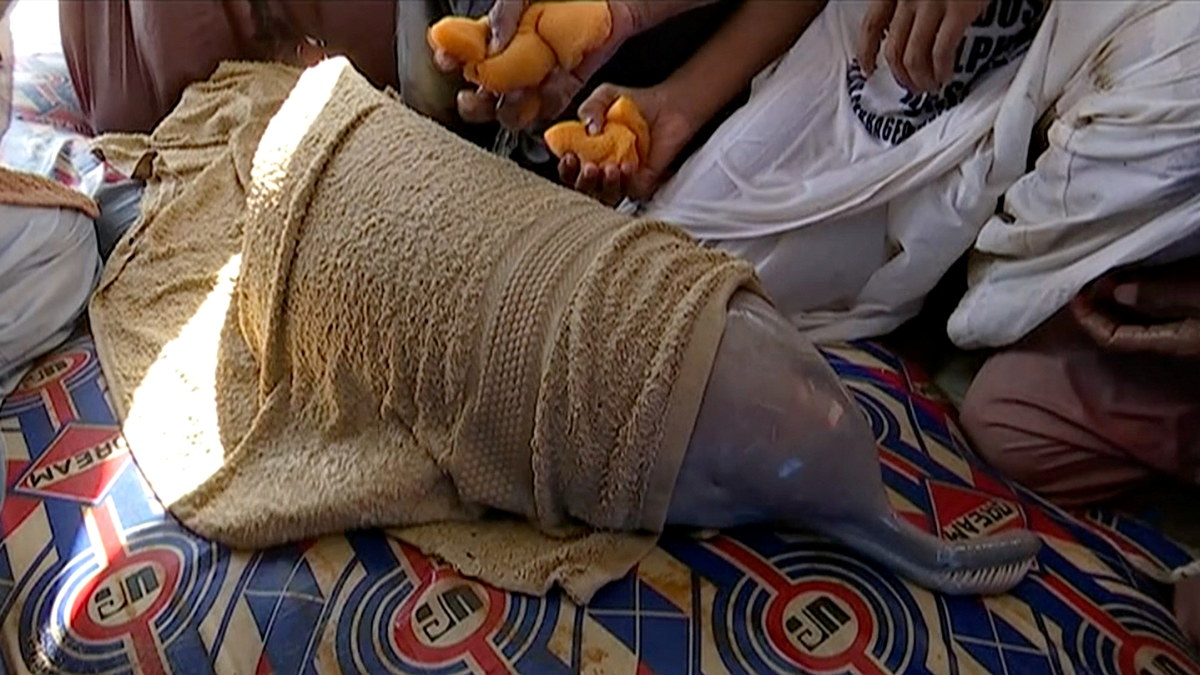


Rescuers pour water over an Indus dolphin inside an ambulance in this still image from a video in Larkana, Pakistan, on October 30, 2021. (REUTERS)

It was a delicate task to keep the skin wet and foster the animal’s impression of being still in the water, while ensuring no fluid entered the blowhole by which it breathes, he added.
The dolphins are being squeezed out of their habitat after human activity, from dams for irrigation projects to pollution, penned them into a 1,200-km (750-mile) stretch of Pakistan’s Indus river, or just half their original range. 
Living for millions of years in the turbid waters, the mammals, just one of four surviving freshwater species, eventually went blind and use echolocation, or a form of sonar, for navigation. 
They can grow to a length of more than two meters (2 yards) and exceed 100 kg (220 lb) in weight, feeding on catfish, carp and prawns, but need waters at least a meter deep to keep alive.
Some smaller animals stray into shallow irrigation canals, ponds and even fields, where they cannot survive. Although hunting them is banned, Sindh wildlife officials say that getting entangled in fishing nets remains a key threat. 
But protection efforts have paid off, with numbers rebounding to 1,816 in 2019, up by half from 2001, a WWF survey showed. That was a far cry from the figure of 132 in 1972 that brought endangered status, leading to creation of the sanctuary. 
About 30 animals have died in the roughly 200 rescue efforts Pakistan has launched since 1992. But all 27 rescues after 2019 have succeeded. 


Bangladesh mourns slain activist as tensions rise ahead of elections

Updated 6 sec ago
Follow

Bangladesh mourns slain activist as tensions rise ahead of elections

  • Sharif Osman Hadi, who took part in 2024 uprising against Sheikh Hasina, passed away last week after getting shot
  • Hadi’s death has sparked a new diplomatic squabble with India, as police say shooter has probably fled to India

DHAKA, Bangladesh: Hundreds of thousands of people attended the funeral Saturday of a leading Bangladeshi activist who died of gunshot wounds sustained in an attack in Dhaka earlier this month, as political tensions gripped the country ahead of elections.

Sharif Osman Hadi, who took part in last year’s political uprising that ended former Prime Minister Sheikh Hasina’s 15-year rule, died in a hospital in Singapore on Thursday after being shot Dec. 12 in Dhaka.

Police said they had identified suspects and that the shooter had most probably fled to India, where Hasina has been in exile. The development sparked a new diplomatic squabble with India and prompted New Delhi this week to summon Bangladesh’s envoy. Bangladesh also summoned the Indian envoy to Dhaka.

Security was tight in Dhaka on Saturday as the funeral prayers were held outside the nation’s Parliament complex.

Hadi’s body returned on Friday night, and Saturday was declared a national mourning day.
Hadi was a spokesperson for the Inqilab Moncho culture group, which said he would be buried on the Dhaka University campus beside the country’s national poet Kazi Nazrul Islam.

Mourners carried Bangladesh flags and chanted slogans, such as “We will be Hadi, we will be fighting decades after decades,” and “We will not let Hadi’s blood go in vain.”

The news of his death on Thursday evening triggered violence, with groups of protesters attacking and torching the offices of two leading national dailies. The country’s interim leader, Nobel Peace Prize laureate Muhammad Yunus, has urged the people to stay calm.

Hadi was a fierce critic of both neighboring India and Hasina, who has been in exile since Aug. 5, 2024, when she fled Bangladesh. Hadi had planned to run as an independent candidate in a major constituency in Dhaka in the next national elections in February.

Bangladesh has been going through a critical transition under Yunus in a bid to return to democracy through the upcoming elections. But the government has been Hasina’s Awami League party, which is one of two major political parties. 

Hasina’s archrival, former Prime Minister Khaleda Zia’s Bangladesh Nationalist Party is the other key party, which hopes to forms the next government. The Jamaat-e-Islami party, the country’s largest Islamist party with a dark history involving the nation’s independence war in 1971, is leading an alliance to carve out a bigger political space in the absence of Hasina’s party and its allies.

Hasina has been sentenced to death on charges of crimes against humanity, but India’s has not responded to repeated requests by the Yunus-led government for her extradition.