With tree-planting program, schoolchildren monitor climate footprint in Karachi and Tharparkar desert

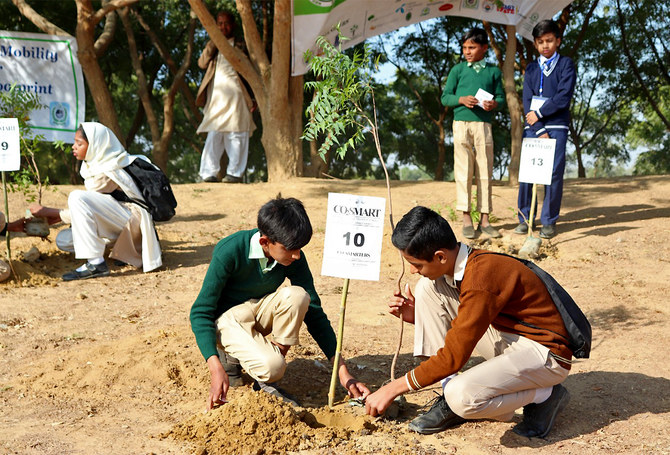
Students plant trees at Ansari Green Park in Tharparkar, Sindh province, Pakistan, in April 2019. (Photo courtesy: NED University)
Short Url
Updated 09 November 2021
Follow

With tree-planting program, schoolchildren monitor climate footprint in Karachi and Tharparkar desert

  • Thar-Karachi Student Mobility Campaign for Reducing Carbon Footprint started in 2019 to raise climate change awareness among schoolchildren
  • Through NED University website, children continue to monitor CO2 absorption of trees they planted in Karachi and Thar

KARACHI: Two years ago when Sameer Islam joined a tree-planting program at his school in Pakistan’s coastal megacity of Karachi, he didn’t know much about the role of plants in tackling climate change. But everything changed when he visited a nearby desert district as part of the Thar-Karachi Student Mobility Campaign for Reducing Carbon Footprint program.
The program was set up by the NED University of Engineering and Technology in April 2019 and established with a grant from the Higher Education Commission and the Sindh Engro Coal Mining Company (SECMC) to raise climate change awareness among schoolchildren. 
Under the program, 35 students from grade five to 10 were selected to work in two regions of Sindh province — Karachi and the desert region of Tharparkar — that have been hit by global warming and seen deadly heatwaves and droughts in recent years.
During the campaign, the children visited the regions to plant trees and until today monitor them through the university’s website to see how the plantation contributes to reducing the global climate footprint.
As trees grow, they absorb carbon dioxide (CO2), a major greenhouse gas in the atmosphere. The trees planted during the NED program are geo-tagged, with their health, diameter and height regularly measured. All data is uploaded to the university’s website, where an algorithm estimates their CO2 absorption, allowing the kids to monitor the trees’ performance.
“I knew very little about the trees,” Islam, a seventh-grade student, told Arab News. “But when I visited Tharparkar for the plantation, I came to know about their importance.”
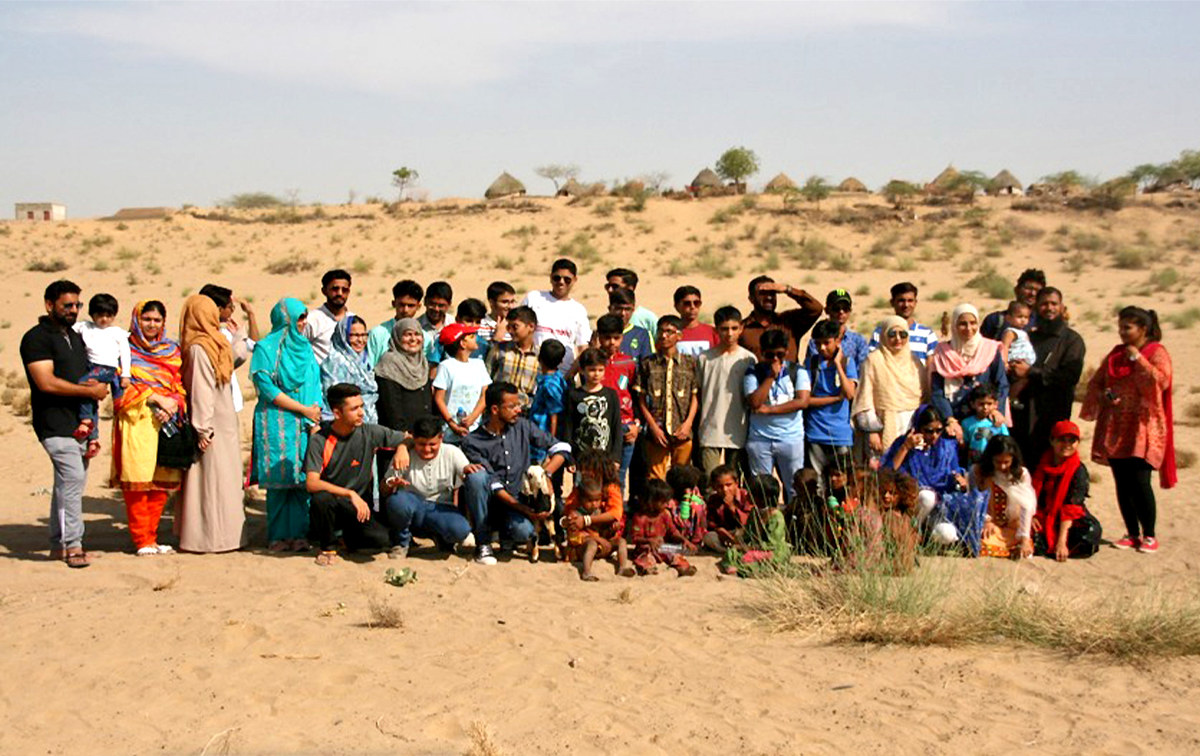


Students from Tharparkar and Karachi pose for a group photo in Tharparkar, Sindh province, Pakistan, in April 2019. (Photo courtesy: NED University)  

For the exchange program, he planted a tree at Tharparkar’s Ansari Green Park, but his involvement did not stop there.
“I have also planted five trees in my neighborhood,” he said. “I personally take care of them.”
Hafiz Mutahir Ahmed, who is now a student at Aga Khan College in Karachi, continues to monitor the trees he planted in Tharparkar as a high school student.
“A tree reduces 8.47 kilograms of carbon and planting one tree is a great achievement,” he said. “Planting trees is the need of the time, especially for the areas like Karachi and Tharparkar where temperature is growing very fast.”
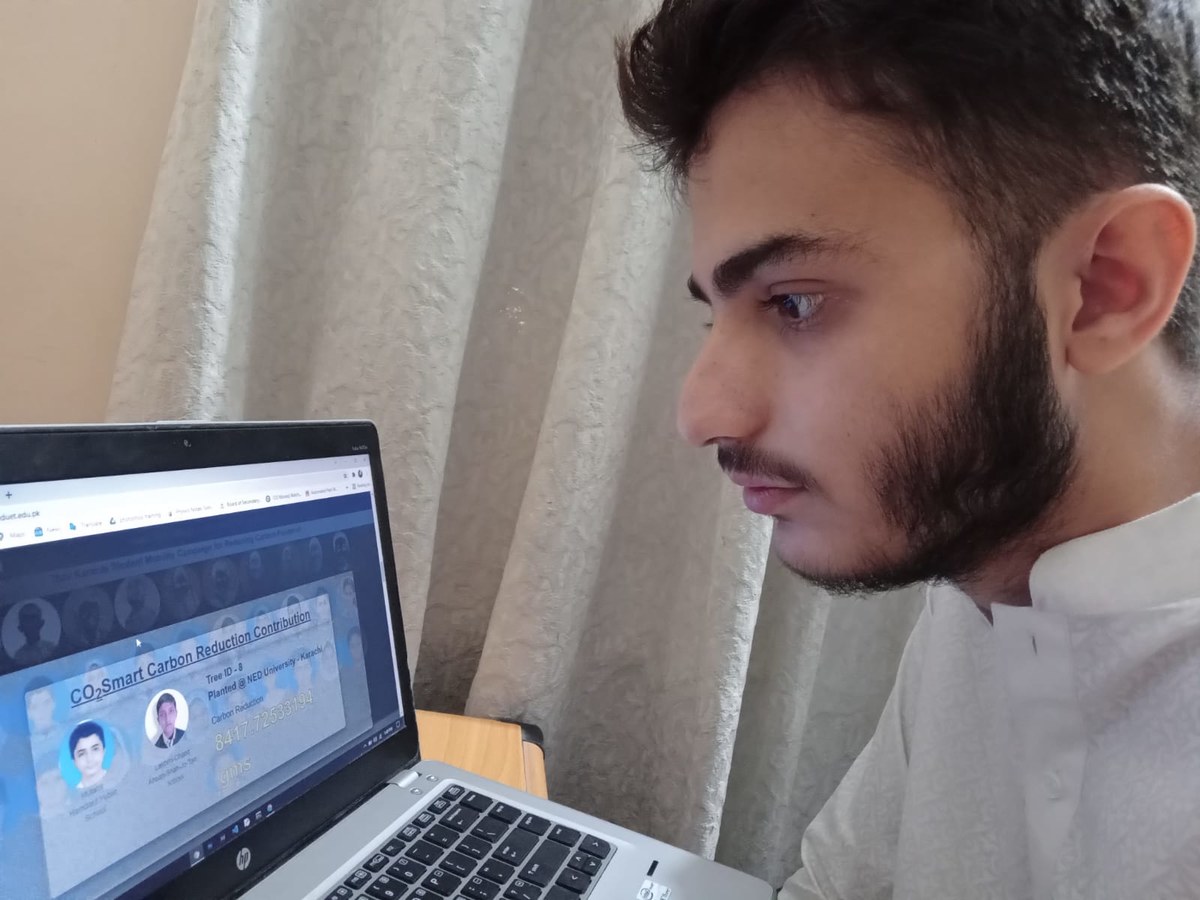


In this photo taken on November 7, 2021, Hafiz Mutahir Ahmed checks from his home in Karachi, Pakistan, the carbon dioxide absorption of the tree he planted during Thar-Karachi Student Mobility Campaign for Reducing Carbon Footprint in April 2019. (AN photo)

Nuzrah Jamal, now a high school student, says she has also been helping others understand the importance of vegetation for the planet.
“I feel very proud of myself when I login to the website and see my plant is contributing,” she said. “A single plant can make a difference.”
Dr. Saad Ahmed Qazi, dean of the Faculty of Electrical and Computer Engineering at the NED University, who was one of the program’s initiators, told Arab News the students enthusiastically monitored the status of their trees. 
“It’s extremely important to connect each person with activities related to climate change mitigation, be it energy conservation, tree plantation or any other thing,” he said. “That is what creates an environmentally conscious and responsible soul.”


Pakistan clears global crypto exchanges Binance, HTX under new regulatory framework

Updated 7 sec ago
Follow

Pakistan clears global crypto exchanges Binance, HTX under new regulatory framework

  • NOCs allow Binance, HTX to conduct engagement activities within Pakistan, says regulator PVARA
  • Says move allows entities to open subsidiaries in Pakistan but doesn’t constitute as operating license

ISLAMABAD: The Pakistan Virtual Assets Regulatory Authority (PVARA) announced on Friday that it has granted no objection certificates (NOCs) to global crypto exchanges Binance and HTX, the latest in a series of moves by Islamabad to regulate its fast-growing virtual assets market. 

PVARA said the NOCs were granted following a review process it conducted with public sector stakeholders which focused on governance structures, compliance frameworks, risk management controls and alignment with Pakistan’s emerging regulatory requirements for virtual asset activities.

Pakistan has been moving to regulate its fast-growing crypto and digital assets market by bringing virtual asset service providers (VASPs) under a formal licensing regime. Officials say the push is aimed at curbing illicit transactions, improving oversight and encouraging innovation in blockchain-based financial services.

“The introduction of this structured NOC framework demonstrates Pakistan’s commitment to responsible innovation and financial discipline,” Finance Minister Muhammad Aurangzeb was quoted as saying in a press release issued by PVARA. 

The regulatory authority said the NOCs allow Binance and HTX to conduct preparatory and engagement activities within Pakistan under “defined regulatory oversight,” clarifying that it does not constitute a “full operating license.”

The NOCs allow Binance and HTX to begin registration on the FMU goAML, Pakistan’s anti–money laundering reporting platform, as reporting entries. It also allows them to engage with the Securities and Exchange Commission of Pakistan (SECP) regulator to incorporate their subsidiaries in the country. 

HTX and Binance can also prepare and submit their full VASP license applications once licensing regulations are promulgated and provide anti-money laundering (AML) registered services after the completion of their goAML registration.

“PVARA will continue to engage with domestic and international stakeholders as it advances subsequent phases of its regulatory framework,” the authority said. 

“Additional guidance regarding licensing standards, compliance obligations and supervisory expectations for virtual asset service providers will be issued in due course.”

Chairman PVARA Bilal Bin Saqib said issuing the NOCs marks the first step toward a fully licensed and regulated environment for digital assets in Pakistan. 

“By adopting a phased and internationally aligned approach, Pakistan is ensuring that only well-governed, fully compliant global platforms progress toward full licensing,” Saqib was quoted as saying by PVARA.

According to PVARA, Pakistan already ranks at number three in crypto adoption and is home to an estimated 30 to 40 million users.

It said industry-wide assessments estimate that annual digital asset trading activity linked to Pakistan exceeds $300 billion. 

The development takes place days after Prime Minister Shehbaz Sharif met a delegation of Binance in Islamabad, led by its CEO Richard Teng, to discuss regulating digital assets in Pakistan.