

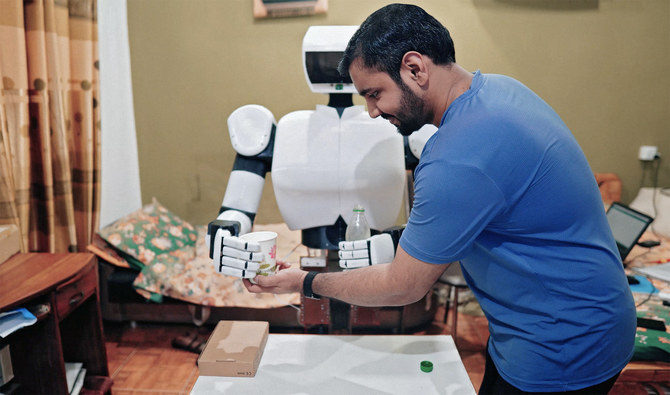

RAWALPINDI: It took Usama Aziz two years to build a white robot that dazzled YouTube viewers last month when with human-like fingers it poured a drink for his creator without spilling a drop.
Aziz, 28, an electrical engineering graduate of the National University of Sciences and Technology (NUST) in Islamabad built the white shiny humanoid at his bedroom-turned- laboratory in Multan, where he has been developing his passion for robotics for the past six years.
“Humanoid robots are the most difficult robots to make because human structure is complex, and very difficult to replicate,” he told Arab News. “There are individual finger control elements, which means I can individually control its fingers as well as the elbow, wrist, shoulders and all the joints separately. It is very complex."
The white robot, which Aziz says is still in the development stage, has made the rounds on social media, but it is not his first creation.
In 2016, he made a food-serving droid, which was even put to work at a Multan restaurant in 2017. But that one was much simpler and could not move its arms.
For the drink-serving robot Aziz opted to go with a 3-D printer, also because of how he believes it could influence robot design, particularly in Pakistan, where research and development have been limited.
“The number one benefit (of 3-D printing) is that it is very accurate, all the parts of the robot once developed can be replicated with exact dimensions, exact sizes, exact parameters, without any changing, without any difficulty it can be replicated,” he said.
“This means once I open source my files through my website, or on any online portal, any researcher, student, enthusiast or roboticist, who wants to work in this field or want to make a humanoid robot, can use my design files and 3-D printable files, and can have their own version of the robot and can do so right here in Pakistan.”
Aziz says he sees a bright future for robotics in his country, where individual initiatives are supported by the National Centre of Robotics and Automation (NCRA).
Established in 2018 under the umbrella of the Higher Education Commission, the purpose of NCRA is to indigenize and advance the discipline in Pakistan.
“Because of these labs and the startup culture that is going to develop in Pakistan, the future of robotics has a great potential,” Aziz said.
His own robotics startup, NextGen Robotix, last year won NCRA's Robotics Start-Up Challenge competition and a prize of Rs300,000 ($1,750).
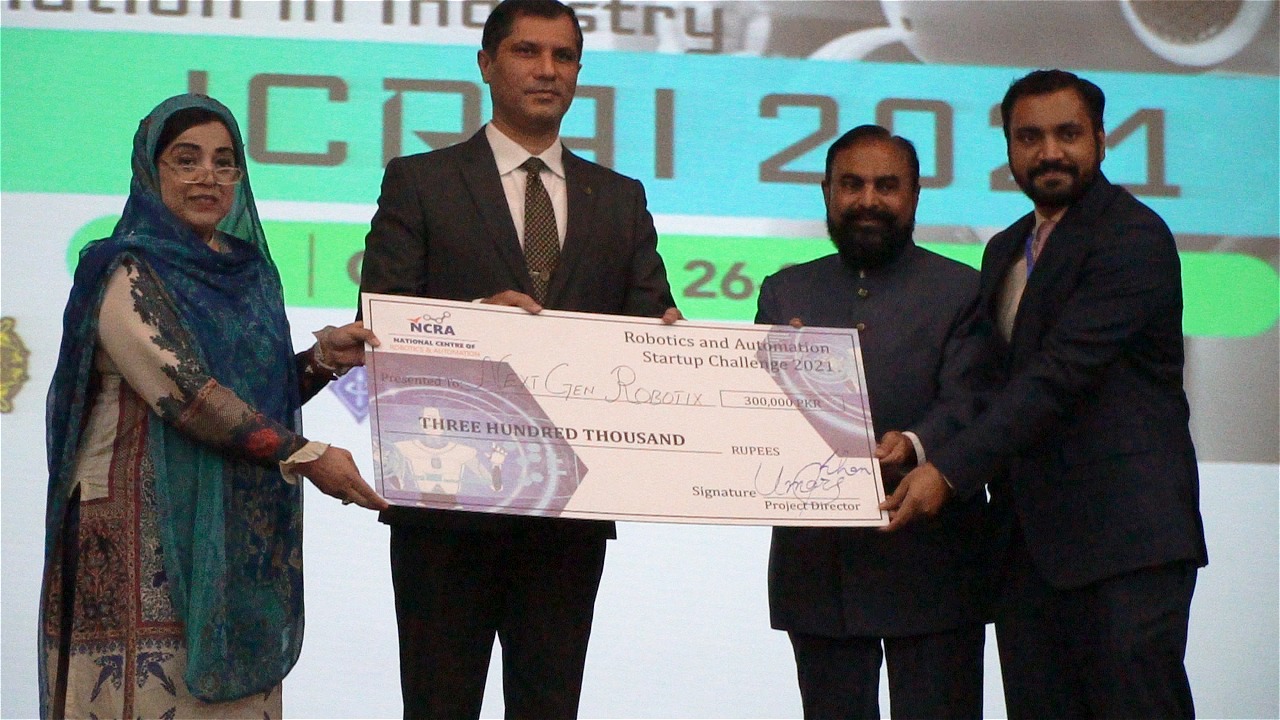
Syed Usama Aziz (right) receives a cheque after winning a robotics competition at the National Centre of Robotics and Automation located at the National University of Sciences & Technology, Islamabad in 2020. (Photo courtesy: Usama Aziz)
“Robotics is a cutting-edge field where you can create intelligent machines having the capability of performing autonomous or semi-autonomous tasks. It’s an exciting field because one can create something out of nothing,” Dr. Umar Shahbaz Khan, NCRA director and NUST faculty member told Arab News.
“The world is moving towards automation and robotics is an integral part of it. Whether it’s the Roomba robot cleaning the carpet in the house or the Mars rover on another planet, these are all robots.”
An educationist by day, Aziz says many students are interested in the field.
"All we need is some sort of companies who are willing to spend money on the indigenous development of robotics here in Pakistan, and then we'll be really progressing in this sphere," he said.
Could this progress lead to a robot takeover of the world?
“It's a very common question among people. But I think there is nothing to be afraid of. We are still far, far, far away from robots taking over the world,” Aziz said. “We control the robots right now. And they are pretty harmless. Robots are pretty dumb, not as intelligent as humans are, so they cannot take over the world anytime soon.”


