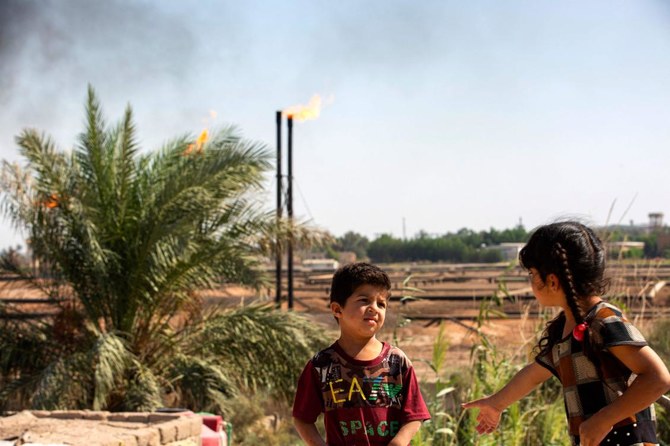
BASRA, Iraq: In Iraq’s southern province of Basra, the oil flows freely but little of the wealth trickles down to the people, and many struggle to make ends meet.
Sajad, 17, who lives in Basra city, says he “has no future” and no present. Like other young people, he says he just survives, a living emblem of the city’s maladies.
Basra province produces about 70 percent of crude oil in Iraq, itself the second biggest exporter in the Middle East after Saudi Arabia.
Yet the province is hit especially hard by many of the problems plaguing Iraq, which is still seeking to recover from years of war and turmoil since the 2003 US-led invasion that toppled dictator Saddam Hussein.
Unemployment in Basra affects 20 to 25 percent of the people and almost 30 percent of youth, estimated Iraqi economist Barik Schuber in the absence of official figures.
This compares to a national rate of 13.7 percent, according to World Bank figures.
From patchy supplies of water and electricity, to pockmarked roads and toxic pollution caused by extracting hydrocarbons, Basra province and its four million inhabitants are struggling.
But what hits hardest is the despair of the young.
Gathered around their shisha pipes, Sajad and Jawad, both aged 16, are hard pressed to find anything to be optimistic about.
Sajad does not work, while Jawad said he toils for “eight to 13 hours in a restaurant for 7,000 dinars (about $4.80) per day.”
“I don’t see a future here, I want to go to Baghdad,” said Sajad, sitting on the shores of the Shatt Al-Arab waterway, where the Tigris and Euphrates rivers meet.
Some investments have been made, such as a new stadium under construction ahead of the Gulf Cup football tournament due to be held in Basra in January 2023.
But the deputy governor of Basra, Dorgham Al-Ajwadi, conceded that “the people are angry.”
He blamed the distant government in Baghdad for the inequitable distribution of the federal budget.
“In 2021, the Iraqi budget is about 130 trillion Iraqi dinars ($89 billion), but for Basra it’s less than one trillion,” he said.
“It is maybe 0.7 percent of the total budget, while more than 108 trillion come from Basra.”
For Basra resident Mortada, 27, it’s not Baghdad that’s to blame but rather the local authorities.
Before the pandemic, he ran an unregistered ice cream shop, he explained.
“Then the authorities shut down the illegal businesses, including mine,” he said, requesting that his surname not be published to avoid problems “with certain people.”
In Iraq’s October 10 parliamentary elections, he voted for an independent candidate unaffiliated with the major parties because “I believe he can change things.”
For many, the grievances run deeper.
Basra was a hotbed of massive protests in mid-2018, a precursor to the near-nationwide protests that rocked the country from October 2019.
Anger erupted in Basra over corruption, poor public services and, above all, the influence of neighboring Iran, whose local consulate was set ablaze.
Tehran has long exercised influence over Iraq through certain political parties, as well as factions of the Hashed Al-Shaabi — a former paramilitary umbrella organization that was folded into the Iraqi armed forces.
In Basra, some accuse “groups loyal to Tehran” of wielding harmful influence and of infiltrating the economic fabric.
One such critic refused to give his name, saying that “if it is published, I risk being killed.”
Three years after the Basra demonstrations, little has changed, according to Mortada, who does odd jobs and dreams of working “for the state.”
In Basra, more than in any other part of the country, a job in the petroleum sector is seen as the ultimate prize for its promise of stability and prosperity.
But according to Mac Skeleton, executive director of the Institute of Regional and International Studies based in Iraqi Kurdistan, jobs in Basra’s petrol industry are handed out through nepotism.
“Each of the major Shia majority parties are competing over the Basra oil company, they’re competing over the security contracts in the oil fields, for different assets,” he explained.
But “connections” are necessary for a way in, he said, adding that “at the end of the day there is a kind of limit to how many people can benefit from these different spheres of power.”
Some people miss out despite having connections, said Sajad, whose uncle works at the oil ministry.
The young man complained that his elder relative had already “accommodated two people from his family” and therefore “cannot hire me.”


![]()

Despite oil wealth, poverty fuels despair in south Iraq
Short Url
https://arab.news/n5p5s
Despite oil wealth, poverty fuels despair in south Iraq
- Basra province produces about 70 percent of crude oil in Iraq
- Unemployment in Basra affects 20 to 25 percent of the people and almost 30 percent of youth


Latest updates


Recommended


© 2026 SAUDI RESEARCH & PUBLISHING COMPANY, All Rights Reserved And subject to Terms of Use Agreement.