

Pakistan’s manufacturers seek government approval to export surplus urea to India, Afghanistan

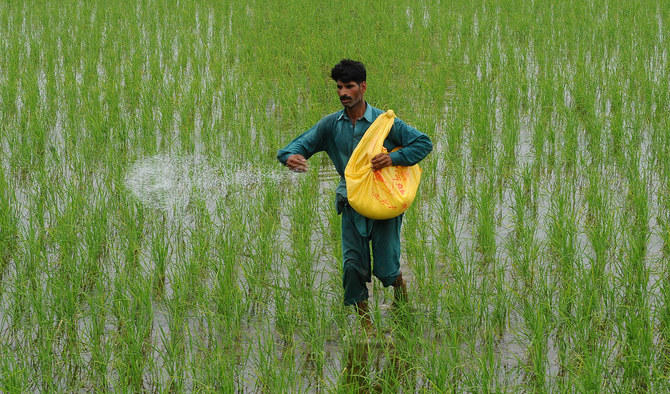
A farmer disperses fertilizer in a rice paddy field on the outskirts of Lahore, Pakistan, on July 2, 2011. (AFP/File)
Short Url
Updated 04 November 2021
Follow

Pakistan’s manufacturers seek government approval to export surplus urea to India, Afghanistan

  • Leading industry players say they can help the country earn $700 million in export revenue by selling urea to India, Afghanistan
  • Fertilizer manufacturers say every Rs50 increase in the price of a urea bag has an impact of one paisa on the overall price of bread

KARACHI: Pakistan’s fertilizer manufacturers said on Wednesday they had requested their government to allow them to export surplus urea to India and Afghanistan, adding their industry could earn about $700 million in export revenue for the country.

Addressing a news conference in Karachi, they said the country’s fertilizer sector could export about 700,000 to 800,000 metric tons of urea after meeting the country’s domestic requirement.

“We have approached the commerce ministry and other relevant departments by writing them a letter, asking them to let us export about 0.7 to 0.8 million tons of surplus urea,” Imran Ahmed, chief financial officer of Engro Fertilizers, told Arab News on the sidelines of the press briefing.

Ahmed said the immediate export market of Pakistan could be India and Afghanistan, though he noted other countries could also be potential buyers.

According to the data shared at the news briefing, the overall demand for fertilizer in India was 35 million tons, though it only produced 24 million tons and imported the remaining 11 million tons.

The import was costing India as much as $1,000 per ton, the media briefing was told.

“Pakistan has an opportunity to earn $700 million by exporting urea without any capital outflow,” Ahmed said, adding: “The potential income tax revenue for government through the export process could be $7 million, making the fertilizer sector one of the top exporters.”

Pakistani fertilizer makers said they could produce exportable surplus within six months through their capacity utilization.

“Pakistan can start exporting urea within six months after building security stocks at home,” Ahmed said.

Pakistan’s own urea demand is about 6.2 million tons per annum. The country meets around 84 percent of its requirement through local production while the remaining is met through imports, according to the official data.

The localization of fertilizer production and supply of subsidized gas has made it possible for the country to consume less foreign exchange on the import of urea and absorb higher impact of international prices.

“The price of local urea is Rs1,768 per bag versus its imported equivalent price of Rs9,345 per bag. This means urea is available in Pakistan at a significant discount of 81 percent which is equivalent to Rs7,500 per bag,” Ahmed said.

“Farmers are getting an annualized benefit of more than Rs350 billion and the country is expected to save $3 billion in import substitution in 2021,” he added.

He denied that fertilizer price hike had a major impact on food inflation.

“Urea prices do not have any impact on food inflation since only 2.6 percent of a farmer’s money is spent on it. Every Rs50 increase in the price of a urea bag has an impact of only one paisa on the price of bread,” he said.


China backs Pakistan in fight against militancy after deadly Balochistan attacks

Updated 03 February 2026
Follow

China backs Pakistan in fight against militancy after deadly Balochistan attacks

  • China is a major ally and investor in Pakistan and has pledged over $65 billion in major infrastructure projects, including in Balochistan
  • Chinese Foreign Ministry spokesperson Lin Jian says ‘we mourn for lives lost, and our hearts go out to injured and those who lost loved ones’

ISLAMABAD: China condemns the recent attacks that killed more than 200 people in Pakistan’s southwestern Balochistan province, a Chinese foreign ministry spokesperson said on Tuesday, reaffirming Beijing’s support for Pakistan in its fight against militancy.

The Baloch Liberation Army (BLA) group launched coordinated attacks in several cities across Balochistan on Saturday, killing 33 civilians and 17 security personnel. Officials said 117 militants were killed in skirmishes and follow-up operations.

Balochistan, which borders Iran and Afghanistan, is the site of a decades-long insurgency waged by Baloch separatist groups who often attack security forces, foreigners and non-local Pakistanis and kidnap government officials.

China is a major ally and investor in Pakistan and has pledged over $65 billion in investment in road, infrastructure and development projects under the China-Pakistan Economic Corridor (CPEC).

“China strongly condemns the [Balochistan] attacks... We mourn for the lives lost, and our hearts go out to the injured and those who lost their loved ones,” Chinese Foreign Ministry spokesperson Lin Jian said at a press briefing on Tuesday.

“China firmly opposes any form of terrorism and will as always firmly support Pakistan in combating terrorism, maintaining solidarity and social stability, and protecting the safety of the people.”

Chinese nationals working in Pakistan have often been targeted by militants, particularly in the southwestern Balochistan province, where China is developing a deep seaport that is touted as the crown jewel of CPEC.

Interior Minister Mohsin Naqvi said last week the attacks, claimed by the separatist Baloch Liberation Army (BLA), were planned from India. New Delhi rejected the allegation as “baseless,” saying Islamabad was attempting to deflect attention from its internal challenges.

Balochistan is home to vast reserves of minerals and hydrocarbons. Separatist militant groups such as the BLA blame Islamabad for exploiting Balochistan’s natural resources and denying locals a share in them. The military and civilian government reject these allegations and say they are investing in the province’s development.