

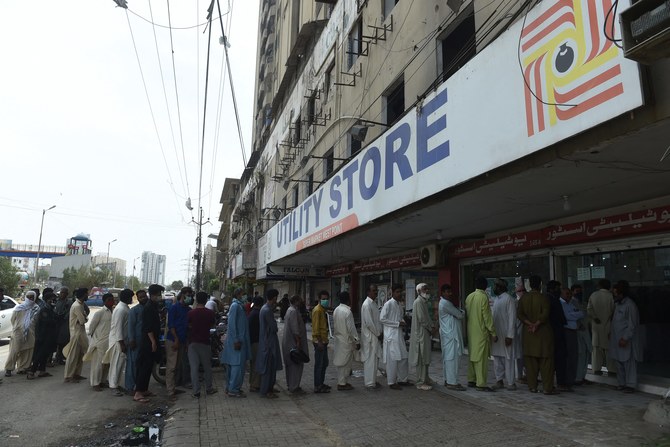

KARACHI: Pakistan will register thousands of grocery stores across the country to disburse over Rs120 billion ($700 million) under the government’s new relief package, the information minister said on Thursday.
Prime Minister Imran Khan on Wednesday announced the package as the “biggest welfare program in Pakistan’s history” to mitigate the impact of surging commodity prices due to the global price hikes and rising inflation.
The prime minister’s announcement came as the statistics bureau announced that Pakistan’s annual inflation rate rose to 9.2 percent in October, compared with 9 percent in the previous month and 8.9 percent in October 2020.
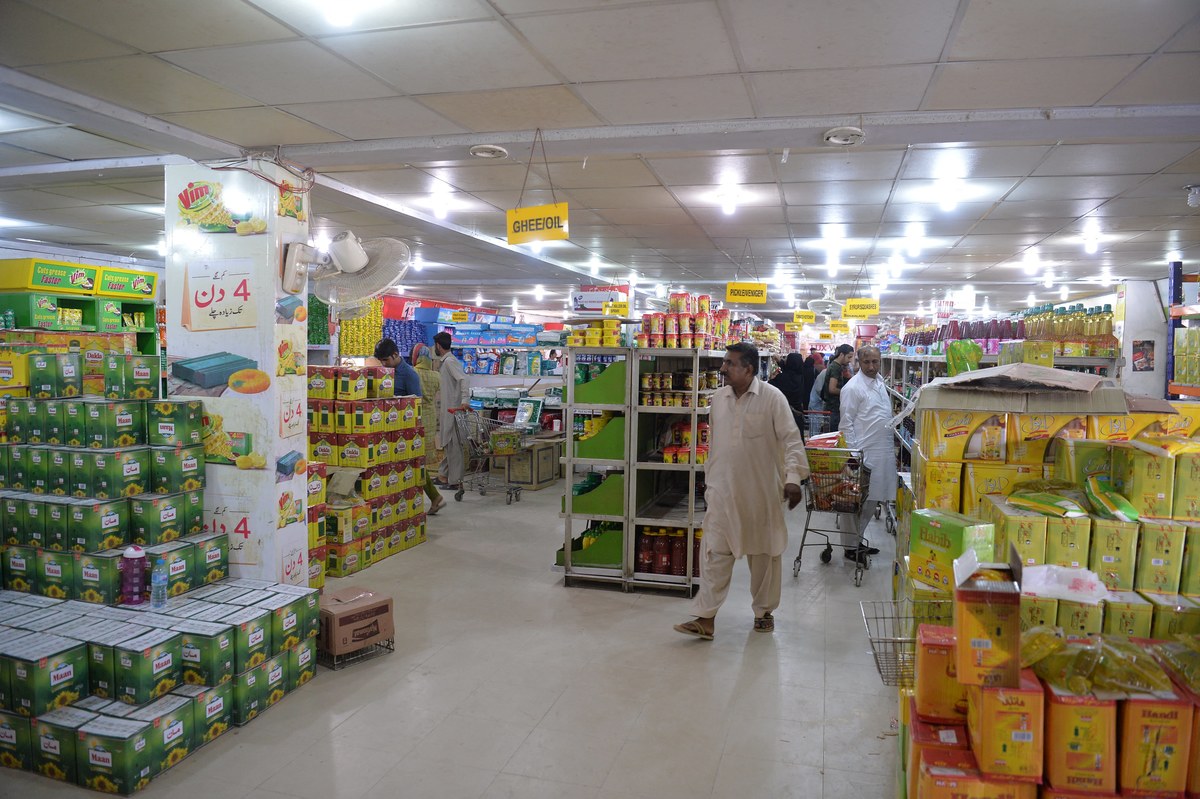
Pakistanis buy food items at a utility store with government-controlled prices in Islamabad on May 16, 2018. (AFP/File)
The subsidy is expected to provide relief to 20 million families, or 130 million people, offering them a 30 percent discount on per unit purchases of three basic edible items: ghee, wheat, and pulses for six months.
“The national bank will register karyana (grocery) stores,” Information Minister Fawad Chaudhry told Arab News. “Thousands of karyana stores will be registered.”
“The eligibility would be that the store owner would have his own bank account and should have at least a smartphone on which he would download an app.”
The stores, Chaudhry said, will be linked with the government’s poverty alleviation Ehsaas program database, which has identity data of individuals eligible to receive aid.
“The store owner will feed the National Identity Card number of the person through the app and if the person’s identity card matches with the Ehsaas database information, he will get subsidy on three items, flour, ghee and pulses,” Chaudhry said.
“The amount (of subsidy) will be transferred from the Ehsaas account to the store owner account directly.”
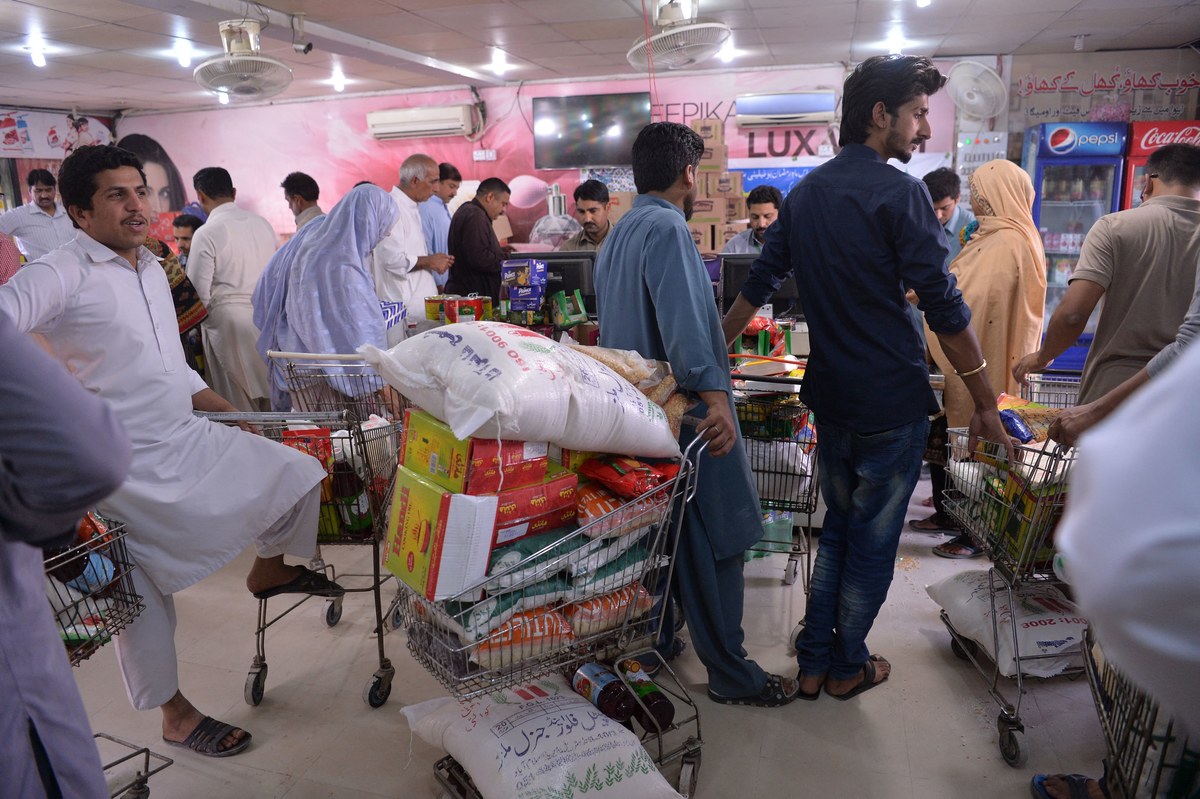
People buy food items at a government-run utility store in Islamabad, Pakistan, on May 16, 2018. (AFP/File)
Analysts say the prime minister’s new relief package will provide a cushion to people affected by high prices and decreasing purchasing power.
Samiullah Tariq, research director at Pakistan Kuwait Investment, said the targeted subsidy is a “good attempt to insulate bottom tier of population from inflation.”
Tahir Abbas, the head of research at Arif Habib Limited, a Pakistani securities brokerage and investment banking firm, told Arab News the program will “cushion the lower strata of the society by providing them essential items at subsidized rates.”
“With the high inflation, societies in general witnessed a significant dip in the purchasing power. This announcement will counter that problem,” he said, but added that allocating an additional Rs 120 billion for the purpose “will put pressure on the fiscal side.”
Some, however, raise concerns over the program’s implementation.
Khurram Schehzad, chief executive of financial advisory firm Alpha Beta Core, told Arab News the relief package was a “good initiative,” but “the implementation of the package will be a key challenge.”
For Dr. Umair Javed from the Lahore University of Management Sciences (LUMS), the disbursement of aid would be better through cash.
“The implementation challenges remain in almost every such initiative, the most suitable way would be to implement it through cash subsidies to the targeted families,” he said. “With Rs120 billion, it would be hard to fight the commodity inflation and the most effective mechanism is to give them cash in their hands.”
Senior economist Dr. Farrukh Saleem said the aid amount may be also too small to provide relief.
“If we calculate the disbursement, the amount would be Rs5 per person per day,” he said. “This is too small as compared to the inflation rate.”
But Dr. Sajid Amin Javed, senior economist at the Sustainable Development Policy Institute, said that regardless of the amount, the initiative was positive, as he also argued that direct cash transfers would be more effective as they would cut down the implementation cost.
“Irrespective of the amount it is positive step that people are getting some relief amid price spike. Social protection is the prime responsibility of government,” he said. “The duration should be extended beyond six months because inflation is going to stay for at least a year.”


