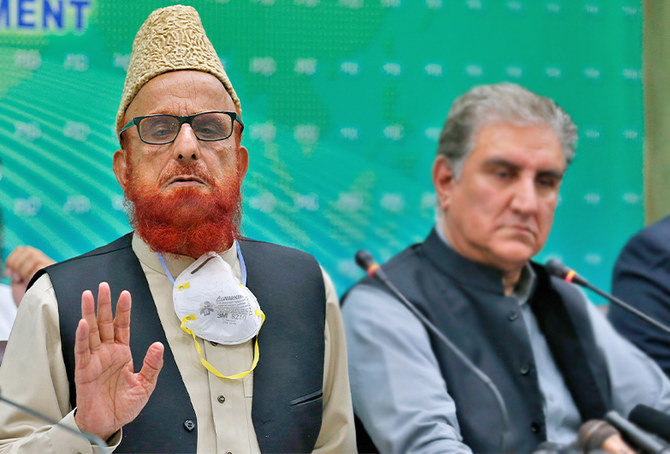
ISLAMABAD: A top cleric who was among a group that helped arrange talks between the government and the banned Tehreek-e-Labbaik Pakistan (TLP) religious political party said on Tuesday the outlawed group had not demanded the “unconditional” expulsion of the French ambassador but that the issue should be debated in parliament.
TLP reached a deal with the government on Sunday, ending more than a week of clashes with police that left at least six policemen dead and scores injured on both sides. The details of the pact have not been shared with the public by either side.
TLP began a protest march last month calling for the release of its jailed leader Saad Rizvi. The group has also been calling for the expulsion of France’s ambassador over the publication of caricatures depicting the Prophet Muhammad (pbuh) in a French satirical magazine last year. Last week, the government said it was ready to meet all of the group’s demands except for breaking diplomatic ties with France.
“TLP has never said that the government should expel the French ambassador and cease its relations with France,” Mufti Muneebur Rehman told Arab News. “They have said that this issue should be presented before parliament. Parliament can decide keeping in view Pakistan’s interest in the international community, our foreign policy and all other elements related to the country’s interest.”
He added that TLP would accept whatever decision was taken by parliament.
“They [TLP] have never said that if the government will not do it [expel France’s envoy], we will attack or ransack the French embassy. TLP is saying that this issue [publication of caricatures] has hurt our [Muslims] feelings and parliament should decide it. It is not an unconstitutional demand,” Rehman added.
His comments came as TLP supporters continued a protest sit-in for the fifth consecutive day in Wazirabad, a city located about 190 kilometers from Islamabad, despite the deal with the government.
“I am confident that the agreement signed will be implemented and things will return to normal,” Rehman said. “Protesters have vacated all roads and once implementation [of agreement] starts they will go back to their homes.”
TLP was founded in 2015 to tackle actions it considers blasphemous to Islam and has mounted multiple protest marches marred by bloodshed that have twice brought Islamabad to a standstill.
In April, the government agreed to have parliament vote on kicking out the French ambassador but backtracked, with Prime Minister Imran Khan saying to take such action would isolate Pakistan internationally.
On Tuesday, a senior TLP leader said the government had released over 1,000 jailed TLP supporters, and would free another 1,300 as well as drop all criminal charges against them under the peace agreement signed on Sunday.
The Lahore High Court is also taking up a petition tomorrow, Wednesday, challenging Saad Rizvi’s detention.
“We are expecting good news regarding Saad Rizvi’s release tomorrow,” Saifi said, adding that the government’s lawyers would meet TLP lawyers in Lahore today, Tuesday, to discuss legal complications in cases against TLP members.
The group estimates the government has included at least 500 of its members in the fourth schedule, a listing of suspected militants under the Anti-Terrorism Act (ATA) 1997.
“The government has promised to remove all our members included in the fourth schedule and a process for it has already started,” Saifi said.
The government banned TLP in April after violent protests by the group in which at least six policemen were killed and 800 people were injured, according to government figures.


TLP never ‘unconditionally’ demanded expulsion of French ambassador from Pakistan — Mufti Muneeb
https://arab.news/vkygs
TLP never ‘unconditionally’ demanded expulsion of French ambassador from Pakistan — Mufti Muneeb

- Mufti Muneebur Rehman was among clerics who facilitated talks between the government and the banned group
- TLP has been calling for expulsion of France’s envoy over the publication last year of anti-Islam cartoons in France

Return of millions of Afghans from Pakistan and Iran pushes Afghanistan to the brink, UN warns
- Afghan authorities provide care packages for those returning that include food aid, cash, a telephone SIM card and transportation
- But the returns have strained resources in a country struggling with a weak economy, severe drought and two devastating earthquakes
GENEVA: The return of millions of Afghans from neighboring Pakistan and Iran is pushing Afghanistan to the brink, the U.N. refugee agency said on Friday, describing an unprecedented scale of returns.
A total of 5.4 million people have returned to Afghanistan since October 2023, mostly from the two neighboring countries, UNHCR’s Afghanistan representative Arafat Jamal said, speaking to a U.N. briefing in Geneva via video link from Kabul, the Afghan capital.
“This is massive, and the speed and scale of these returns has pushed Afghanistan nearly to the brink,” Jamal said.
Pakistan launched a sweeping crackdown in Oct. 2023 to expel migrants without documents, urging those in the country to leave of their own accord to avoid arrest and forcible deportation and forcibly expelling others. Iran also began a crackdown on migrants at around the same time.
Since then, millions have streamed across the border into Afghanistan, including people who were born in Pakistan decades ago and had built lives and created businesses there.
Last year alone, 2.9 million people returned to Afghanistan, Jamal said, noting it was “the largest number of returns that we have witnessed to any single country.”
Afghanistan’s Taliban rulers have criticized the mass expulsions.
Afghanistan was already struggling with a dire humanitarian situation and a poor human rights record, particularly relating to women and girls, and the massive influx of people amounting to 12% of the population has put the country under severe strain, Jamal said.
Already in just the month and a half since the start of this year, about 150,000 people had returned to Afghanistan, he added.
Afghan authorities provide care packages for those returning that include some food aid, cash, a telephone SIM card and transportation to parts of the country where they might have family. But the returns have strained resources in a country that was already struggling to cope with a weak economy and the effects of a severe drought and two devastating earthquakes.
In November, the U.N. development program said nine out of 10 families in areas of Afghanistan with high rates of return were resorting to what are known as negative coping mechanisms — either skipping meals, falling into debt or selling their belongings to survive.
“We are deeply concerned about the sustainability of these returns,” Jamal said, noting that while 5% of those who return say they will leave Afghanistan again, more than 10% say they know of someone who has already left.
“These decisions, I would underscore, to undertake dangerous journeys, are not driven by a lack of a desire to remain in the country, on the contrary, but the reality that many are unable to rebuild their viable and dignified lives,” he said.