

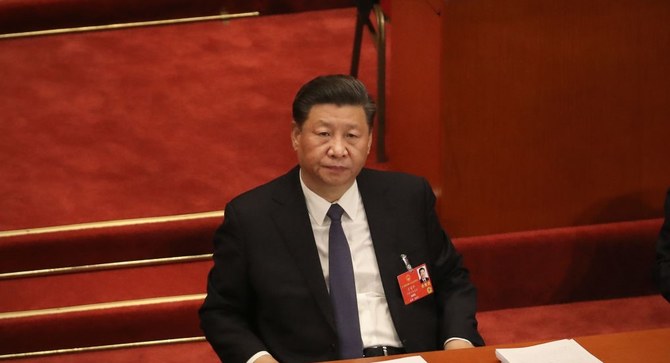

China said on Tuesday that President Xi Jinping was not given an opportunity to deliver a video address to the COP26 climate talks in Scotland and had to send a written response instead.
Xi, who is not attending the United Nations meeting in person, delivered a written statement to the opening "high-level segment for heads of state and government" on Monday in which he offered no additional pledges, while urging countries to keep their promises and "strengthen mutual trust and cooperation".
"As I understand it, the conference organisers did not provide the video link method," Chinese foreign ministry spokesman Wang Wenbin told reporters at a regular briefing.
Britain has organised the COP26 meeting in Glasgow, Scotland which aims to secure net zero carbon emissions and keep the Paris Agreement target of a 1.5 degrees Celsius temperature rise within reach in order to curb the impact of global warming.
Climate watchers have expressed concern that Xi's physical absence from Glasgow means China is not prepared to offer any more concessions during this round of talks.
But Beijing has said it has already made a number of major pledges in the last year, promising to bring emissions to a peak by 2060, raise total solar and wind capacity to 1,200 gigawatts by 2030 and curb coal use starting in 2026.
The faltering diplomatic relationship between China and the United States - the two biggest emitters of climate-warming greenhouse gases - is emerging as one of the biggest stumbling blocks during the latest round of climate talks.
Beijing has rejected Washington's efforts to separate climate from wider conflicts between the two sides, with senior diplomat Wang Yi telling U.S. climate envoy John Kerry in September that there was still a "desert" threatening the "oasis" of climate cooperation.
One particular point of contention for China has been the U.S. imposition of sanctions on Chinese companies, including solar equipment suppliers, with links to the Xinjiang region.
China rejects western claims of human rights abuses in the northwestern region of the country.
"You can't ask China to cut coal production on the one hand, while at the same time imposing sanctions on Chinese photovoltaic enterprises," Wang said on Tuesday.
The Global Times, part of the Communist Party-run People's Daily stable of newspapers, said in a Monday editorial that the United States should not expect to be able to influence Beijing on climate, while attacking it on human rights and other issues.
Washington's attitude towards China has made it "impossible for China to see any potential to have fair negotiation amid the tensions", the paper said.


