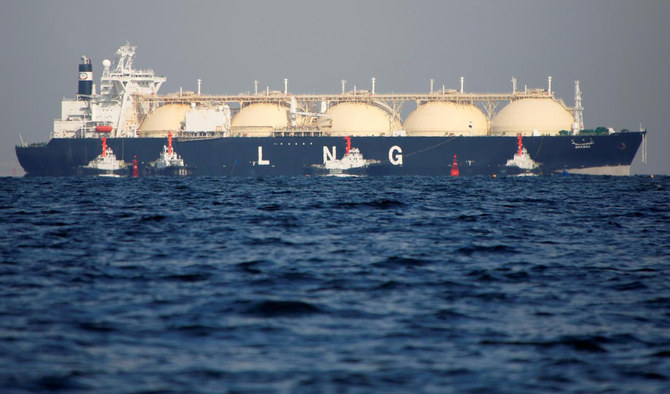
SINGAPORE: Pakistan LNG is seeking two liquefied natural gas (LNG) cargoes for delivery in November through an emergency tender after its term suppliers canceled delivery of cargoes, two industry sources said on Tuesday.
A sharp increase in gas prices has caused power shortages in many parts of the world, including China, amid a global energy crunch.
Pakistan LNG is seeking the cargoes for delivery into Port Qasim, Karachi, over Nov. 19 to 20 and Nov. 26 to 27 through a tender closing on Nov. 5, with same-day validity, according to a tender document posted on the company website.
This is due to the cancelation of two cargoes by the firm’s term suppliers for the month, one of the sources familiar with the matter said.
Commodities trader Gunvor could not supply the cargo because of force majeure at Equatorial Guinea’s LNG plant, the source said.
Italian energy group ENI could not deliver a cargo due to a default by its backend supplier, the source added.
Gunvor, ENI and Pakistan LNG did not immediately respond to Reuters’ requests for comment.
Pakistan has a five-year import deal with Gunvor and a 15-year agreement with ENI to buy LNG. Under the contracts, Pakistan LNG can impose a penalty of about 30 percent of the contractual price of a cargo on each company for cargo defaults.
Spot LNG prices rose to a record high of above $56 per million British thermal units (mmBtu) last month before pulling back to just above $30 per mmBtu, which is still over 400 percent higher than the same time last year.
That works out to three times the price of oil-linked term cargoes, which are priced at above 11 percent of Brent crude oil prices, or about $10 per mmBtu based on current oil prices.


Pakistan LNG issues emergency tender after term cargoes canceled
https://arab.news/p679s
Pakistan LNG issues emergency tender after term cargoes canceled

- Pakistan LNG is seeking the cargoes for delivery into Port Qasim, Karachi, in November
- Country needs this due to the cancelation of two cargoes by the firm’s term suppliers for the month

At ECO meeting, Pakistan proposes ‘Regional Innovation Hub’ to curb natural disasters
- Pakistan hosts high-level 10th ECO Ministerial Meeting on Disaster Risk Reduction in Islamabad
- Innovation hub to focus on early warning technologies, risk informed infrastructure planning
ISLAMABAD: Pakistan has proposed to set up a “Regional Innovation Hub on Disaster Risk Reduction” that focuses on early warning technologies and risk informed infrastructure planning, the Press Information Department (PID) said on Wednesday, as Islamabad hosts a high-level meeting of the Economic Cooperation Organization (ECO).
The ECO’s 10th Ministerial Meeting on Disaster Risk Reduction (DRR) is being held from Jan. 21-22 at the headquarters of the National Disaster Management Authority (NDMA) in Pakistan’s capital.
The high-level regional forum brings together ministers, and senior officials from ECO member states, representatives of the ECO Secretariat and regional and international partner organizations. The event is aimed to strengthen collective efforts toward enhancing disaster resilience across the ECO region, the PID said.
“Key agenda items include regional cooperation on early warning systems, disaster risk information management, landslide hazard zoning, inclusive disaster preparedness initiatives, and Pakistan’s proposal to establish a Regional Innovation Hub on Disaster Risk Reduction, focusing on early warning technologies, satellite data utilization, and risk-informed infrastructure planning,” the statement said.
The meeting was attended by delegations from ECO member states including Pakistan, Türkiye, Azerbaijan, Iran, Kyrgyzstan, Tajikistan, Turkmenistan and Uzbekistan. Representatives of regional and international organizations and development partners were also in attendance.
Discussions focused on enhancing regional coordination, harmonizing disaster risk reduction frameworks, and strengthening collective preparedness against transboundary and climate-induced hazards impacting the ECO region, the PID said.
ECO members states such as Pakistan, Türkiye, Afghanistan and others have faced natural calamities such as floods and earthquakes in recent years that have killed tens of thousands of people.
Heavy rains triggered catastrophic floods in Pakistan in 2022 and 2025 that killed thousands of people and caused damages to critical infrastructure, inflicting losses worth billions of dollars.
Islamabad has since then called on regional countries to join hands to cooperate to avert future climate disasters and promote early warning systems to avoid calamities in future.


