

Pakistan highlights livelihood challenges in Asia at global climate change summit

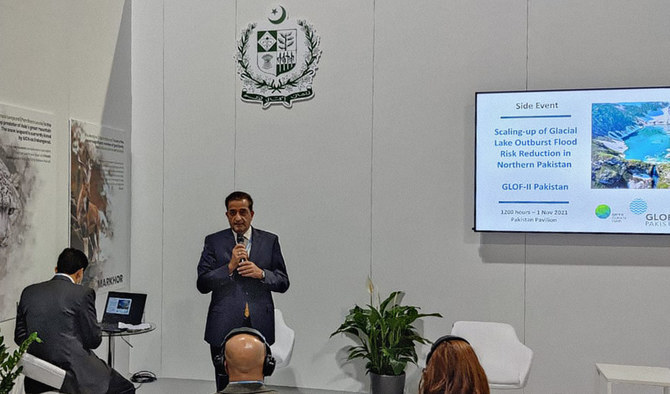
Malik Amin Aslam, SAPM on climate change, speaks at the United Nations Climate Change Conference in Glasgow, Scotland on November 1, 2021. (Photo courtesy: @ClimateChangePK/Twitter)
Short Url
Updated 02 November 2021
Follow

Pakistan highlights livelihood challenges in Asia at global climate change summit

  • Malik Amin Aslam tells COP26 conference in Glasgow his region is becoming more vulnerable to the risk of flooding due to climate change
  • According to a German think tank, Pakistan is the eighth most vulnerable country to extreme weather patterns

ISLAMABAD: The lives and livelihoods of Asian nations have become vulnerable to flooding due to the risk of climate change, said a senior Pakistani official on Monday who is representing his country at the UN Climate Change Conference in Glasgow.

World leaders have gathered in Scotland’s port city to attend the COP26 climate summit amid increasing skepticism regarding their ability to take measures required to address the dangers of global warming.

The conference will continue until November 12, 2021, under the presidency of the United Kingdom.

While addressing a session, Accelerating Adaptation in Asia through large-scale Nature-based Solutions, Malik Amin Aslam, adviser to Pakistan's prime minister on climate change, said the Asian Development Bank in its latest studies had ranked his country among the most vulnerable places in Asia.

“There’s a consistency in the global climate models, showing that the climate breakdown is all set to translate into more floods because of more intense rainy seasons in Asia in the coming years,” he said. “As a result, millions are most likely to see their homes, all their belongings and livelihoods destroyed when floods sweep, chiefly during summer wet seasons.”

The prime minister’s adviser expressed his concern over “inadequate allocations” of mere 25 percent of the total global climate finance for adaptation needs of the climate-vulnerable developing countries, including Pakistan.

He urged rich countries, widely blamed for the global climate crisis, to increase climate finances up to 60 percent for adaptation needs of the poor countries, saying it was critical for them to be able to adjust to the fallouts of the global climate crisis.

“More visibly, now nature is brutally revenging upon the lives and livelihoods of us all through unstoppable colossal floods, suffocating heat waves, surging wildfires, devouring sea intrusions and vanishing groundwater,” he continued.

A German think tank, Germanwatch, in January this year described Pakistan as the eighth most vulnerable country to climate change, having witnessed 173 extreme weather events and suffered an estimated loss of $3.8 billion between 2000 and 2019.


Pakistani president arrives in Iraq to deepen trade, energy cooperation

Updated 20 December 2025
Follow

Pakistani president arrives in Iraq to deepen trade, energy cooperation

  • Visit follows recent high-level contacts as Islamabad seeks to expand limited commercial ties with Baghdad
  • Talks are expected to cover investment, manpower and facilitation of Pakistani pilgrims visiting holy sites in Iraq

ISLAMABAD: President Asif Ali Zardari arrived in Iraq on Saturday on an official visit aimed at expanding cooperation in trade, energy and investment, as Pakistan seeks to deepen ties with Baghdad after years of limited engagement.

Pakistan and Iraq established diplomatic relations in 1947 and have traditionally maintained cordial ties, though commercial links remain modest, with officials and business groups identifying scope for cooperation in construction services, pharmaceuticals, manpower and agricultural exports.

“President Asif Ali Zardari arrived in Baghdad on a four-day official visit to Iraq,” his office said in a post on X. “He was received by Culture Minister Dr. Ahmed Fakkak Al-Badrani. During the visit, meetings with senior Iraqi leadership are expected to advance cooperation and further strengthen Pakistan-Iraq relations.”

Zardari’s visit follows a series of recent high-level contacts between the two countries, reflecting efforts to broaden bilateral engagement beyond traditional diplomatic ties and explore collaboration across economic, political and people-to-people domains.

According to Pakistan’s foreign office, the president is expected to hold meetings with Iraq’s senior leadership to discuss cooperation in various areas such as trade and investment, energy, technology, education and manpower.

He is also expected to discuss regional and international issues with Iraqi officials.

Earlier this month, Pakistan’s Interior Minister Mohsin Naqvi met his Iraqi counterpart, Abdul Ameer Al-Shammari, on the sidelines of meetings in Brussels, where both sides agreed to enhance cooperation on security and facilitate travel for Pakistani Shia pilgrims to Najaf and Karbala.

The two officials discussed measures to ensure the smoother movement of these pilgrims and their compliance with visa regulations.