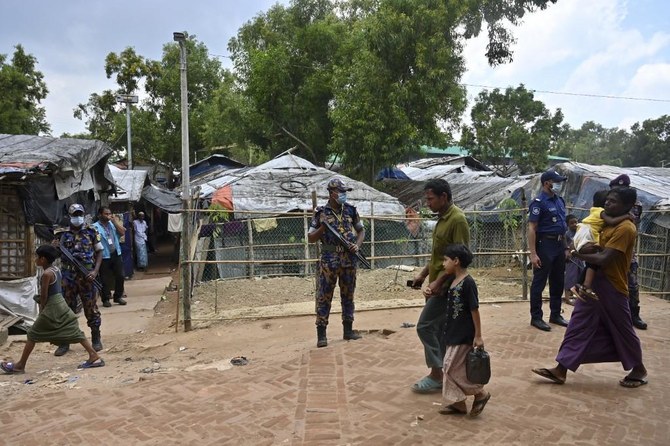
COX’S BAZAR, Bangladesh: Bangladesh police have arrested 172 Rohingya in recent weeks after a crackdown sparked by the brutal murder of a prominent community leader, the force said Monday.
Mohib Ullah was shot dead in late September in a refugee camp near the port city of Cox’s Bazar, in a region home to over 700,000 members of the stateless Muslim minority who fled a 2017 military crackdown in Myanmar.
The 48-year-old teacher was a respected advocate for the community but in the weeks before his assassination he had been the target of death threats from the Arakan Rohingya Salvation Army (ARSA) militant group.
Among those arrested in the weeks since were 10 suspected of involvement in the killing, said Naimul Haque, commander of the elite Armed Police Battalion (APB).
“Our drives against the miscreants in the camps will continue,” he added.
Another 114 people taken into custody had declared themselves ARSA members, Haque’s unit said in a statement.
Bangladesh routinely denies that the insurgents operate in the refugee camps, claiming instead that criminals involved in armed violence and drug trafficking use the group’s name to trade on their reputation.
But Ullah’s family and colleagues have blamed the group for his murder, an allegation that ARSA denies.
Police have also relocated more than 70 people, including the slain advocate’s family and relatives of seven people shot dead last month in an assault on an Islamic school — another attack blamed on the militants.
“All the families of the victims were terrified after these incidents,” senior officer Kamran Hossain said.
Nurul Islam, a Rohingya refugee whose son was killed in the school attack, said his family felt too afraid to remain in the camps.
“All Rohingya are unsafe from ARSA,” he said by phone. “They want to kill us, they want instability.”
The UN refugee agency has also helped move some refugees to “safe locations” since Ullah’s killing, UNHCR spokeswoman Regina De la Portilla said.


Bangladesh arrests more than 170 Rohingya after leader’s murder
https://arab.news/2bkgt
Bangladesh arrests more than 170 Rohingya after leader’s murder

- Mohib Ullah was shot dead in late September in a refugee camp near the port city of Cox’s Bazar


Indonesia becomes first Asian country to ban elephant rides
- Elephant-ride ban is nationwide, including in popular holiday destination of Bali
- Animal rights group urges officials in Thailand, Nepal, India to follow Indonesia
JAKARTA: Indonesia has banned elephant rides, becoming the first Asian nation to outlaw the popular tourist activity on animal welfare grounds.
Indonesia, home to the critically endangered Sumatran elephant and the endangered Bornean elephant, first announced the nationwide ban in December, with authorities gradually monitoring compliance since the start of this year.
The move followed widespread calls to ban elephant rides, with many Indonesians now using social media to alert authorities on sites still offering such activities especially in Bali, the country’s most popular holiday island.
All of Bali’s conservation sites, including Bali Zoo and Mason Elephant Park & Lodge, have officially banned elephant rides by the end of January, according to the Bali Natural Resources Conservation Agency.
“Based on our most recent monitoring, all five of the conservation sites in Bali have complied and are no longer offering elephant rides for visitors,” Ratna Hendratmoko, who heads the agency, told Arab News on Tuesday.
Elephant rides were a popular tourist attraction in Bali, which last year welcomed nearly 7 million foreign visitors.
“There was demand from visitors, tourists, who are enthusiastic and attracted to elephant rides, even if it’s just for 10 to 15 minutes.
“But maybe for them, it’s an opportunity to show off on social media, showing that they’re doing something that they think it’s cool, something that not many others can do,” Hendratmoko said.
“I’m thankful to online friends who have been raising their concerns and reminding us to continue our monitoring. We are giving our best to do our job.”
Indonesian authorities are urging conservation sites to prioritize animal welfare, offer educational activities for visitors and shift to “innovative and non-exploitative” attractions, such as wildlife observation without direct physical contact.
In November, an investigation by the rights group People for the Ethical Treatment of Animals, showed that elephants in Bali are routinely chained and beaten with sharp bullhooks to force them to obey for tourist rides.
The action that followed “puts Indonesia at the forefront of elephant welfare,” and makes it “the first country in Asia to ban elephant rides nationwide,” said Jason Baker, president of PETA in Asia.
The ban is “a huge step toward improving the treatment of elephants,” PETA Asia said in a statement to Arab News.
“We are optimistic that the new guidelines will provide a framework for phasing out all harmful practices in the future.”
Elephant camps are also major tourist attractions in other parts of Asia, with Thailand being their largest promoter.
“We urge the Thai government and other countries, including Nepal, Laos and India to follow Indonesia’s lead,” PETA said.


