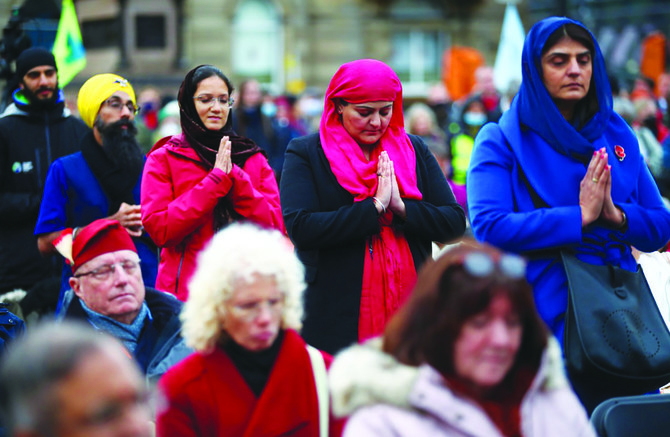

GLASGOW: Global COP26 climate negotiations are the “last, best hope” to keep the goal of limiting global warming to 1.5 C alive, said summit president Alok Sharma as he opened the meeting on Sunday.
The Glasgow gathering, which runs until Nov. 12, comes as an accelerating onslaught of extreme weather events across the world underscores the devastating impacts of climate change from 150 years of burning fossil fuels.
“We know that our shared planet is changing for the worse,” Sharma said at the opening ceremony, as protesters gathered in the Scottish city to pile pressure on governments.
Experts warn that only transformative action in the next 10 years will help stave off far more cataclysmic impacts. And the warming of the planet did not pause for the COVID-19 pandemic, which caused the UN meeting to be delayed by a year.
The last year alone has seen a once-in-a-thousand-years heatwave and scorching wildfires in North America, extreme rainfall and flooding in Asia, Africa, the US and Europe and severe drought in Madagascar, which Sharma said has been referred to as the “first climate-induced famine.”
UN climate chief Patricia Espinosa told the gathering that the world must deliver on large-scale reductions of emissions to limit global warming to 1.5 C, or “accept that humanity faces a bleak future on this planet.”
Her comments came as the World Meteorological Organization published its 2021 report on the State of the Global Climate in which it warned “extreme events,” such as Hurricane Ida in the US and the Algeria wildfires which killed 90 people this year, “are the new norm.”
We know that our shared planet is changing for the worse.
Alok Sharma, COP26, president
The report, which includes data on temperature, CO2 emissions, rain fall, and sea levels, right up to the end of September 2021, said global warming levels will increase by the end of this century far in excess of the Paris Agreement targets of 1.5 to 2 degrees unless action is taken at COP26.
In August a bombshell “code red” report from the world’s top climate science body warned that Earth’s average temperature will hit the 1.5 C threshold around 2030, a decade earlier than projected only three years ago. And last week a UN report said even the latest, most ambitious carbon-cutting commitments would still lead to “catastrophic” warming of 2.7C.
Much of the world’s hopes for wrestling down emissions rest on the G20 richer nations — whose leaders met in Rome at the weekend and whose economies account for about 80 percent of carbon pollution. They committed to the key goal of limiting global warming to 1.5 C and pledged to bring a halt to international funding for coal plants without emissions capture facilities.
They also pledged to reach a target of net zero carbon emissions “by or around mid-century,” falling short of setting a clear 2050 date, as campaigners and summit host Italy were hoping for.
More than 120 heads of state and government will make the trip to Glasgow for the UN meeting, including US President Joe Biden, France’s Emmanuel Macron, India’s Narendra Modi and Australia’s Scott Morrison.
But President Xi Jinping of China has not left his country during the pandemic and will not be traveling to Glasgow. Vladimir Putin of Russia will also be a no-show.
Sharma said more than 21,000 representatives from governments were registered, as well as nearly 14,000 observers and 4,000 media representatives.
With poorer nations least responsible for greenhouse gas emissions hit hardest by its impacts, inequality overshadows the COP26 negotiations.
The failure of rich countries to cough up $100 billion a year starting in 2020 to help developing nations lower emissions and adapt — a pledge first made in 2009 — will complicate the already fraught talks.