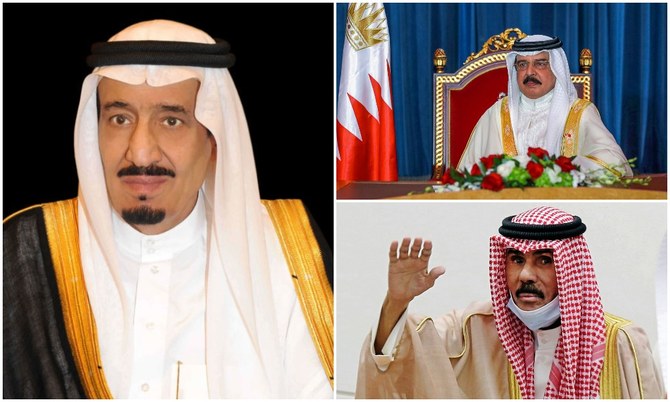
Saudi Arabia’s King Salman thanks leaders of Kuwait, Bahrain for Lebanon stance
King Salman said the stances of Kuwait and Bahrain reflect solidarity with the Kingdom
Lebanese information minister George Kordahi had said that the Iran-aligned Houthis were defending themselves
Updated 31 October 2021
Arab News
RIYADH: Saudi Arabia’s King Salman thanked the leaders of Kuwait and Bahrain for measures taken by their countries in response to comments made by the Lebanese information minister.
During separate phone calls with Kuwait’s Emir Sheikh Nawaf Al-Ahmad Al-Sabah and Bahrain’s King Hamad, the King said the stances of their countries reflect solidarity with the Kingdom and the unity of the Gulf Cooperation Council.
A video of Lebanese information minister George Kordahi saying that the Iran-aligned Houthis were defending themselves and calling the war in Yemen “futile” emerged on Tuesday.
Kordahi also described the war in Yemen as a Saudi “aggression.”
Bahrain gave the Lebanese ambassador to the country 48 hours to leave on Friday after Saudi Arabia recalled its ambassador to Lebanon for consultations, requested the departure of Lebanon's envoy to the Kingdom, and banned Lebanese imports hours earlier.
Kuwait followed suit on Saturday and summoned its ambassador to Lebanon for consultations and requested the departure of Lebanon’s charge d’affaires within 48 hours.
The king of Bahrain reiterated the depth of relations between his country and the Kingdom and the unity of the GCC countries.
Kuwait’s emir said that measures taken by his country affirm the unity of GCC countries and the depth of brotherhood among its peoples.
From leather crafts and archery to Saudi coffee, Minzal offers a lesson in ‘Sloum Al-Arab’
Updated 07 January 2026
Haifa Alshammari
RIYADH: This season of Minzal places social norms and traditional etiquette at its center, with tents set up to teach what is locally known as “Sloum Al-Arab” alongside gatherings for coffee, dinner and stargazing around campfires.
“Sloum Al-Arab” refers to the unwritten customers and values that have shaped Arab and Bedouin society for centuries, including generosity, coffee preparation, courage and archery.
In Saudi Arabia, these traditions are closely ties to cultural identity and religious belief.
Leather products and the making of leather goods is one of the crafts featured at Minzal this year and is one of the oldest crafts still practiced in the kingdom.
“The most difficult thing I faced to work on was camel leather because it is a little tough,” Nada Samman, a leather trainer and craftsman at Minzal, told Arab News.
Minzal continues to evolve with each season, offering activities that highlight Bedouin values, traditional skills and sports. (AN photo by Haifa Alshammari)
“The work on leather is wonderful whether it is goat leather, cow leather, Sawakni sheep, and of course, camel leather. At Minzal, we are offering multiple handicraft workshops, most specifically the leather handicrafts. We want visitors to spend time at something useful and fun."
Samman explained the workshops allowed participants to preserve heritage while engaging in meaning, hands on activities.
Faisal Al-Khaled, a visual artist and craftsman specializing in Saudi designs at Minzal, shared a similar goal: “I want people to have, by the end of this experience, a unique and traditional art piece created by them, and that I know I helped them to preserve this craft.”
Minzal, which has been organized for several years now, continues to evolve with each season, offering activities that highlight Bedouin values, traditional skills and sports. Archery is a key feature, reflecting its deep roots in Arab and Islamic history.
Mohammed Al-Sharif, a certified archery player and coach with the Saudi Archery Federation since 2028, said the sport was closely connected to Saudi culture. It was encouraged by the Prophet Muhammad, which led people to learn and teach it through generations.
“Our traditional bow is considered one of the most important and widely used bows in Arab culture,” Al-Sharif said. “We have several styles, and professional archers specializing in traditional bow shooting … There are various types of archery, such as horseback archery and standing archery, where bow sizes vary according to specific needs, such as types used for hunting and others used during warfare.”
He explained that archery was historically part of daily life, used for protection and hunting.
Saudi coffee also plays a significant role in the Minzal experience, with live demonstrations. One of the most frequently consumed beverages in the Kingdom, it is a symbol of hospitality and generosity.
Ahmed Al-Shuaibi explained how it was prepared at the Sloum tent, first by roasting the beans and then allowing them to cool. The beans are ground with spices in a Nigr.
“Coffee is passed from our grandparents,” he added. “In significant majlis, you see them offering our local coffee and not other types of coffee. We organized this corner so that young generations can visit and learn this.”