

Four children killed in Houthi mortar strike in Yemen

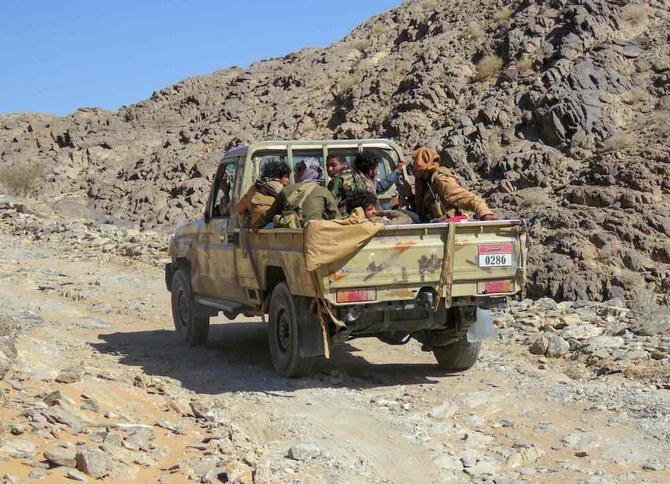
Fighters loyal to the Yemeni government deploy in a position of the Al-Juba frontline, facing Iran-backed Houthi militants in the northeastern province of Marib, on Oct. 24, 2021. (AFP)
Short Url
Updated 30 October 2021
Follow

Four children killed in Houthi mortar strike in Yemen

  • Residents said targeted area is not close to battlefields or military bases under government’s control
  • Shelling is latest in series of deadly strikes by Houthis on residential areas in Taiz

AL-MUKALLA: Four children were killed and two more wounded when a mortar shell fired by the Iran-backed Houthis on Saturday struck a residential area in the city of Taiz, in southern Yemen, residents said.

The six children, belonging to the same family, were playing in front of their house when the shell exploded, Ahmed Mansour, a local medic, told Arab News by telephone.

Residents said the targeted area is not close to the battlefields or military bases under the government’s control, adding that the shell was fired from a Houthi-controlled base east of Taiz.

The shelling is the latest in a series of deadly strikes by the Houthis on residential areas in Taiz that have killed dozens of civilians.

The attack came as local authorities in the central province of Marib announced that the death toll from the Houthi missile strike on the house of a tribal leader in Marib’s Juba district on Thursday evening had risen to 13 civilians. The bodies of seven unidentified civilians have been retrieved from the debris of the house.

The tribal leader, Abdul Latif Al-Qibli Namran, who survived the attack, vowed to fight off the Houthi attacks in Marib province till they are defeated. “We will fight as long as we breathe till victory is achieved,” he said.

Yemen’s Prime Minister Maeen Abdul Malik Saeed, who called Namran to offer his condolences, strongly condemned the Houthi attacks and vowed to make the Houthi militia “pay the price for crimes against civilians and the displaced,” the official news agency SABA said.

Juba has a large concentration of internally displaced people who fled fighting or Houthi repression.

As fighting between the government troops and the Houthis intensified in the district, local aid organizations and officials warned of a big humanitarian crisis as a large number of families are trapped with limited humanitarian assistance.

Local officials said on Saturday that the Houthi had intensified missile and mortar strikes on government-controlled areas in Juba to pave the way for their ground forces to advance.

Separately, the US special envoy for Yemen, Timothy Lenderking, on Saturday accused the Houthi of obstructing peace efforts to end the war and fueling the humanitarian crisis.

“Houthi escalation in Marib is not just an obstacle to peace, it is exacerbating a humanitarian situation already on the brink,” Lenderking said while discussing humanitarian crisis in Yemen with NGOs, according to the US State Department’s Bureau of Near Eastern Affairs.


France, allies preparing bid to ‘gradually’ reopen Strait of Hormuz: Macron

Updated 3 sec ago
Follow

France, allies preparing bid to ‘gradually’ reopen Strait of Hormuz: Macron

ABOARD FRENCH AIRCRAFT CARRIER CHARLES DE GAULLE: France and its allies are preparing a “defensive” mission to reopen the strategically vital Strait of Hormuz, President Emmanuel Macron said Monday as the Middle East war entered its second week.
The French leader landed by helicopter on the Charles de Gaulle aircraft carrier, dispatched to the Mediterranean after US-Israeli strikes on Iran on February 28 triggered a war that has sown regional chaos and which threatens to spill into other parts of the world.
Macron said during a visit to Cyprus earlier in the day that the Hormuz mission would be aimed at escorting container ships and tankers in order to gradually reopen the strait “after the end of the hottest phase of the conflict.”
“This is essential for international trade, but also for the flow of gas and oil, which must be able to leave this (Gulf) region once again,” Macron said during a visit to the island to discuss regional security.
Speaking alongside Cypriot President Nikos Christodoulides and Greek Prime Minister Kyriakos Mitsotakis, Macron said a “purely defensive, purely support mission” will be put together by European and non-European states.
The European Union on Monday said it was ready to “enhance” its operations to protect maritime traffic in the Middle East.
The EU has been discussing reinforcing its naval mission in the Red Sea after the US-Israeli attacks on Iran triggered a broader regional war.
Maritime traffic in the Strait of Hormuz, a key Gulf waterway through which a fifth of global crude passes, has all but halted since the war broke out.
Macron visited Cyprus after the EU member was targeted by Iranian-made drones last week.
The French leader said an attack on Cyprus was an attack on all of Europe.
“When Cyprus is attacked, it is Europe that is attacked,” he said.
The drone attack in Cyprus led to France’s deployment of the Charles de Gaulle carrier to the Mediterranean, as well as a frigate and air defense units to the island.
Paris has insisted its stance in the region is “strictly defensive.”

- Bombing won’t bring change -

The initial US-Israeli strikes on Iran killed supreme leader Ali Khamenei, and the Islamic republic on Monday named his son, Mojtaba Khamanei, as his successor — an appointment US President Donald Trump said he was “not happy” with.
Aboard the Charles de Gaulle, Macron said the conflict’s duration depended on what US-Israeli objectives were, warning that “profound” changes to the Iranian leadership could not occur “through American-Israeli bombings alone.”
“We are putting ourselves in a position to last,” he said, adding that the war, “in this intense phase,” could last “several days, perhaps several weeks.”
The flagship Charles de Gaulle may eventually be deployed to the Strait of Hormuz as part of the announced mission, Macron said.
A French frigate was already taking part in the EU’s Operation Aspides, which was launched in the Red Sea in 2024 to prevent attacks on trade vessels by Iran-backed Houthi rebel forces.
Macron earlier said that France would contribute “in the long term” with two frigates to Operation Aspides.
“What we want to do is to ensure freedom of navigation and maritime security,” he said.
Separately, the French president on Monday morning spoke to Israeli Prime Minister Benjamin Netanyahu about the situation in the Middle East and Lebanon, the Elysee said.