



WASHINGTON: A Pakistani held at the US military prison in Guantanamo Bay, Cuba, told a sentencing jury how he was raped, beaten and waterboarded by CIA interrogators in the first-ever public account of torture by someone detained in the wake of the September 11 attacks.
Majid Khan was sentenced to 26 years in prison by the jury Friday afternoon after he pleaded guilty to helping in Al-Qaeda plots in 2002, according to a spokesman for the military commissions at Guantanamo.
Based on an earlier plea deal, he could be freed as early as next year, after spending 19 years in US custody.
The sentence came after his excruciating account on Thursday of being submitted to three years of CIA abuse — testimony never before allowed in the military commissions.
Khan was allowed to tell his story as a part of his plea deal, agreeing not to divulge classified information.
He told the court of being held for days partially suspended by chains, without food or clothing, in dark cells while loud music blasted and guards doused him with ice water.
In CIA dark sites in unidentified countries, he said, he was placed hooded in a bathtub filled with ice water and had his head held under water.
From the first days of his capture in Karachi on March 5, 2003, Khan said he admitted to interrogators that he had worked with Al-Qaeda and provided them with information on the group.
“Whenever I was being tortured, I told them what I thought they wanted to hear. I lied just to make the abuse stop,” he said in the 39-page statement that was posted online afterward by his lawyers.
But, he said, “the more I cooperated and told them, the more I was tortured.”
The torture went on over three years.
He was chained to chairs or floors for days on end. Interrogators threatened to harm his family in the United States and to rape his sister.
His glasses, without which he said he was effectively blind, were broken early on and he didn’t get a new pair for almost three years.
Days of sleep deprivation left him in a daze. “I remember hallucinating, seeing a cow, and giant lizard. I lost my grip on reality,” he said.
The worst part of his ordeal, he said, were repeated enemas and anal force-feedings that left him permanently injured.
At one point, he said, a green garden hose was forced into his rectum, ostensibly to rehydrate him.
“I was raped by the CIA medics,” he said.
Khan, who grew up in Pakistan and moved to the United States at the age of 16 when he attended high school in Baltimore, said his decision to help Al-Qaeda was poor judgment.
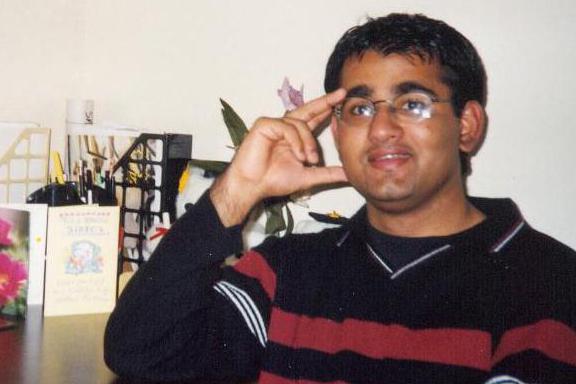
This photo provided by the Center for Constitutional Rights shows Majid Khan during his high school years in the late 1990's when he was in Baltimore. (AP)
He was recruited to help Al-Qaeda by family members in Pakistan while he was there in 2002 to find a bride.
In his 2012 plea deal he admitted to the court that he joined a plot to assassinate Pakistan’s president.
He also admitted he had couriered $50,000 to Indonesian Al-Qaeda allies that was used to fund a hotel bombing.
He said he has tried to take responsibility for his actions.
“I’m not the young, impressionable, vulnerable kid I was 20 years ago,” he told the court Thursday. “I reject Al-Qaeda, I reject terrorism.”
He added that he bore no ill will toward his captors.
“To those who tortured me, I forgive you — all of you,” he told the court.
His testimony on torture is supported by the US Senate’s own investigation of the CIA’s use of torture following the September 11, 2001 attacks.
“Majid’s powerful words ... reveal devastating atrocities committed by our own government in the name of national security,” said Katya Jestin, one of his attorneys.
“The CIA program was a failure and contrary to our democratic principles and the rule of law,” she said.


