

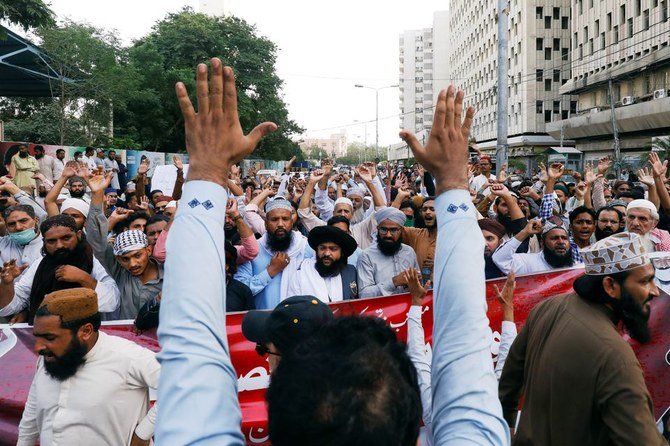

ISLAMABAD: Pakistani government representatives on Saturday held negotiations with Saad Rizvi, the incarcerated chief of the outlawed Tehreek-e-Labbaik Pakistan (TLP) behind the week-long violent protests, in Rawalpindi, the banned religious group said, with a final round of talks to broker peace expected tonight.
The government arrested Rizvi in April this year for inciting violence against the state. Thousands of his supporters have already been marching toward Islamabad, demanding his release and the expulsion of the French ambassador over the publication of anti-Islam caricatures in France last year.
The demonstrators left Lahore for Islamabad last Friday after violent clashes with law enforcement personnel and stayed in Muridke for three days, giving time to the government to meet the group’s demands.
At least five policemen have so far been killed in the clashes with TLP supporters. The demonstrators were currently camped in Wazirabad, a city some 190 kilometers from Islamabad, and waiting for a final nod from their leaders whether to return home or head forth to the federal capital.
“The TLP chief along with other central shura members held dialogue with government representatives in Rawalpindi,” the TLP said in a statement.
The government delegation comprised Foreign Minister Shah Mahmood Qureshi, National Assembly Speaker Asad Qaiser and State Minister for Parliamentary Affairs Ali Mohammad Khan.
“All demands will be announced after a final approval by the prime minister,” the banned religious group said. “A final sitting for the dialogue is expected tonight.”
The group said it was considering staying in Wazirabad for another day, apparently giving some more time to the government to meet their demands.
Also on Saturday, Prime Minister Imran Khan held a discussion with veteran religious scholars to defuse the crisis.
“A twelve-member committee [of clerics] is constituted that is in touch with both the government and the TLP leadership,” Religious Affairs Minister Noorul Haq Qadri said at a media briefing after the prime minister’s meeting with clerics.
“We are hopeful that these people will help improve the situation,” Qadri added.
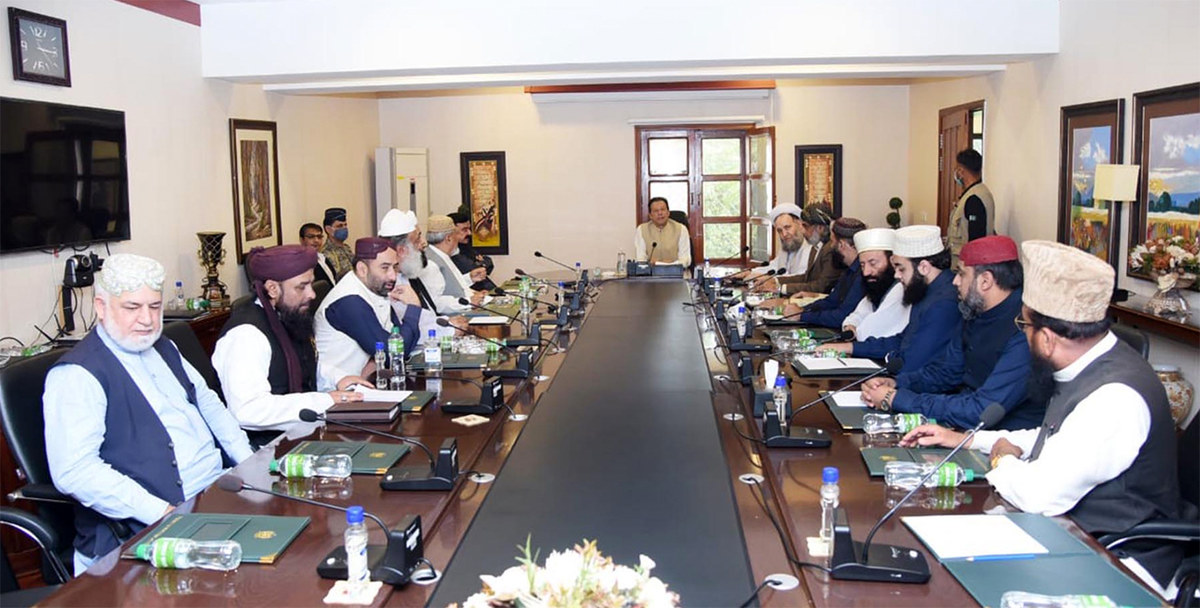
Pakistan's Prime Minister Imran Khan (center) chairs a meeting of religious scholars in Islamabad, Pakistan, on October 30, 2021. (PID)
The Punjab police said that the TLP caravan reached Wazirabad from Gujranwala on Saturday and the protesters were peacefully camped on the Grand Trunk Road.
“They are comparatively peaceful and waiting for orders from their top leadership,” Nayab Haider, a spokesperson for the Punjab police, told Arab News. “Today, they haven’t clashed with the police and appeared somewhat somber as well.”
Haider said that police and paramilitary Rangers had been deployed in Wazirabad to deal with any untoward situation, but “all is peaceful up till now.”
Days of protests have severely affected routine life, primarily in Punjab cities, as authorities blocked roads and highways to prevent the marchers from moving forward. The Pakistan Railways has also suspended twelve train services between Lahore and Rawalpindi, and rerouted several others over the last three days, according to the Express Tribune.
While Pakistani President Arif Alvi on Friday urged religious leaders to play their role in defusing the protests, members of the country’s top security body, the National Security Committee (NSC), commended the police force for showing restraint against violent TLP protesters.
“The Prime Minister stressed that no group or entity will be allowed to cause public disruption or use violence to pressure the government,” said the statement. “Taking serious note of the unprovoked violent attacks committed by TLP members, the Committee resolved not to tolerate any further breach of law by this proscribed group.”
While emphasizing that all Pakistanis had the right to peaceful protest, the statement said that TLP activists were deliberately employing violence against public property, state officials, and ordinary citizens to create instability in the country.
“All organs of the state [are] ready to act as per the law to protect the life and property of citizens,” it added.


