

Pakistan and Russia conclude negotiations on $3 billion Karachi-Lahore gas pipeline

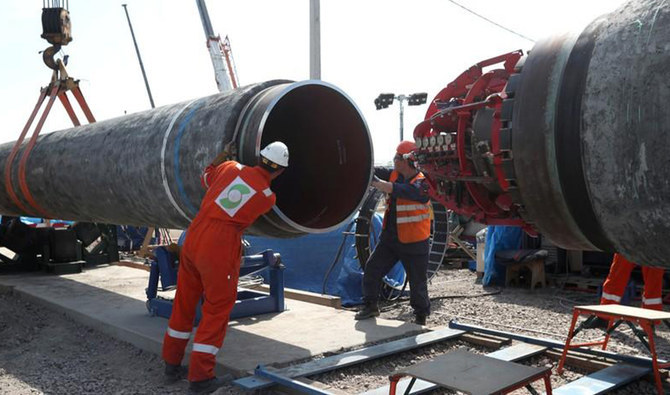
Workers are seen at the construction site of the Nord Stream 2 gas pipeline, near the town of Kingisepp, Leningrad region, Russia, June 5, 2019. (REUTERS)
Short Url
Updated 29 October 2021
Follow

Pakistan and Russia conclude negotiations on $3 billion Karachi-Lahore gas pipeline

  • The two countries have yet to sign shareholders agreement for the Pakistan Stream Gas Pipeline Project
  • Experts question the economic viability of the 56-inch diameter gas pipeline, saying it is too big for a country that faces gas scarcity

KARACHI: Pakistan and Russia agreed to finalize the shareholders agreement for the implementation of a $3 billion gas pipeline project next month as their current round of negotiations concluded on Thursday, the Pakistani energy ministry said. 

The two countries signed an inter-governmental agreement in 2015 for the construction of the Pakistan Stream Gas Pipeline project, which could carry 1.6 billion cubic feet per day (bcfd) of gas between Karachi and Lahore. 

“The parties discussed the draft Shareholders Agreement (SHA) of the Pakistan Stream Gas Pipeline Project,” the country’s energy ministry said in a statement, issued at the end of the fourth Russia-Pakistan Joint Technical Committee Meeting that began in Islamabad on October 25. 

The two sides had previously signed the heads of terms of shareholders agreement in July. They also agreed that 74 percent of the project’s shares would remain with Pakistan, while the rest of 26 percent would go to Russia. 

“The parties held in-depth discussions covering all major issues pertaining to the SHA in a cordial and congenial environment and developed consensus on key issues,” the statement said. 

It informed that the two sides would “resume negotiations in Islamabad from the week starting 8th November, 2021.” 

According to the understanding between the two sides, the pipeline will have a 56-inch diameter to cater to Pakistan’s energy requirements for the next 30 to 40 years. 

The official cost of the project has not been disclosed, but a petroleum ministry official who declined to be named suggested it could be somewhere between $2 billion to $3 billion. 

As the two sides negotiate the agreement, experts question economic viability of the pipeline with 56-inch diameter. 

“There are very few pipelines of such diameter in the world and they are usually cross-country pipelines that supply gas from one state to another,” Syed Kamran Ali, an energy consultant, told Arab News.  

“The price of the project of such caliber should be around $5 billion. Ideally, under the current situation where there is scarcity of gas, the country should have opted for a 48-inch diameter of pipeline to cater to its long-term requirements.” 

However, the energy ministry said both sides exchanged views on the best practices to finance similar infrastructure projects globally. 

The pipeline project is viewed as a flagship initiative that can further strengthen bilateral relations between Pakistan and Russia. 

The meeting was also attended by senior officials belonging to the Pakistani ministries of finance, foreign affairs and law and justice. 

Other participants belonged to the Securities and Exchange Commission of Pakistan, Oil and Gas Regulatory Authority, Inter-State Gas System, Government Holding Private Limited and the Petroleum Division. 


Government says Pakistan’s IT exports hit record monthly high in December

Updated 20 January 2026
Follow

Government says Pakistan’s IT exports hit record monthly high in December

  • Finance adviser says IT exports crossed $400 million for first time in a month
  • Pakistan aims to double exports to $60 billion in four years, with IT a key driver

ISLAMABAD: Pakistan’s information technology exports climbed to a record $437 million in December, crossing the $400 million mark for the first time on a monthly basis, the government’s finance adviser Khurram Schehzad said in a social media post on Monday.

The surge underscores the growing role of the tech sector as Pakistan seeks to boost exports while emerging from a prolonged economic crisis that drained foreign exchange reserves, widened balance-of-payments pressures and weakened the currency.

The government is now aiming for export-led growth as part of broader structural reforms under a $7 billion International Monetary Fund (IMF) loan program.

“December 2025 exports reached $437 million — crossing $400 million in a month for the first time ever,” Schehzad said in a post on X, adding that this represented 23 percent month-on-month growth from November and 26 percent year-on-year growth compared with December 2024.

For the first half of the current fiscal year, IT exports reached $2.24 billion, up 20 percent from a year earlier, making the sector the largest and most consistent contributor within services exports, he said.

Pakistan has been under pressure to sharply lift exports as it works to stabilize its economy.

Earlier this month, Planning Minister Ahsan Iqbal said the country must double its exports to $60 billion within four years or risk returning to the IMF.

Pakistan’s IT exports have been on a steady upward trajectory in recent years. They reached a record $3.8 billion in the 2024–25 financial year, according to official data.

The momentum has carried into the current fiscal year, with IT exports posting 19 percent year-on-year growth during the first five months from July to November.

Exports during the period stood at $1.8 billion, according to data released by the State Bank of Pakistan.

The government has said it sees the technology sector as a key driver of foreign exchange earnings and job creation as Pakistan seeks to lock in recent macroeconomic gains and attract new investment.