

Bangladesh to launch Myanmar curriculum for Rohingya refugee children

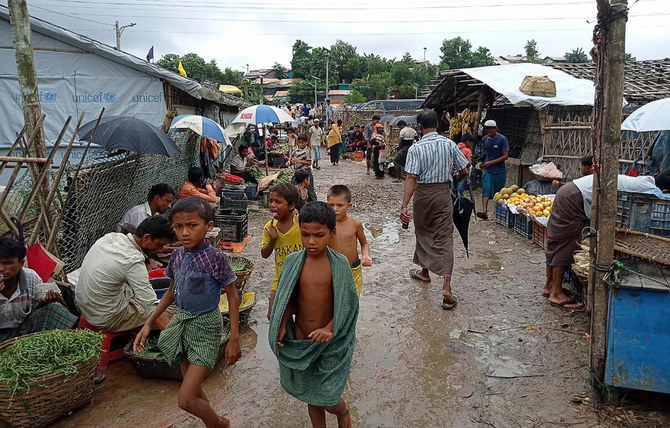
Bangladesh authorities and the UN will start a formal education program using Myanmar curriculum to benefit Rohingya children at refugee camps in Cox’s Bazar. (File/AFP)
Short Url
Updated 27 October 2021
Follow

Bangladesh to launch Myanmar curriculum for Rohingya refugee children

  • Stalled by COVID-19 lockdowns, pilot program now set to swing into action

DHAKA: Bangladeshi authorities and the UN are preparing to introduce formal education using a Myanmar curriculum for hundreds of thousands of Rohingya children living in refugee camps in Cox’s Bazar.

The fishing port in southeastern Bangladesh, hosts more than 1.1 million Rohingya Muslims — members of an ethnic and religious minority group who fled persecution in neighboring Myanmar during a military crackdown in northern Rakhine state in 2017.

The children, who constitute half of the refugee population, now attend 6,250 informal learning centers run by UN agencies and aid partners at 34 camps in Cox’s Bazar, which provide basic education to more than 354,000 students.

The Bangladeshi government in January 2020 agreed with the UN that the Rohingya children should be provided with Myanmar education to prepare them for a future return to their country. Stalled by coronavirus disease pandemic lockdowns for one-and-half years, a pilot program is now set to be launched as Bangladeshi schools reopened last month.

Regina de la Portilla, UN refugee agency spokesperson at Cox’s Bazar, recently told Arab News: “The Myanmar curriculum is to be introduced in learning centers, as per the government of Bangladesh request, with the objective that children can restart their education when they are able to safely and voluntarily return to their home country. Preparations are completed to roll out the pilot.”

The foreign ministry expected the program to be launched soon as final preparations are underway. A ministry official, who wished to remain anonymous, said: “We are working on it and are currently busy with last-minute preparations. We hope to roll out the curriculum anytime soon.

“We have made some observations in the curriculum to incorporate Myanmar culture. Our objective is to prepare them to integrate with the Myanmar society once they are repatriated,” he said.

BRAC, the largest development organization based in Bangladesh, which has been running learning centers for 65,000 Rohingya children in Cox’s Bazar, plans to teach them in Myanmar’s main language, Burmese.

Khan Mohammed Ferdous, BRAC’s education program chief at Cox’s Bazar, told Arab News: “Teachers at our learning centers have received basic training but are yet to be trained for the new curriculum.

“Currently, we are following a learning competence framework and approach, a government-approved guideline for the informal education system. Gradually, the framework will jump into the Myanmar curriculum.”

Rohingya parents in Cox’s Bazar are waiting for the introduction of the new curriculum, which would help prepare them for future repatriation.

Fatema Begum, 35, said she had been worrying about her four children as formal education was not available at the camps.

“The introduction of the Myanmar curriculum in the camps is inspiring news to me because my children will have the opportunity to learn more about their homeland. They will have the eligibility to pursue higher education,” she added.

Abdur Rahim, 41, a father-of-three, was also hoping for a better future for his children.

He said: “The boys and girls at Rohingya camps have nothing to do except roam around. When the Myanmar curriculum is launched, they will be able to receive some quality education, which will help them to pursue a better career in Myanmar.”

Prof. Amena Mohsin from the University of Dhaka’s international relations department described the move as a “message” to the world that Rohingya refugees were Myanmar citizens whose opportunities in Bangladesh were limited.

She said: “There is no point in teaching the refugee children with the Bangladeshi curriculum since they are not allowed to get engaged in any formal job in Bangladesh. The Myanmar curriculum will help them prepare for livelihoods when they return to Myanmar.”


National security trial for Hong Kong’s Tiananmen vigil organizers to open

Updated 4 sec ago
Follow

National security trial for Hong Kong’s Tiananmen vigil organizers to open

  • Three government-vetted judges will preside over the trial, which is expected to last 75 days

HONG KONG: Two pro-democracy activists behind a group that for decades organized a vigil that commemorated people killed in Beijing’s Tiananmen Square crackdown in 1989 will stand trial on Thursday, in another landmark case brought under a China-imposed national security law that has practically crushed protests in the semiautonomous Chinese city.
Critics say their case shows that Beijing’s promise to keep the city’s Western-style civil liberties intact for 50 years when the former British colony returned to Chinese rule in 1997 has weakened over time. But the city’s government said its law enforcement actions were evidence-based and strictly in accordance with the law.
Chow Hang-tung and Lee Cheuk-yan, former leaders of the Hong Kong Alliance in Support of Patriotic Democratic Movements of China, were charged with incitement to subversion in September 2021 under the law. They are accused of inciting others to organize, plan or act through unlawful means with a view to subvert state power, and if convicted, they face a maximum penalty of 10 years in prison.
A third leader of the group, Albert Ho, is expected to plead guilty, his lawyer said previously. This might result in a sentence reduction.
Before sunrise, dozens of people were in line outside the court building to secure a seat in the public gallery under a cold-weather warning.
Tang Ngok-kwan, a former core member of the alliance, has been queuing since Monday afternoon. He said he wanted to show support for his former colleagues in detention.
“They use their freedom to exchange for a dignified defense,” he said. “It’s about being accountable to history.”
Former pro-democracy district councilor Chan Kim-kam, a former vigil-goer and also Chow’s friend, stayed awake the whole night outside the building.
“We need to witness this, regardless of the results,” she said.
Trial expected to last 75 days
Three government-vetted judges will preside over the trial, which is expected to last 75 days. Videos related to the alliance’s years of work will be part of the prosecution evidence.
Chow, also a lawyer defending herself, tried to throw out her case in November, arguing the prosecution had not specified what “unlawful means” were involved. But the judges rejected her bid.
The judges explained their decision on Wednesday, saying the prosecution made it clear that “unlawful means” meant ending the Chinese Communist Party’s rule and violating the Chinese constitution. The prosecution accused the defendants of promoting the call of “ending one-party rule” by inciting people’s hatred of and disgust over the state’s power, the judges said.
The prosecution, they said, had pointed to the defendants’ media interviews and public speeches related to the alliance to sustain the group’s operation and promote that call to others after the security law took effect in June 2020. Although the scope of the charge was relatively wide, the prosecutors had provided sufficient details for the defendants, they added.
The court will not allow the trial to become a tool of political suppression in the name of law, the judges said.
Prosecutors are expected to detail their case this week.
Urania Chiu, lecturer in law at Oxford Brookes University, said the case goes to the heart of freedom of expression.
“The prosecution case hinges on the argument that the Alliance’s general call for ‘bringing the one-party rule to an end’ constitutes subversion without more, which amounts to criminalizing an idea, a political ideal that is very far from being actualized,” she said.
Sarah Brooks, Amnesty International’s Deputy Regional Director, alleged the case was about “rewriting history and punishing those who refuse to forget the victims of the Tiananmen crackdown.”
Alliance’s disbandment a blow to civil society
The alliance was best known for organizing the only large-scale public commemoration of the 1989 crackdown in China for decades. Tens of thousands of people attended it annually until authorities banned it in 2020, citing anti-pandemic measures.
After COVID-19 restrictions were lifted, the park was occupied instead by a carnival organized by pro-Beijing groups. Those who tried to commemorate the event near the site were detained.
Before the alliance voted to disband in September 2021, police had sought details about the group, saying they had reasonable grounds to believe it was acting as a foreign agent. The alliance rejected the allegations and refused to cooperate.
Chow, Tang, another core member of the alliance were convicted in a separate case in 2023 for failing to provide authorities with information on the group and were each sentenced to 4 1/2 months in prison. But the trio overturned their convictions at the city’s top court in March 2025.
Chow, Lee and Ho have been in custody, awaiting the trial’s opening, which has been postponed twice.
Beijing said the 2020 security law was necessary for the city’s stability following the 2019 protests, which sent hundreds of thousands of people onto the streets.
The same law has convicted dozens of other leading pro-democracy activists, including pro-democracy former media mogul Jimmy Lai last month. Dozens of civil society groups have closed since the law took effect.