World Bank warns of inflation in low-income countries as energy prices rise

Short Url
Updated 27 October 2021
Follow

World Bank warns of inflation in low-income countries as energy prices rise

MOSCOW: Rising energy prices pose significant risks of inflation in many emerging markets and developing countries, World Bank warned on Monday.

In its semi-annual report “Commodity Markets Outlook,” the bank said the ongoing energy crunch is likely to weigh on the growth of energy-importing countries in 2022.

Energy prices are expected to increase more than 2 percent in 2022 after jumping more than 80 percent in 2021, supported by continued robust demand and gradual production gains. 

The bank has raised its forecast for average oil prices to $74/bbl in 2022 from $70/bbl in 2021 projected previously in April. Natural gas and coal prices are expected to decline only slightly in 2022 to $4/mmbtu and $3.9/mmbtu from $4.1/mmbtu in 2021, as demand growth eases and production and exports increase, driven by the US.
Prices of non-energy commodities like metals and wheat are also projected to remain at elevated levels. After rising more than 48 percent this year, metal prices are projected to decline 5 percent in 2022. Prices for US hard red wheat are projected to decrease to $250 per metric ton and $245 per metric ton in 2022 and 2023 respectively from $255/mt in 2021.  

The rally in energy prices has sharply increased agricultural input costs. This includes fertilizers, which have risen more than 55 percent since January this year, with several fertilizer manufacturers halting or reducing production capacity. Elevated food prices combined with the recent spike in energy costs is pushing food price inflation up in several low-income countries such as Ethiopia, Zambia, and Zimbabwe as well as higher-income economies including Argentina and Turkey, the report pointed out.

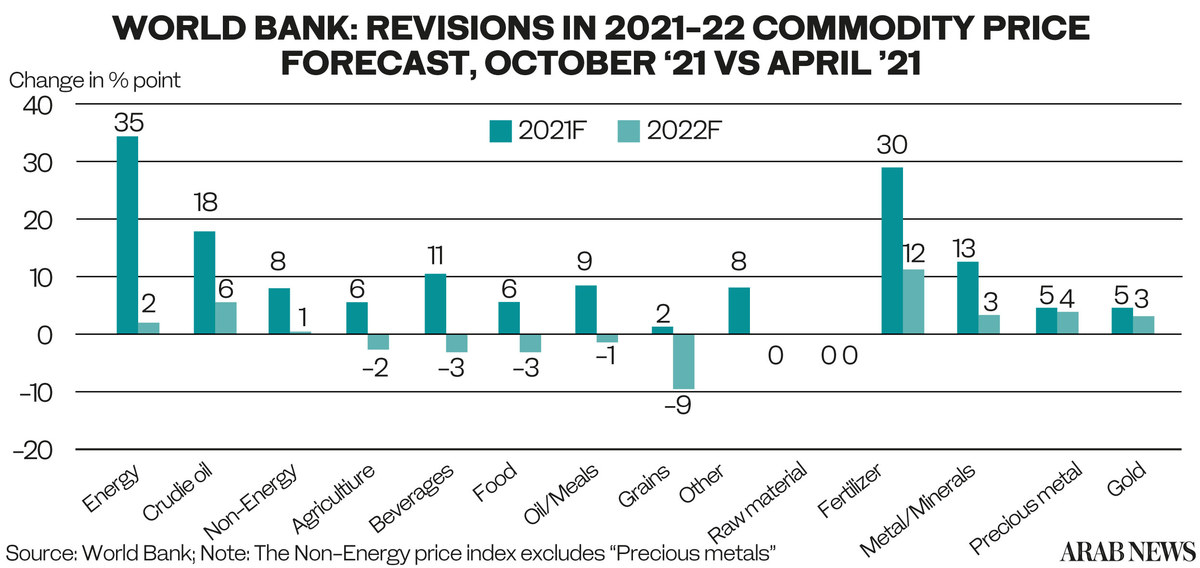
The report provided its 2022 price forecast for energy and non-energy commodity groups revised from its previous estimate published in April this year. The most notable revisions include fertilizers (+11.8 percentage points), precious metals (+4.1 ppts), metals and minerals (+3.4 ppts), grains (-9.2 ppts), beverages (-2.7 ppts).


Closing Bell: Saudi main index closes in green at 11,382 

Updated 27 January 2026
Follow

Closing Bell: Saudi main index closes in green at 11,382 

RIYADH: Saudi Arabia’s Tadawul All Share Index rose on Tuesday, gaining 111.21 points, or 0.99 percent, to close at 11,381.83. 

The total trading turnover of the benchmark index was SR6.37 billion ($1.70 billion), as 204 of the listed stocks advanced, while 56 retreated. 

The MSCI Tadawul Index also rose, adding 13.85 points, or 0.91 percent, to close at 1,533.33. 

The Kingdom’s parallel market Nomu gained 8.39 points, or 0.04 percent, to close at 23,749.38. This came as 30 of the listed stocks advanced, while 45 retreated. 

The best-performing stock was East Pipes Integrated Co. for Industry, with its share price surging 9.94 percent to SR146. 

Other top performers included Tourism Enterprise Co., which saw its share price rise by 9.93 percent to SR14.17, and Thob Al Aseel Co., which saw a 7.84 percent increase to SR3.99. 

On the downside, Saudi Arabian Mining Co. was among the weaker performers, with its share price falling 2.64 percent to SR77.40. 

Saudi Paper Manufacturing Co. saw its shares fall 2.54 percent to SR57.50, while Yamama Cement Co. declined 2.07 percent to SR27.40. 

On the announcements front, Future Vision for Health Training Co. signed a two-year cooperation agreement with King Saud University aimed at strengthening links between academia and professional readiness. 

According to a Tadawul statement, the partnership focuses on the joint development and execution of specialized training programs for university students, aiming to enhance their practical skills and employability. 

The initiative includes coordinated efforts in training design, academic supervision, and program evaluation, with the goal of better preparing graduates for the labor market. 

The agreement, which is renewable by mutual consent, is expected to start generating a positive financial impact in the second half of 2026. The company said no related parties are involved in the deal. 

The company’s share price closed at SR7.30 on Nomu, marking a 1.39 percent decrease.