

Arab leaders, Pakistan’s Imran Khan arrive in Saudi Arabia for Middle East Green Initiative Summit

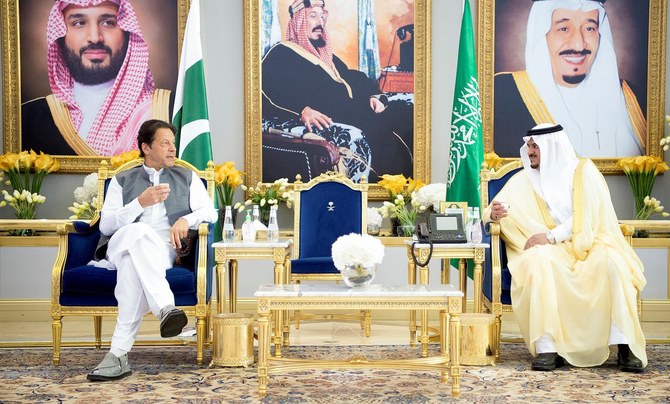
Pakistan's Prime Minister Imran Khan (left) meets Deputy Governor of Riyadh, Prince Mohammed bin Abdulrahman bin Abdulaziz in Riyadh, Saudi Arabia, on October 24, 2021. (Photo courtesy: PakPMO/Twitter)
Short Url
Updated 25 October 2021
Follow

Arab leaders, Pakistan’s Imran Khan arrive in Saudi Arabia for Middle East Green Initiative Summit

  • Libyan president and Morocco’s prime minister also arrived in Riyadh to attend the regional summit
  • The inaugural summit will see world leaders and representatives gather on Monday to define green policy solutions

RIYADH: Pakistani Prime Minister Imran Khan and his accompanying delegation arrived in the Saudi capital, Riyadh, on Sunday, to participate in the Middle East Green Initiative Summit.
Khan was received at King Khalid International Airport by Prince Mohammed bin Abdulrahman, acting governor of Riyadh, and other Saudi officials.
The inaugural summit will see world leaders and representatives gather on Monday to examine green policy solutions to climate challenges, as part of a regional initiative launched by Crown Prince Mohammed bin Salman earlier this year.

Later on Sunday, Chairman of the Libyan Presidential Council Mohamed Al-Menfi, Moroccan Prime Minister Aziz Akhannouch, and Tunisian Prime Minister Najla Bouden also arrived at King Khalid International Airport and were received by Prince Mohammed bin Abdulrahman.
The Middle East Green Initiative aims to apply a number of ambitious programs that will reduce carbon emissions by 60 percent in the region and plant 50 billion trees in the world’s biggest afforestation project.


At ECO meeting, Pakistan proposes ‘Regional Innovation Hub’ to curb natural disasters

Updated 21 January 2026
Follow

At ECO meeting, Pakistan proposes ‘Regional Innovation Hub’ to curb natural disasters

  • Pakistan hosts high-level 10th ECO Ministerial Meeting on Disaster Risk Reduction in Islamabad
  • Innovation hub to focus on early warning technologies, risk informed infrastructure planning

ISLAMABAD: Pakistan has proposed to set up a “Regional Innovation Hub on Disaster Risk Reduction” that focuses on early warning technologies and risk informed infrastructure planning, the Press Information Department (PID) said on Wednesday, as Islamabad hosts a high-level meeting of the Economic Cooperation Organization (ECO).

The ECO’s 10th Ministerial Meeting on Disaster Risk Reduction (DRR) is being held from Jan. 21-22 at the headquarters of the National Disaster Management Authority (NDMA) in Pakistan’s capital. 

The high-level regional forum brings together ministers, and senior officials from ECO member states, representatives of the ECO Secretariat and regional and international partner organizations. The event is aimed to strengthen collective efforts toward enhancing disaster resilience across the ECO region, the PID said. 

“Key agenda items include regional cooperation on early warning systems, disaster risk information management, landslide hazard zoning, inclusive disaster preparedness initiatives, and Pakistan’s proposal to establish a Regional Innovation Hub on Disaster Risk Reduction, focusing on early warning technologies, satellite data utilization, and risk-informed infrastructure planning,” the statement said. 

The meeting was attended by delegations from ECO member states including Pakistan, Türkiye, Azerbaijan, Iran, Kyrgyzstan, Tajikistan, Turkmenistan and Uzbekistan. Representatives of regional and international organizations and development partners were also in attendance.

Discussions focused on enhancing regional coordination, harmonizing disaster risk reduction frameworks, and strengthening collective preparedness against transboundary and climate-induced hazards impacting the ECO region, the PID said. 

ECO members states such as Pakistan, Türkiye, Afghanistan and others have faced natural calamities such as floods and earthquakes in recent years that have killed tens of thousands of people. 

Heavy rains triggered catastrophic floods in Pakistan in 2022 and 2025 that killed thousands of people and caused damages to critical infrastructure, inflicting losses worth billions of dollars. 

Islamabad has since then called on regional countries to join hands to cooperate to avert future climate disasters and promote early warning systems to avoid calamities in future.