

Government says considering freeing chief of banned Tehreek-e-Labbaik Pakistan party 

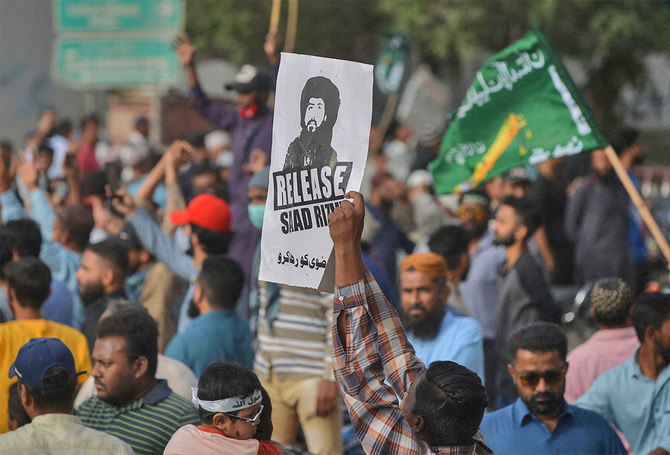
Supporters of Tehreek-e-Labbaik Pakistan (TLP) party take part in a protest in Karachi on October 24, 2021, demanding the release of their leader Hafiz Saad Hussain Rizvi, son of late Khadim Hussain Rizvi. (AFP)
Short Url
Updated 24 October 2021
Follow

Government says considering freeing chief of banned Tehreek-e-Labbaik Pakistan party 

  • Interior minister says will withdraw cases against TLP protesters, TLP negotiators to visit interior ministry on Monday 
  • Says party had third largest vote bank in Punjab and the government wanted to avoid confrontation with it

ISLAMABAD: Pakistan’s Interior Minister Sheikh Rashid Ahmed said on Sunday the government was considering the release of Saad Rizvi, the leader of the banned Tehreek-e-Labbaik Pakistan (TLP) religious party who was arrested earlier this year for threatening to lead anti-government protests.
The party announced this week it would march to the capital, Islamabad, to pressure the government to release Rizvi and expel the French ambassador over caricatures of the Prophet Muhammad (PBUH) published in France last year. Thousands of supporters of the radical party on Saturday left the eastern city of Lahore, clashing for a second straight day with police. On Friday, two policemen were killed in a violent standoff between security forces and protesters. 
Protesters are currently camped in Muridke, a city about 55 kilometers from Lahore, and will stay there while a TLP negotiation team meets government representatives for talks. 
The party held similar protests in April this year in which six policemen were killed. 

The interior minister said of 7,000 TLP supporters arrested during the April violence, cases were still pending against 173, but would now be quashed as part of an agreement with the party to convince it to give up the ongoing protest march. 
“We will take back the [police] cases against the TLP by Wednesday,” Ahmed told reporters at a press conference. “Also considering the release of Saad Rizvi.”
“A negotiation team of the TLP will come to the interior ministry on Monday, and all issues will be addressed,” the minister said, adding that the party had the third largest vote bank in Punjab and the government wanted to avoid confrontation with it.
“There should be no confrontation with religious people. It’s their right to protest, and the government should show flexibility,” the minister said. “I had a one-on-one meeting with Saad Rizvi too, and their people in Muridke will go back on Wednesday.” 
To a question about the expulsion of the French ambassador, a main demand by TLP, Ahmed said: “Currently, France has no ambassador in Pakistan, but we will take this matter to the National Assembly.” 
The minister also directed Islamabad and Rawalpindi administrations to reopen roads and remove shipping containers placed at entrances to the city to keep out protesters. 
Earlier on Sunday, Minister for Religious Affairs Noorul Haq Qadri said in a press statement negotiations between the government and the TLP were moving toward “success.” 
“The protesters will record their protest till Tuesday ... Protesters will continue peaceful protests wherever they are,” Qadri said. 
The minister said the government had listened to all of TLP’s demands and would consider them “seriously.” He said all roads in the country that had been closed due to the protests would be reopened by tomorrow, Monday, and there would be no confrontation between the protesters and the police. 
“In case of peace, police and security agencies will not take any action against the sit-in,” Qadri said. “All the issues will be resolved with mutual discussion.” 


World Bank approves $700 million for Pakistan’s economic stability

Updated 20 December 2025
Follow

World Bank approves $700 million for Pakistan’s economic stability

  • Of this, $600 million will go for federal programs and $100 million will ⁠support a provincial program in Sindh
  • The results-based design ensures that resources are only disbursed once program objectives are achieved

ISLAMABAD: The World Bank has approved $700 million in ​financing for Pakistan under a multi-year initiative aimed at supporting the country’s macroeconomic stability and service delivery, the bank said on Friday.

The funds will be released under the bank’s Public ‌Resources for Inclusive ‌Development — Multiphase ‌Programmatic ⁠Approach (PRID-MPA) that ‌could provide up to $1.35 billion in total financing, according to the lender.

Of this amount, $600 million will go for federal programs and $100 million will ⁠support a provincial program in ‌the southern Sindh province. The results-based design ensures that resources are only disbursed once program objectives are achieved.

“Pakistan’s path to inclusive, sustainable growth requires mobilizing more domestic resources and ensuring they are used efficiently and transparently to deliver results for people,” World Bank country director Bolormaa Amgaabazar said in a statement.

“Through this MPA, we are working with the Federal and Sindh governments to deliver tangible impacts— more predictable funding for schools and clinics, fairer tax systems, and stronger data for decision‑making— while safeguarding priority social and climate investments and strengthening public trust.”

The approval ‍follows a $47.9 ‍million World Bank grant ‍in August to improve primary education in Pakistan’s most populous Punjab province.

In November, an IMF-World Bank ​report, uploaded by Pakistan’s finance ministry, said Pakistan’s fragmented ⁠regulation, opaque budgeting and political capture are curbing investment and weakening revenue.

Regional tensions may surface over international financing for Pakistan. In May, Reuters reported that India would oppose World Bank funding for Pakistan, citing a senior government ‌source in New Delhi.

“Strengthening Pakistan’s fiscal foundations is essential to restoring macroeconomic stability, delivering results and strengthening institutions,” said Tobias Akhtar Haque, Lead Country Economist for the World Bank in Pakistan.

“Through the PRID‑MPA, we are launching a coherent nationwide approach to support reforms that expand fiscal space, bolster investments in human capital and climate resilience, and strengthen revenue administration, budget execution, and statistical systems. These reforms will ensure that resources reach the frontline and deliver better outcomes for people across Pakistan with greater efficiency and accountability.”

In Sindh, the program is expected to increase provincial revenues, enhance the speed and transparency of payments, and broaden the use of data to guide provincial decision making. The program will directly support the increase of public resources for inclusive development, including more equitable and responsive financing for primary health care facilities and more funding for schools.