SABIC announces carbon neutrality strategy at inaugural Saudi Green Initiative forum

1 / 2
SABIC chairman, Khalid Hashim Al-Dabbagh. (Supplied)
2 / 2
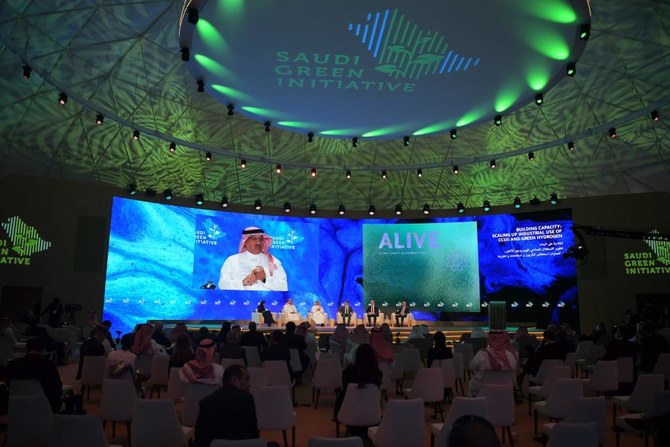
SABIC unveiled its global strategy towards carbon neutrality at the inaugural Saudi Green Initiative in Riyadh on Saturday. (Supplied)
Short Url
Updated 24 October 2021
Follow

SABIC announces carbon neutrality strategy at inaugural Saudi Green Initiative forum

  • SABIC and 10 peer companies will work together to share early-stage risks and co-invest in developing and upscaling LCETs

RIYADH: SABIC unveiled its global strategy towards carbon neutrality at the inaugural Saudi Green Initiative in Riyadh on Saturday.

The event was attended by a high-level delegation from the company who joined international heads of state and global leaders of business, finance, and civil society to discuss Saudi Arabia’s vision for tackling environmental challenges.

SABIC chairman, Khalid Hashim Al-Dabbagh, said: “The SGI provides an ambitious framework aimed towards the shared goal of achieving a green future. SABIC is an active contributor to several strategic initiatives announced today, including those geared towards the production of hydrogen, reusing captured carbon, and recycling plastics.”
He added: “At SABIC, we recognize the power of collaboration to improve and protect the quality of life for the next generations. Sustainability is in our DNA and we’re pleased to contribute innovative technologies that will accelerate our journey towards carbon neutrality.”

SABIC’s Vice Chairman and CEO Yousef Al-Benyan joined an industry panel at the event to discuss the scaling up of new technologies and reasserted the company’s global commitment to reduce greenhouse gas emissions and pursue carbon neutrality. 

He said that “SABIC is uniquely contributing to the SGI goals and taking bold actions that support the Kingdom’s ambitions for the circular carbon economy. Our global carbon neutrality strategy reaffirms our commitment to the Paris Agreement goals and the continuous pursuit of solutions that can reduce greenhouse gas emissions.”

He added: “Many countries are competing for position as the world looks to broaden its energy mix and reduce carbon emissions. The foresight of Vision 2030, our abundant renewable resources and the innovative advances made by Saudi Arabian companies are making circularity a reality, placing the Kingdom in pole position to lead the new energy revolution.”

During the session, he outlined SABIC’s key circular innovations and collaborative efforts to transform energy intensive industry towards renewables, and being a founding member of the Low Carbon Emitting Technologies (LCET) initiative with the World Economic Forum. 

In this collaboration, SABIC and 10 peer companies will work together to share early-stage risks and co-invest in developing and upscaling LCETs.

SABIC is also partnering in the development of the world’s first large-scale chemical site to operate on 100 percent renewable power and, in a different project, developing solutions for electrically heated steam cracker furnaces which could reduce emissions by up to 90 percent.

Al-Benyan also highlighted some of the company’s accomplishments including the demonstration of the blue ammonia supply chain and the development of the world’s largest CO2 capture and purification plant. Based in Jubail and operational from 2015, the pioneering facility can process up to 500,000 megatons of CO2 per year into feedstock for industrial processes.

The company’s range of certified renewable polymers are providing an important bridge for the value chain to evolve from a linear to a circular economy and its landmark plastic chemical recycling processes contribute to CO2 reduction by preventing the incineration of plastic waste.


Airlines across Middle East, Asia extend flight suspensions for 3rd straight day 

Updated 12 sec ago
Follow

Airlines across Middle East, Asia extend flight suspensions for 3rd straight day 

RIYADH: Airlines and airport operators across the Middle East extended flight suspensions for a third consecutive day after US and Israeli strikes on Iran triggered widespread airspace closures, disrupting global travel routes. 

Major Gulf hubs halted operations as authorities kept sections of regional airspace closed, forcing carriers to cancel thousands of flights and reroute long-haul services linking Europe, Asia and Australia.  

This comes as flight cancellations affected seven airports across the Middle East on March 1, including Dubai and Abu Dhabi in the UAE, Doha in Qatar, and Manama in Bahrain.

Emirates said in a statement that, due to multiple regional airspace closures, it has temporarily suspended all operations to and from Dubai until 3:00 p.m. UAE time on March 3. 

“The situation remains dynamic and is assessed continuously. We urge all customers to review the latest operational updates on emirates.com and check their email for any notifications about changes or cancellations to their flights before travelling to the airport,” the airline said. 

Hamad International Airport said flights remain suspended and will resume once the Civil Aviation Authority announces the reopening of Qatari airspace. The airport advised passengers not to travel to the airport and to contact their airlines for updates. 

The closures disrupted key hub airports in Dubai, Abu Dhabi and Doha. Emirates, Qatar Airways and Etihad — which operate from these hubs — normally handle around 90,000 passengers daily, with even more traveling to other Middle Eastern destinations, according to aviation analytics firm Cirium.

The disruption has compounded volatility in airline shares amid concerns over higher fuel costs and prolonged operational uncertainty.   

Ipek Ozkardeskaya, senior analyst at Swissquote, said: “The weekend was marked by tensions between the US, Israel, and Iran, leading to hundreds of explosions targeting broader Middle East countries as well, including the UAE, Saudi Arabia, Qatar, Bahrain and Kuwait.” 

He added: “The flare-up was predictable; markets had been preparing for weeks as US warships advanced to the region preceding the explosions.”  

Asian airlines shares plunge 

Asian airline stocks slid on March 2, with Hong Kong’s Cathay Pacific, Australia’s Qantas, Singapore Airlines, and Japan Airlines falling more than 5 percent after the escalation disrupted travel flows and heightened concerns over fuel prices, Asharq Bloomberg reported. 

Qantas shares dropped as much as 10.4 percent to a 10-month low at the Australian market open before trimming losses to trade down nearly 6 percent. 

Other carriers, including Japan Airlines, Air China and Malaysia Airlines, also declined. 

Cathay Pacific canceled all flights to the Middle East, including passenger services to Dubai and Riyadh, until further notice. 

Singapore Airlines suspended flights to and from Dubai until March 7, while Japan Airlines halted services between Tokyo and Doha for the time being.  

Flight data provider VariFlight said Chinese airlines have canceled 26.5 percent of their services to and from the Middle East scheduled between March 2 and 8.