

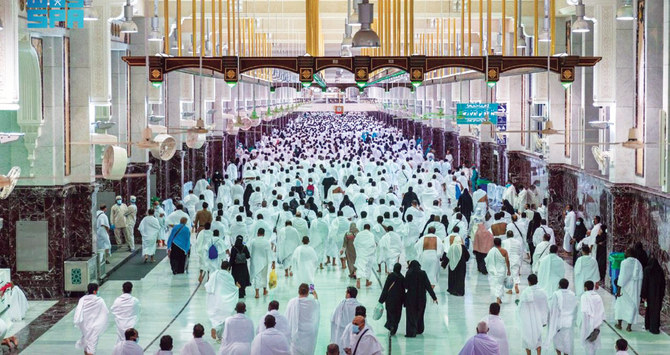
First full Friday prayers at Two Holy Mosques

Authorties have used all of their human and mechanical resources to implement the plan to return to full capacity. (SPA)
Short Url
Updated 23 October 2021
Follow

First full Friday prayers at Two Holy Mosques

  • Worshippers return to holy cities as restrictions eased

MAKKAH: After more than a year and a half, Muslims worldwide were delighted to see Friday prayers at the Two Holy mosques return to full capacity.

Considered the two holiest sites in Islam, painful images of the mosques devoid of worshippers due to the onset of the COVID-19 pandemic in March of 2020 affected Muslims everywhere, but particularly citizens of Makkah and Madinah.

“It’s a blessing, to walk in the mosque’s pathways and you’re surrounded by people again,” said Abdullah Mahdi, a private-sector worker and longtime resident of the holy city. “Though masked still, it doesn’t really matter, the place is alive with movement and worshippers again.

“It’s truly a sight to behold and to see the Grand Mosque’s courtyard around the Kaaba filled with people on the first Friday after the easing of the restrictions is a sign that it’ll be alright, God-willing.”

Last Saturday, the Ministry of Interior announced the easing of restrictions across the Kingdom, including those affecting the Grand Mosque in Makkah and the Prophet’s Mosque in Madinah, which are returning to full operations and capacity.

Deputy Secretary-General for the Affairs of the Grand Mosque Dr. Saad bin Mohammed Al-Muhaimid told Arab News that the Presidency of the Affairs of the Two Holy Mosques had used all of their human and mechanical resources to implement the plan to return to full capacity.

FASTFACTS

• Last Saturday, the Ministry of Interior announced the easing of restrictions across the Kingdom, including those affecting the Grand Mosque in Makkah and the Prophet’s Mosque in Madinah, which are returning to full operations and capacity.

• Those working at the Two Holy Mosques had been asked to abide by and enforce the directives issued by the authorities concerned with fighting the coronavirus pandemic to ensure everyone’s safety.

“They did so through an integrated plan of capabilities and services that were harnessed to preserve the safety of the Grand Mosque’s visitors and facilitate the performance of their rites in a spiritual, safe and reassuring atmosphere,” he said.

“Based on the directives of the president of the General Presidency for the Affairs of the Two Holy Mosques, Sheikh Dr. Abdulrahman Al-Sudais, we have accelerated the pace of work and raised the level of readiness in an effort to provide the Grand Mosque’s visitors with better services and means of comfort.

“We have also doubled our efforts since we started implementing the plan to return to full capacity while achieving the highest-quality standards.”

The deputy secretary-general said that those working at the Two Holy Mosques had been asked to abide by and enforce the directives issued by the authorities concerned with fighting the coronavirus pandemic to ensure everyone’s safety.

The ministry and authorities stressed the importance of visitors adhering to the directives included in the Interior Ministry’s statement by wearing face masks at all times inside the Grand Mosque and booking their Umrah and prayer appointments through the official applications (Eatmarna and Tawakkalna).


Saudi space technology plays growing role in conflict and disaster zones: NSG executive

Hassan Al-Johani, vice president of business development at Neo Space Group, speaks to Arab News at the World Defense Show.
Updated 7 sec ago
Follow

Saudi space technology plays growing role in conflict and disaster zones: NSG executive

  • Company analyzes damage from natural disasters, including flash floods

RIYADH: Saudi-built space systems are moving beyond data collection to play a direct role in operational decision-making, particularly in high-stakes situations like conflict zones and natural disasters, according to one industry executive.

Hassan Al-Johani, vice president of business development at Neo Space Group, spoke on the sidelines of the World Defense Show in Riyadh, which has Arab News as a media partner, about how the company’s technology is used in real-life scenarios.

Al-Johani pointed to disaster management as an example of how integrated space services can directly influence outcomes on the ground.

The company uses high-resolution Earth observation imagery in optical, radio and infrared spectrums, to analyze damage from natural disasters, including flash floods.

He said this information can then be turned into actionable intelligence and shared directly with teams operating in affected areas, allowing them to assess damage to roads and determine the best routes for delivering equipment and emergency aid.

“We can utilize that in geospatial intelligence and communicate it to teams in the field using advanced satellite communications,” Al-Johani said.

The company’s satellite technology allows people to communicate in crisis-hit areas when traditional communication infrastructure has been damaged.

He added: “Even when communication fails, even when there’s disruption in infrastructure, we have the ability to understand what has happened, but also communicate it to people (who) need to take decisions in real time to save lives and property.”

Demonstrations at the World Defense Show, he said, were designed to show how this integrated approach worked in practice.

“We are not promoting one domain or one technology, but rather a unified architecture that brings together the best of the latest technologies,” he said.

The company’s technology has military uses, allowing users to determine the best locations for deploying troops and equipment, and its satellite technology allows secure communications in war zones.

He also highlighted the technical design choices behind ensuring continuity of service, particularly in contested or disrupted environments.

Artificial intelligence, he added, is increasingly part of the company’s system.

“We’re not utilizing just traditional geospatial intelligence, but rather AI-powered intelligence,” Al-Johani said.

This layered approach, he explained, is intended to reduce dependence on any single system or data source.

He added: “If one layer fails, then you have other layers to supplement and ensure the continuity of the value delivered to the clients.”

Beyond technology, Al-Johani said discussions at the World Defense Show reflected a broader shift in how Saudi Arabia approaches the space and defense sectors.

“Saudi Arabia has demonstrated that we are not looking to be buyers, but rather partners and builders,” he said.

“That means that we have to have an engaging dialogue with partners from around the world, understanding which parts of the ecosystem we need to build on.”

He said this approach ultimately supported local capability building and long-term sector development, adding that it was targeted at “finding a meaningful partnership that delivers win-win for everyone, (and) ultimately contributes to building this country, this industry and the space sector.”