

At Moscow meet, Pakistan urges global powers to continue economic engagement with Afghanistan

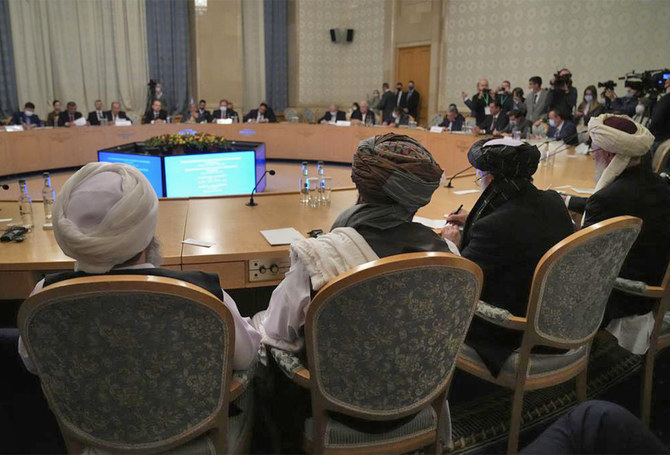
Members of the political delegation from the Afghan Taliban's movement attend talks involving Afghan representatives in Moscow, Russia, on October 20, 2021. (AP)
Short Url
Updated 21 October 2021
Follow

At Moscow meet, Pakistan urges global powers to continue economic engagement with Afghanistan

  • Ambassador Sadiq asks world to unfreeze Afghanistan assets to avert economic meltdown
  • Pakistan advocates enhanced cooperation with Afghanistan to address challenges such as global terrorism

ISLAMABAD: Pakistan on Wednesday urged the international community to continue its economic engagements with Afghanistan to prevent another humanitarian disaster in the region, adding it was imperative in this context to unfreeze the Afghan financial assets parked in other countries.
Pakistan’s special representative for Afghanistan, Ambassador Muhammad Sadiq, highlighted the issue while addressing a major international conference in Moscow that brought together officials from various regional countries.
The international community froze nearly $10 billion of Afghanistan’s financial assets in other countries after the fall of Kabul on August 15 since the money was viewed as a key instrument to mount political pressure on the Taliban.
Sadiq said in a Twitter post on Wednesday he proposed three “broad contours of engagement with Afghanistan” while speaking at the Moscow forum.
These included “extending urgent humanitarian support to Afghanistan, to remain economically engaged to [avert] financial meltdown [by] de-freezing of Afghanistan’s foreign assets … [and] enhance cooperation [with Kabul] to address common challenges, such as combatting terrorism, trans-national crime and border management,” he wrote on the social media platform.


Sadiq said the “international community must not abandon Afghanistan at this critical juncture.”
Meanwhile, Russia stepped up pressure on the Taliban to create an inclusive administration during the conference which was also attended by China, Iran, India and Central Asian countries.
Russian foreign minister Sergei Lavrov was quoted by Reuters as saying that he regretted the US absence from the talks, the biggest international meeting on the region since the Taliban victory in August.
Russia previously said it was not a rush to recognize the Taliban, as officials in Moscow noted the former Afghan rebel faction should fulfil its political commitments on human rights and political inclusivity to the world at large.
The Taliban deputy prime minister, Abdul Salam Hanafi, told the forum that “isolating Afghanistan is in no one’s interest.”
He added the Taliban had moved as quickly as possible on opening up their government and guaranteeing rights to women, reported Reuters, while adding that the Afghan faction did not represent a threat to any other country.


Arif Habib-led group plans to buy remaining 25 percent stakes in Pakistan International Airlines

Updated 4 sec ago
Follow

Arif Habib-led group plans to buy remaining 25 percent stakes in Pakistan International Airlines

  • Consortium bought 75 percent stake in Pakistan International Airlines in December 2025 for $482 million
  • Group will have to pay government $161 million by April 2027 for 25 percent stakes, says Arif Habib Ltd. CEO

ISLAMABAD: The Pakistani consortium led by Arif Habib Ltd. which bought a 75 percent stake in the Pakistan International Airlines (PIA) plans to secure full control of the airline, a senior official of the firm confirmed on Sunday. 

In December 2025, the consortium headed by Arif Habib Group secured a 75 percent stake in the PIA for Rs135 billion ($482 million) after several rounds of bidding, valuing the airline at Rs180 billion ($643 million). Pakistan had previously attempted to reform the debt-ridden airline, which had accumulated more than $2.8 billion in financial losses over the years. 

Arif Habib Ltd. CEO Shahid Habib told Arab News that since the PIA’s privatization documents were signed in January, the group will formally take over the airline at the end of April. He said as per the by-laws, the group will have to notify the government whether it intends to buy the remaining 25 percent stake in the airline or “leave it with the government.”

“At present, their [Arif Habib-led group’s] stated position is that they intend to acquire the 25 percent from the government,” Habib said.

He said once the group conveys its decision to buy the remaining 25 percent stakes in the airline, it will have 12 months to complete the payment.

“This means that from April to the following April [in 2027], they must pay the Government of Pakistan Rs45 billion [$161 million] more for the additional stake,” Habib said. 

Habib said beyond ownership, the group intends to improve service for customers. This would include strengthening overall safety and security standards, enhancing staff performance and upgrading the airline’s ticketing system. 

He said the group intends to increase the frequency of flights on commercially viable routes.

“For example, routes that currently operate only two flights every two weeks could be expanded to as many as six flights per week,” Habib said.

“This would significantly improve passenger convenience and availability.”

Habib said currently, PIA has 18 operational aircraft, adding that some of them require capital expenditure (CAPEX) for upgrades and improvements. He said six to seven aircraft could be made operational with additional CAPEX.

“The medium-term goal is to expand the fleet from 18 to 38 aircraft over the coming years,” Habib said.

“While the exact timeline has not been specified, the intention is to achieve this within a defined multi-year framework.”

Habib shared leasing brand new aircraft would require time, adding that current delivery slots that are being offered for them are for 2030, 2031 and 2032.

He said that as an interim solution, relatively newer aircraft — around eight to ten years old — can be acquired for the airline.

“If orders are placed now, Boeing or comparable models, as well as Airbus aircraft in the seven-to-ten-year range, could be secured to stabilize and expand short-term operations,” he said. 

Once considered among Asia’s leading airlines, PIA struggled with chronic mismanagement, political interference, overstaffing, mounting debt and operational issues that led to a 2020 ban on flights to the European Union, UK and the US after a pilot licensing scandal.

The EU and the UK lifted the bans, providing fresh momentum to the carrier.