

FATF begins new plenary session, will determine Pakistan’s ‘grey list’ status

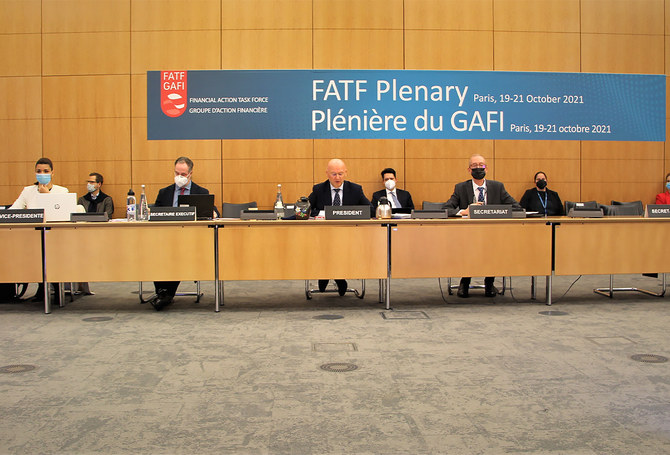
Financial Action Task Force (FATF) begins new plenary session in Paris, France, on October 19, 2021. (Photo courtesy: FATF)
Short Url
Updated 19 October 2021
Follow

FATF begins new plenary session, will determine Pakistan’s ‘grey list’ status

  • The watchdog put Pakistan on list of countries with inadequate terror funding and money laundering controls in June 2018
  • Outcome of the plenary to be announced on Thursday after meeting ends, Pakistan hopes for good news

ISLAMABAD: The Financial Action Task Force announced the beginning of its new plenary on Tuesday in which it will take up a number of issues and determine if Pakistan can be removed from a list of countries with strategic deficiencies in their financial system.
The global dirty money watchdog placed Pakistan on its “grey list” of countries in June 2018 since it found vulnerabilities in its financial system which could be exploited for terror financing and money laundering.
Pakistan has tried to address the FATF concerns by implementing the recommended action plan, and its progress has also been acknowledged by the international body.
“The Financial Action Task Force Plenary has started,” the FATF announced in a Twitter post. “Due to COVID-19 it is a hybrid meeting, with delegates from around the world meeting virtually and in person.”


According to a statement issued by the global watchdog, “the outcomes of the FATF Plenary will be published on Thursday 21 October, at the close of the meeting.”
The meeting, which is taking place under the German presidency of Dr. Marcus Pleyer, will also be observed by global financial institutions such as the International Monetary Fund.
Pakistan’s foreign minister Shah Mahmood Qureshi said earlier this year there was “no justification” for the FATF to keep his country on the grey list since it had taken extensive measures to curb money laundering and terror financing.
“We will have to see if the FATF is a technical forum or … being used for political purposes,” he added.
The global financial watchdog recently expressed satisfaction with Pakistan’s progress, though it also gave the country another action plan to fix a separate set of problems to strengthen the financial system further.


Punjab committee clears kite-flying ordinance, assembly approval expected next session

Updated 6 sec ago
Follow

Punjab committee clears kite-flying ordinance, assembly approval expected next session

  • The ordinance sets strict registration requirements for kite makers and sellers, bans chemically coated strings
  • Police of sub-inspector rank and above have been allowed to search premises and make arrests without warrants

ISLAMABAD: The Punjab Assembly Standing Committee on Home Affairs on Monday approved a new ordinance regulating kite flying, setting the stage for lawmakers to endorse the measure in the next assembly session as the provincial government moves toward reviving the Basant festival after a 25-year ban.

The Punjab Regulation of Kite Flying Ordinance 2025 has already received approval from the governor, with the provincial administration announcing earlier this month it would allow Basant to be held from Feb. 6-8.

The festival once drew thousands to rooftops across Lahore and other cities in the province, but from 2005 onwards authorities repeatedly prohibited kite flying after dozens of people, many of them children, were killed or injured by metal and chemically coated strings that slashed motorcyclists and pedestrians.

“It is necessary to provide for regulation of kite flying in Punjab in order to save human life, public and private property and matters connected therewith,” the ordinance said.

Under the ordinance, kite makers, sellers and kite-flying associations must register with the deputy commissioner, and kite flying may only be permitted in districts where the government issues a formal notification.

District authorities may allow kite flying only with prior approval from the provincial government, the text said.

The ordinance also imposes up to five years’ imprisonment and fines of up to 2 million rupees ($7,200) for manufacturing, transporting or selling prohibited kite strings, including metallic wire, nylon cord (tandi) or chemically coated sharp string.

Unregistered kite production or sale carries penalties of up to five years in prison and fines of up to Rs500,000 ($1,800).

Offences under the ordinance are cognizable and non-bailable.

“A police officer not below the rank of sub-inspector may, upon receiving information regarding prohibited kite material, conduct a search or make an arrest without warrant,” the ordinance said.

The ordinance repeals the Punjab Prohibition of Kite Flying Ordinance 2001 and is expected to be presented to the provincial assembly for formal approval when it reconvenes, officials said.