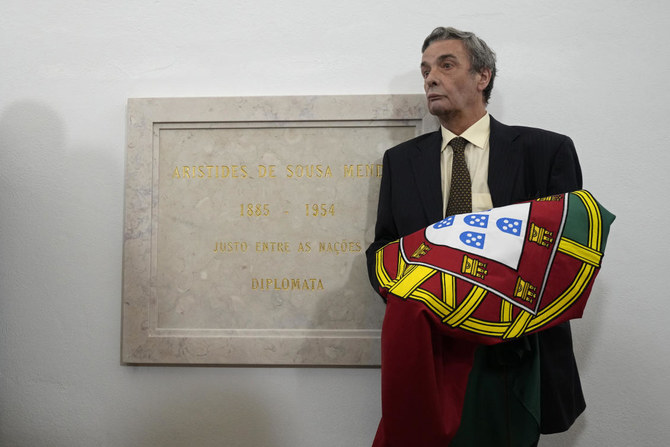
LISBON, Portugal: Portugal paid official homage Tuesday to Aristides de Sousa Mendes, a Portuguese diplomat who during World War II helped save thousands of people from Nazi persecution, by placing a tomb with his name in the country’s National Pantheon.
Leading Portuguese politicians and public figures attended the formal televised ceremony as the tomb was placed alongside other celebrated figures from Portuguese history at the landmark Lisbon building.
The speaker of the Portuguese Parliament, Eduardo Ferro Rodrigues, said Sousa Mendes’ conduct lent prestige to Portugal.
“People who at the decisive moment put their and their family’s safety at risk for the greater good are rare. Sousa Mendes was one of those people,” Ferro Rodrigues said in a speech.
The ceremony marked the completion of Sousa Mendes’ 80-year journey from ostracized Portuguese civil servant to honored international personage.
Perhaps Portugal’s most famous 20th-century diplomat, Sousa Mendes defied his superiors, including dictator António Salazar, when as consul in Bordeaux, France, in 1940 he handed out visas to many people who feared being hunted down by the Nazis.
The Portuguese visas allowed people, including Jews fleeing the Holocaust, to escape through neutral Portugal by air and sea to the United States and elsewhere.
The Portuguese diplomatic service was supposed to ask for the Lisbon government’s specific consent to grant visas to certain categories of applicants, as the country trod a careful path of neutrality, but Sousa Mendes gave out visas on his own initiative.
Leah Sills, a board director of the Sousa Mendes Foundation in the United States, said she flew in for the ceremony “to be able to honor the man that rescued my father and my grandparents” on May 24, 1940.
“It’s been just a beautiful experience,” she said.
Álvaro Sousa Mendes, a grandson of Aristides Sousa Mendes, said his family had seen an ambition fulfilled.
“This was a ceremony we had been requesting for a long time,” he said. “Finally he was recognized ... with National Pantheon honors.”
Breaking the rules got Sousa Mendes fired from the diplomatic service, with public shame attaching to his family at the time. He died in poverty in 1954.
Decades later, he won recognition for his key role in saving people from the Nazis.
In 1966, Israel’s national Holocaust memorial, Yad Vashem, recognized Sousa Mendes as a “Righteous among the Nations.”
Last year, he drew praise from Pope Francis, and last March the US Senate in a motion saluted “the humanitarian and principled work” of Sousa Mendes.
It wasn’t until the late 1980s that he earned recognition in Portugal, with authorities posthumously granting him accolades.
In 2017, President Marcelo Rebelo de Sousa bestowed Portugal’s highest honor, the Grand Cross of the Order of Liberty, on Sousa Mendes.
Last year, the Portuguese parliament voted to honor the former diplomat at the National Pantheon by placing there a plaque and a tomb without his body. Sousa Mendes wanted to be buried at his birthplace near Viseu, in northern Portugal.
Of the 19 historical figures entombed at the National Pantheon, 12 contain the person’s remains.


![]()

Portugal honors diplomat who saved thousands from Nazis
Short Url
https://arab.news/pa33p
Portugal honors diplomat who saved thousands from Nazis
- The speaker of the Portuguese Parliament, Eduardo Ferro Rodrigues, said Sousa Mendes’ conduct lent prestige to Portugal
- The ceremony marked the completion of Sousa Mendes’ 80-year journey from ostracized Portuguese civil servant to honored international personage


Latest updates


© 2026 SAUDI RESEARCH & PUBLISHING COMPANY, All Rights Reserved And subject to Terms of Use Agreement.