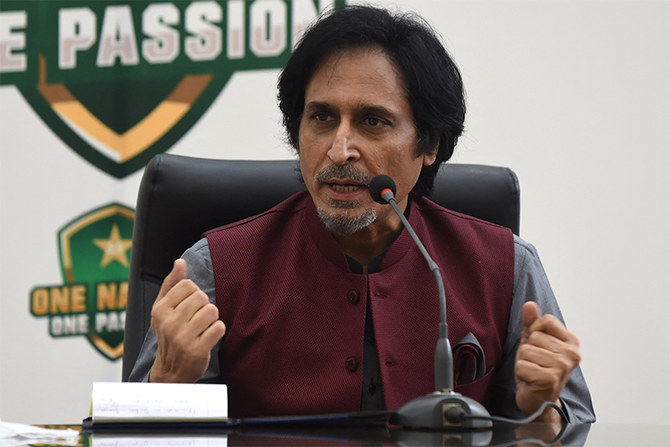
ISLAMABAD: Pakistan Cricket Board (PCB) Chairman Ramiz Raja has said Pakistan needed to create a “cricketing bond” with India, adding that he had always believed that politics should remain separate from sports, the PCB website said.
Raja was speaking to PCB Digital following his return from Dubai, where he met officials from the Board of Control for Cricket in India (BCCI), as well as held meetings on the Asian Cricket Council Asia Cup, a men’s One Day International and Twenty20 International cricket tournament whose next season will be held in Pakistan in 2023.
“I met with BCCI President Sourav Ganguly and secretary Jay Shah on the sidelines of the ACC meetings,” Raja said on Monday. “We need to create a cricketing bond, while I have also believed that politics should stay away from sport as much as possible and this has always been our stance.
“A lot of work needs to be done to revitalize Pakistan-India cricket but there needs to be some comfortable level between the two boards and then we can see how far we can go. So overall, we had a good discussion.”
The PCB chairman said the 2023 ACC Cup in Pakistan would be a 50-over competition: ““The ACC has agreed and approved that the 2023 event in Pakistan will be a 50-over competition and will be held in September. This aligns very nicely with the ICC Men’s Cricket World Cup 2023, which will be held in October and November.
“We are looking forward to hosting this tournament in Pakistan and I am confident it will be a well-organized event because this is what the fans want.”

We need to create ‘cricketing bond’ with India, keep politics separate — PCB chairman
https://arab.news/4t9vp
We need to create ‘cricketing bond’ with India, keep politics separate — PCB chairman
- Ramiz Raja was talking to PCB Digital following his return from Dubai where he met officials from Board of Control for Cricket in India
- Says next Asian Cricket Council Asia Cup would be a 50-over competition held in Pakistan in September 2023
Pakistan raises India's suspension of water-sharing treaty with UNGA president, seeks action
- New Delhi said in April last year it was holding the treaty in abeyance after a gun attack in Indian-administered Kashmir
- Official says such actions threaten lives of 240 million Pakistanis, particularly at a time of climate stress, water scarcity
ISLAMABAD: Pakistan has taken up India’s suspension of a decades-old water-sharing treaty with the president of the United Nations General Assembly (UNGA), urging action over the move that Islamabad said sets "dangerous precedents."
The Indus Waters Treaty (IWT) divides control of the Indus basin rivers between the two nuclear-armed neighbors. India said in April last year it would hold the treaty “in abeyance” after a gun attack in Indian-administered Kashmir killed more than 26 tourists. New Delhi blamed the assault on Pakistan, Islamabad denied it.
The attack led to a four-day military conflict between the neighbors last May that say them attack each other with fighter jets, missiles, drones and artillery before the United States-brokered a ceasefire. Tensions have remained high between the nuclear-armed neighbors.
During a meeting on the sidelines of the Inter-Parliamentary Union (IPU) annual hearing, Pakistan Senate Chairman Yusuf Raza Gilani told UNGA President Annalena Baerbock that India's unlawful action constituted a blatant violation of the treaty’s provisions and principles of customary international law.
"Such actions threaten the lives and livelihoods of over 240 million Pakistanis and set dangerous precedents, particularly at a time when climate stress and water scarcity demand cooperation and strict respect for international agreements," he was quoted as saying by the Pakistani information ministry.
The treaty, mediated by the World Bank, grants Pakistan rights to the Indus basin’s western rivers — Indus, Jhelum, and Chenab — for irrigation, drinking, and non-consumptive uses like hydropower, while India controls the eastern rivers — Ravi, Beas, and Sutlej — for unrestricted use but must not significantly alter their flow.
Highlighting the adverse impacts of climate change, Gilani said countries like Pakistan remain among the most severely affected and underscored the urgency of collective action, climate justice and strengthened international cooperation.
"The United Nations provides an indispensable platform for addressing these interconnected challenges," he said at the meeting.
Gilani, who was leading a six-member parliamentary delegation, this week delivered the national statement at the IPU annual hearing at the UN headquarters, calling for democratic, transparent, and accountable decision-making in order to enhance the UN’s credibility, according to the Senate of Pakistan.
“Parliaments are indispensable partners in ensuring national ownership of international commitments,” he was quoted as saying by the Senate. “Reform is essential. But it must be ‘Reform for All, Privilege for None’.”
The Senate chairman highlighted the continuing importance of the United Nations as the cornerstone of multilateral cooperation, stressing that the organization’s universal membership and Charter-based mandate remain central to promoting global peace and security.


