

'SGI signals a new era for mankind': How the Saudi Green Initiative Forum could change the world

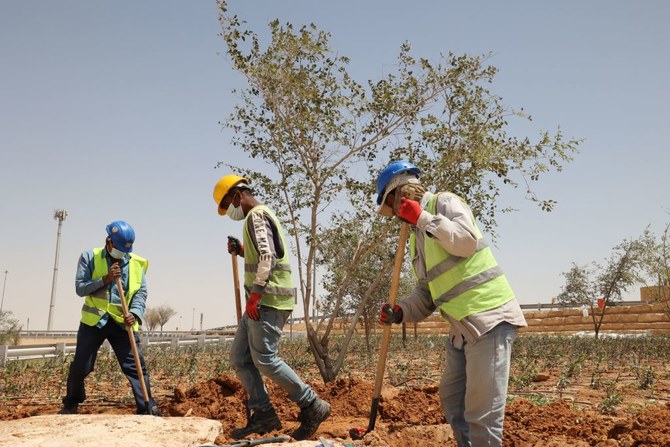
Workers plant trees next to a highway in the Saudi capital Riyadh. (Getty)
Short Url
Updated 20 October 2021
Follow

'SGI signals a new era for mankind': How the Saudi Green Initiative Forum could change the world

  • "We reject the false choice between preserving the economy and protecting the environment," says Crown Prince Mohammed Bin Salman

Since the early part of the last century, the image and fortunes of Saudi Arabia have been inextricably linked to a single element. The discovery and exploitation of oil transformed life in the KSA and positioned the country front and center in the petrol-driven global economy.

But times have changed over the last two decades. There is a recognition that oil and its derivatives, such as plastic and petrochemicals, are a primary cause of global warming, pollution and environmental catastrophe. In the KSA, air pollution from greenhouse gases shortens life expectancy by 1.5 years, while desertification and dust storms cause $13 billion of damage per year.

This bleak picture is a wake-up call, triggering a seismic shift across the world, away from carbon-sourced energy and hyper-consumption towards a cleaner and more sustainable way of life.

An energy leader for decades, the KSA is now positioning itself at the vanguard of environmental action. This effort is encapsulated in the Saudi Green Initiative (SGI) – a national program to combat pollution and land degradation, increase vegetation cover, reduce carbon emissions and preserve marine life.

“The Kingdom fully recognizes its share of responsibility in advancing the fight against the climate crisis. Just as the Kingdom underpinned energy markets during the oil and gas era, it is going to become a global leader in forging a greener world,” says Crown Prince Mohammed Bin Salman, patron of the SGI.

Having introduced the concept of the Circular Carbon Economy (a closed-loop system involving ‘4Rs’: reduce, reuse, recycle and remove) during its presidency of the G20 summit last year, Saudi Arabia is again taking a leadership role by hosting the forthcoming SGI Forum, to be held in Riyadh on 23-24 November.

The forum will, in its own words, “catalyze climate action in a regionally and internationally coordinated manner . . . bring together heads of state, public officials, business leaders, academic pioneers and environmental specialists. . . and drive action and spark innovative solutions to help tackle climate change.”

The event will help to define a road map that seeks to rally the Gulf region and contribute to agreed global targets by confronting climate change, increasing the use of clean energy, offsetting the impact of fossil fuels and protecting the environment.

The SGI is hugely ambitious. Ten billion trees are to be planted in the Kingdom over the next decade, rehabilitating some 40 million hectares of degraded land and bringing about a 12-fold increase from current tree covers. This is equal to four percent of the global initiative to limit the degradation of land, and one percent of the target to plant one trillion trees globally.

The percentage of protected areas in Saudi Arabia will reach over 30 percent of total land – about 600,000 square kilometers — exceeding the global target of 17 percent. Carbon emissions will be reduced by 130 million tons brought about by a plan to generate 50 percent of the Kingdom’s energy from renewables by 2030; and landfills – where 95 percent of waste is currently deposited — will be reduced to only five percent of waste.

In fact, the very notion of ‘garbage’ will become largely a thing of the past, as every form of waste becomes the raw material for a value-added product or energy source, in what is a key part of the ‘circular economy’ concept.

The SGI will work in tandem with the broader Middle East Green Initiative, which includes all GCC states along with other regional countries. The overall goal is to plant 50 billion trees across the Middle East — the largest reforestation program in the world, restoring 200 million hectares of degraded land. Carbon emissions from the region are to be reduced by over 60 percent, equal to more than 10 percent of the intended global reduction.

While Saudi citizens are used to a comfortable life of big cars and disposable products, it is clear that the SGI is already having a profound cultural impact.

“I think the SGI will open up a whole new era for mankind,” Ziyad Al Shiha, chief executive of the Saudi Investment Recycling Company, a leading agency in the circular economy, told Arab News.

“We're at a turning point now and it’s part of a major shift in the world economy. We are putting investment on the ground, working with corporations, small and medium-sized enterprises and with individuals — anything that will contribute to the circular economy.”

The greening of Saudi Arabia will involve changes to the daily lives of ordinary people, and an entirely new mindset. It will be young people, in particular, who forge a new path away from the habits of the past few decades.

“The SGI is an initiative by our government for a greener future for Saudi and the Middle East,” Fatimah Ahmad, a young Saudi professional translator, told Arab News.

She added: “The KSA is taking the lead to protect tomorrow from the climate change crisis. It’s one of the Vision 2030 projects I am personally excited about. It’s an ambitious, wild dream and I am sure it will come true very soon.”

Cynical voices might say that the decline of the oil era, and the global transition to a greener way of life, will have a detrimental effect upon the economy and standard of living in Saudi Arabia.

But Crown Prince Mohammed Bin Salman has a more positive outlook. “We reject the false choice between preserving the economy and protecting the environment,” he declared when launching the SGI in March.

He added: “Climate action will enhance competitiveness, spark innovation, and create millions of high-quality jobs. Young people, both in the Kingdom and the world, are demanding a cleaner, greener and more inclusive future, and we owe it to them to deliver on this.”

The SGI Forum will no doubt generate more ideas, greater awareness and practical solutions in the drive towards a sustainable future in Saudi Arabia and across the world.


Over 3k flights cancelled across the Middle East after attack on Iran by the US, Israel

Updated 01 March 2026
Follow

Over 3k flights cancelled across the Middle East after attack on Iran by the US, Israel

RIYADH: US and Israeli strikes on Iran led to widespread airspace shutdowns in the Middle East, canceling and rerouting thousands of flights and paralyzing key international travel corridors.

Flight cancellations affected seven airports across the Middle East, including Dubai and Abu Dhabi in the UAE, Doha in Qatar, and Manama in Bahrain.

Emirates Airlines said in a statement: “Due to multiple regional airspace closures, Emirates has temporarily suspended all operations to and from Dubai, up until 1500 hrs UAE time on Monday, 2 March.”

A flydubai spokesperson said the situation is evolving, and the airline is closely monitoring developments while coordinating with authorities to adjust its flight schedule.

“Our teams are working diligently to implement comprehensive welfare for all affected customers. The safety of our passengers and crew remains our highest priority,” the spokesperson said.

He added: “We are currently experiencing a high volume of calls and appreciate our customers’ patience while our teams work to assist everyone as quickly as possible.”

Qatar Airways announced that the airport will remain closed until at least the morning of March 2.

“Qatar Airways flights to, and from, Doha have been temporarily suspended due to the closure of Qatari airspace,” the airline said.

It added: “Qatar Airways will resume operations once the Qatar Civil Aviation Authority announces the safe reopening of Qatari airspace.”

Saudia also said in an official statement that it had canceled a number of flights due to developments in the region and the closure of airspace.

The organization said the decision was taken in line with aviation safety and security standards, noting that its Emergency Coordination Center is closely monitoring developments with relevant authorities.

Saudia urged passengers to verify the status of their flights before heading to the airport and said guests would be notified of updates through the contact details associated with their bookings.

The carrier added that further information would be announced in a subsequent statement if available.

Air Arabia also said its flights were experiencing cancellations, delays, or rerouting as a result of the evolving situation and airspace closures.

Airlines cited airspace closures and safety concerns as the main reasons for flight disruptions, urging passengers to check official channels for updates as the situation develops.

Israeli airspace also remained closed on March 1st. Israeli airline El Al said it was preparing a recovery effort to bring home Israelis stranded abroad once the airspace reopened.

Travelers were either stranded or diverted to other airports on Feb. 28 after Israel, Qatar, Syria, and Iran as well as Iraq, Kuwait and Bahrain, closed their airspace.

After the UAE announced a temporary partial airspace closure, FlightRadar24 recorded no flights over the country.

The closures affected key hub airports in Dubai, Abu Dhabi, and Doha. Emirates, Qatar Airways, and Etihad, airlines that operate from these hubs, normally handle around 90,000 passengers daily, with even more traveling to other Middle Eastern destinations, according to aviation analytics firm Cirium.

Airports hit by attacks

Two airports in the UAE reported incidents as the government there condemned what it called a “blatant attack involving Iranian ballistic missiles” on Feb.28.

Dubai International Airport, the UAE’s largest and one of the world’s busiest, reported four injuries, while Abu Dhabi’s Zayed International Airport said a drone attack killed one person and injured seven others. Strikes were also reported at Kuwait International Airport.

Though Iran did not publicly claim responsibility, the scope of retaliatory strikes that Gulf nations attributed to Iran extended beyond the US bases that it previously said it would target.

Flight delays, cancellations are likely to continue

“For travelers, there’s no way to sugarcoat this,” said Henry Harteveldt, an airline industry analyst and president of Atmosphere Research Group.

“You should prepare for delays or cancellations for the next few days as these attacks evolve and hopefully end,” he added.

To avoid conflict zones, airlines are rerouting Middle East flights over Saudi Arabia, adding hours and fuel costs, which could push ticket prices higher if the tensions persist.

The extra flights will strain air traffic controllers in the Kingdom, who may need to slow traffic for safety. Meanwhile, countries that closed their airspace will lose out on overflight fees from passing airlines.

Mike McCormick, former head of air traffic control at the FAA and now a professor at Embry-Riddle Aeronautical University, said some countries may reopen parts of their airspace in the coming days once US and Israeli officials provide airlines with details on military flight zones and Iran’s missile capabilities.

“Those countries then will be able to go through and say, ok, we can reopen this portion of our space but we’ll keep this portion of our airspace closed,” McCormick said.

“So, I think what we’ll see in the next 24 to 36 hours is how the use of airspace evolves as the kinetic activity gets more well-defined and as the capability of Iran to actually shoot missiles and create additional risk is diminished due to the attacks,” he added.

But it is unclear how long the disruption to flight operations could last. For comparison, the Israeli and US attack on Iran in June 2025 lasted 12 days.