BEIRUT: They may often squabble but Lebanon’s political parties seem united in rejecting an investigation into Beirut’s massive port explosion that they fear could threaten their survival, analysts say.
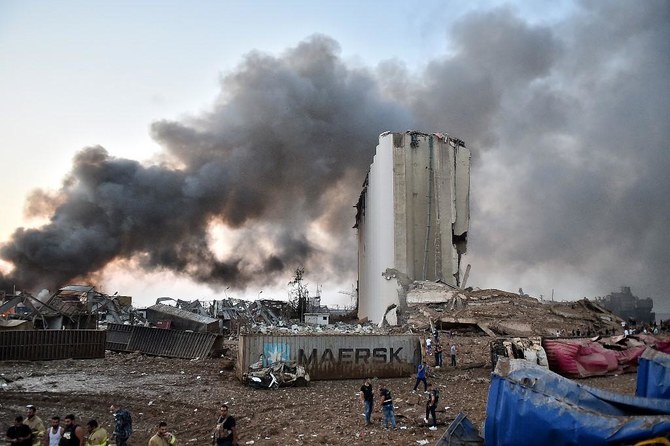
The explosion of a huge stockpile of poorly stored fertilizer on the dockside on August 4, 2020 killed more than 210 people, wounded thousands and ravaged half the capital.
In the aftermath of mass protests in late 2019 demanding the ouster of the traditional ruling class, many said the disaster was just the latest example of official incompetence and corruption.
But months into a domestic investigation, no one has been held accountable.
Politicians have repeatedly obstructed the work of judge Tarek Bitar by refusing to show up for questioning, filing legal complaints against him or calling for his dismissal, which last week sparked deadly violence in the heart of Beirut.
Analyst Lina Khatib said hopes were fading of holding those responsible for the port blast accountable.
“The ruling class in Lebanon is in agreement about wanting the port probe to be abandoned and they will use all available means to derail it,” said Khatib, director of the Middle East and North Africa program at the Chatham House think tank.
The country’s powerful Shiite movement Hezbollah has spearheaded a campaign to remove Bitar, accusing him of political bias.
The debate over his future, which comes after the previous investigator was removed in February, has already triggered the postponement of one cabinet meeting despite the urgency of addressing Lebanon’s acute economic crisis.
Nadim Houry, executive director at the Arab Reform Initiative, said that the whole ruling class felt under threat in what he described as “an essential battle in Lebanon for rule of law.”
“A section of society has decided that they want to go all the way and ask for truth,” but they face “a political class that is willing to use threats, use violence, use even launching into another civil war to prevent that quest for truth from leading to a result,” he said.
It emerged after the port blast that officials had known that hundreds of tons of ammonium nitrate had for years been left to linger in a warehouse near residential neighborhoods.
Families of the victims see in Bitar the only hope for justice in a country where impunity has long been the norm.
After the 1975 to 1990 civil war, Lebanon issued a broad amnesty that benefited the country’s warlords, allowing many of them to become political leaders.
“Regardless of what Bitar finds, it’s the idea itself that any of them can somehow be held accountable that they are resisting,” Houry said.
Any success in the blast probe would set a precedent and unravel a “impunity regime” under which each party agrees not to pursue the other for its crimes, as long as it is not targeted itself.
Tensions came to a boil last week after a rally against Bitar organized by Hezbollah and its Shiite ally Amal descended into violence that killed seven of their supporters.
The sound of gunfire and rocket-propelled grenades trapped residents indoors for hours, reviving memories of the civil war.
Hezbollah accused snipers of the Lebanese Forces, a Christian party, of causing the bloodshed, but the latter has denied this.
The army, meanwhile, is investigating a video circulated on social media that appears to show a soldier shooting at protesters.
“Hezbollah is increasingly acting as the praetorian guard of the regime that has come into place since the 1990s,” Houry said.
The Iran-backed movement, the only one not to have disarmed after the civil war, is at least partly blacklisted by most Western governments but holds seats in parliament.
While political parties have publicly supported an investigation, analysts say they ultimately wish to protect their own interests.
“Lebanon’s ruling class may be political opponents but they are united in profiteering from the system... and they therefore oppose any steps to reform it or to instil accountability within it,” Khatib said.
A spokesman for the families of blast victims quit on Saturday, after many feared he had been intimidated into toeing the Hezbollah line and calling for Bitar to step down.
Ibrahim Hoteit, who lost his brother in the explosion, lives in a Shiite-majority neighborhood.
The following day, many refrained from taking part in a protest to mark the second anniversary of the now-defunct 2019 protest movement, fearing further violence.
“Ultimately, the ruling class want to push the Lebanese to conclude that the price of accountability is too high,” Khatib said.

Lebanon elite united against Beirut port blast probe seen as survival threat
Short Url
https://arab.news/nj9h4
Lebanon elite united against Beirut port blast probe seen as survival threat
- Explosion of a huge stockpile of poorly stored fertilizer on the dockside on August 4, 2020 killed more than 210 people
- ‘Lebanon’s ruling class may be political opponents but they are united in profiteering from the system’
Turkish, Greek leaders voice desire to resolve issues
- Greek Prime Minister Kyriakos Mitsotakis, Turkish President Tayyip Erdogan say they discussed their issues 'in an open and sincere way'
- The NATO allies but historic rivals try to build on warming relations
ANKARA: The leaders of Turkiye and Greece voiced their desire to resolve longstanding maritime disputes hobbling ties during discussions in Ankara on Wednesday, as the NATO allies and historic rivals try to build on warming relations.
The neighbors have been at odds over a range of issues for decades, primarily maritime boundaries and rights in the Aegean, an area widely believed to hold energy resources and with key implications for airspace and military activity.
Following years of heightened tensions, a 2023 declaration on friendly relations prompted a thaw in rhetoric, though their maritime issues have remained unresolved and the two sides still disagree over regional matters.
Speaking at a press conference in Ankara with Greek Prime Minister Kyriakos Mitsotakis, Turkish President Tayyip Erdogan said they had discussed their issues in the Aegean and eastern Mediterranean “in an open and sincere way” during the talks.
“While the issues may be thorny, they are not unsolvable on the basis of international law. I saw that we were in agreement with my friend Kyriakos,” Erdogan said.
He added that the two countries would continue working to achieve their goal of reaching $10 billion in bilateral trade.
Mitsotakis said he hoped circumstances would allow the sides to solve a dispute on the demarcation of maritime and exclusive economic zones in the Aegean and eastern Mediterranean.
If not now when?
“It is time to remove any substantial and formal threats to our relations, if not now, when?” Mitsotakis said.
“Destiny has appointed us to live in the same neighborhood. We cannot change geography, but we can make it an ally, choosing convergence, dialogue and trust in international law... to build a future of peace, progress and prosperity for our people.”
Despite the positive tone, Greece’s foreign minister earlier said Athens planned to extend its territorial waters further, including potentially in the Aegean.
Shortly after, Ankara said it had issued a maritime notice urging Greece to coordinate research activities in areas of the Aegean that Turkiye considers part of its continental shelf.
In 1995, Turkiye’s parliament declared a casus belli — a cause for war — should Greece unilaterally extend its territorial waters beyond six nautical miles in the Aegean, a stance Athens says violates international maritime law. Greece says it wants only to discuss demarcation of maritime zones.
Migrant flows
Mitsotakis also said the flows of migrants in the Aegean Sea had decreased by almost 60 percent last year due to cooperation between the two countries, adding this should be strengthened.
Fifteen migrants died in a shipwreck off the Greek island of Chios last week after their boat collided with a Greek coast guard vessel and sank in the Aegean Sea off the Turkish coast.
Turkiye is a transit country for migrants seeking to reach the European Union via Greece. Ankara says the EU has not fully delivered on commitments under a 2016 migration deal and Athens wants Turkiye to do more to curb irregular crossings.
The neighbors have been at odds over a range of issues for decades, primarily maritime boundaries and rights in the Aegean, an area widely believed to hold energy resources and with key implications for airspace and military activity.
Following years of heightened tensions, a 2023 declaration on friendly relations prompted a thaw in rhetoric, though their maritime issues have remained unresolved and the two sides still disagree over regional matters.
Speaking at a press conference in Ankara with Greek Prime Minister Kyriakos Mitsotakis, Turkish President Tayyip Erdogan said they had discussed their issues in the Aegean and eastern Mediterranean “in an open and sincere way” during the talks.
“While the issues may be thorny, they are not unsolvable on the basis of international law. I saw that we were in agreement with my friend Kyriakos,” Erdogan said.
He added that the two countries would continue working to achieve their goal of reaching $10 billion in bilateral trade.
Mitsotakis said he hoped circumstances would allow the sides to solve a dispute on the demarcation of maritime and exclusive economic zones in the Aegean and eastern Mediterranean.
If not now when?
“It is time to remove any substantial and formal threats to our relations, if not now, when?” Mitsotakis said.
“Destiny has appointed us to live in the same neighborhood. We cannot change geography, but we can make it an ally, choosing convergence, dialogue and trust in international law... to build a future of peace, progress and prosperity for our people.”
Despite the positive tone, Greece’s foreign minister earlier said Athens planned to extend its territorial waters further, including potentially in the Aegean.
Shortly after, Ankara said it had issued a maritime notice urging Greece to coordinate research activities in areas of the Aegean that Turkiye considers part of its continental shelf.
In 1995, Turkiye’s parliament declared a casus belli — a cause for war — should Greece unilaterally extend its territorial waters beyond six nautical miles in the Aegean, a stance Athens says violates international maritime law. Greece says it wants only to discuss demarcation of maritime zones.
Migrant flows
Mitsotakis also said the flows of migrants in the Aegean Sea had decreased by almost 60 percent last year due to cooperation between the two countries, adding this should be strengthened.
Fifteen migrants died in a shipwreck off the Greek island of Chios last week after their boat collided with a Greek coast guard vessel and sank in the Aegean Sea off the Turkish coast.
Turkiye is a transit country for migrants seeking to reach the European Union via Greece. Ankara says the EU has not fully delivered on commitments under a 2016 migration deal and Athens wants Turkiye to do more to curb irregular crossings.
© 2026 SAUDI RESEARCH & PUBLISHING COMPANY, All Rights Reserved And subject to Terms of Use Agreement.