

Pakistan minister says country can’t run on subsidy after petrol prices soar to historic high 

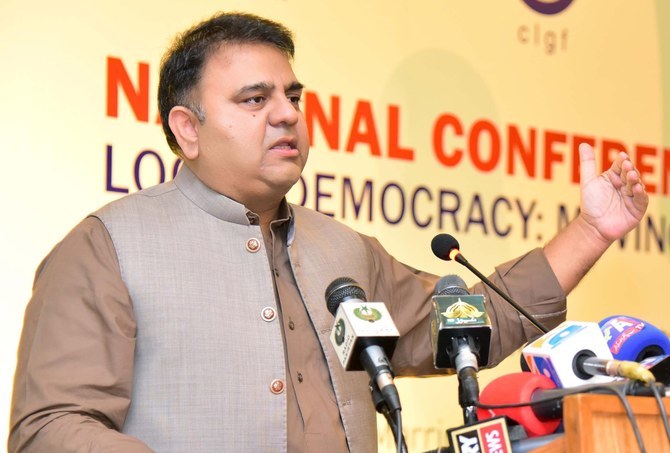
Pakistani information minister Chaudhry Fawad Hussain addressing a national conference on "Local Democracy and Moving Forward" in Islamabad, Pakistan on Sept. 28, 2021. (PID Photo)
Short Url
Updated 17 October 2021
Follow

Pakistan minister says country can’t run on subsidy after petrol prices soar to historic high 

  • Chaudhry Fawad Hussain laments “propaganda,” says industries, agriculture, construction sectors making record profits 
  • Government increased petrol price by Rs10.49 on Saturday, taking it to Rs137.79 per liter 

ISLAMABAD: Pakistani Information Minister Chaudhry Fawad Hussain on Sunday said the entire country could not be run on subsidy, a day after Pakistan recorded a historic hike in petroleum prices. 

The Pakistani government increased the price of petrol by Rs10.49 and that of high-speed diesel by Rs12.44 on Saturday, taking them to Rs137.79 and Rs134.48 per liter, respectively. 

The prices of kerosene and light diesel oil rose by Rs10.95 and Rs8.84 to Rs110.26 and Rs108.35 a liter, respectively. 

This is perhaps the first time the four major petroleum products are being simultaneously sold above Rs100 in the country, according to the publicly available data. 

The move drew the ire of the opposition and the masses, who said it would lead to further inflation in the country. 

But Hussain said the opponents were waging such “propaganda” as if Pakistan existed on some other “planet.” 

“If the prices of oil and gas would go up globally, then they would increase in Pakistan as well,” he contended in a Twitter post. 

“The entire country cannot run on subsidy. Prices are high today, they will come down tomorrow, then they will decrease here too.” 

The minister said these financial difficulties were temporary, adding that industries, agriculture and the construction sector were making historic profits. 

Admitting financial difficulties of the working class, he also suggested a solution to them. 

“The salaried class is facing problems and the private sector should raise salaries of its workers,” Hussain said. 

“Increase in pay and employment is a solution to inflation.” 


Pakistan mulls 'Super App' for public services, document verification in major technology push

Updated 15 February 2026
Follow

Pakistan mulls 'Super App' for public services, document verification in major technology push

  • Pakistan has been urging technology adoption in public, private sectors as it seeks to become a key tech player globally
  • The country this month launched the Indus AI Week to harness technology for productivity, skills development and innovation

KARACHI: Pakistan is planning to launch a “Super App” to deliver public services and enable digital document verification, the country's information technology (IT) minister said on Sunday, amid a major push for technology adoption in public and private sectors.

Pakistan, a country of 240 million people, seeks to become a key participant in the global tech economy, amid growing interest from governments in the Global South to harness advanced technologies for productivity, skills development and innovation.

The country's information and communications technology (ICT) exports hit a record $437 million in Dec. last year, according to IT Minister Shaza Fatima Khawaja. This constituted a 23% increase month on month and a 26% increase year on year.

Pakistan's technology sector is also advancing in artificial intelligence (AI) and cloud computing, marked by the launch of Pakistan’s first sovereign AI cloud in November, designed to keep sensitive data domestic and support growth in the broader digital ecosystem.

“In developed countries, citizens can access all government services from a mobile phone,” Fatima said, announcing plans for the Super App at an event in Karachi where more than 7,000 students had gathered for an AI training entrance test as part of the ‘Indus AI Week.’

“We will strive to provide similar facilities in the coming years.”

Khawaja said the app will reduce the need for in-person visits to government offices such as the National Database and Registration Authority (NADRA) and the Higher Education Commission (HEC).

The Indus AI Week initiative, which ran from Feb. 9 till Feb. 15. was aimed at positioning Pakistan as a key future participant in the global AI revolution, according to the IT minister.

At the opening of the weeklong initiative, Prime Minister Shehbaz Sharif announced that Pakistan would invest $1 billion in AI by 2030 to modernize the South Asian nation’s digital economy.

“These initiatives aim to strengthen national AI infrastructure and make the best use of our human resource,” Khawaja said, urging young Pakistanis to become creators, inventors and innovators rather than just being the consumers of technology.