

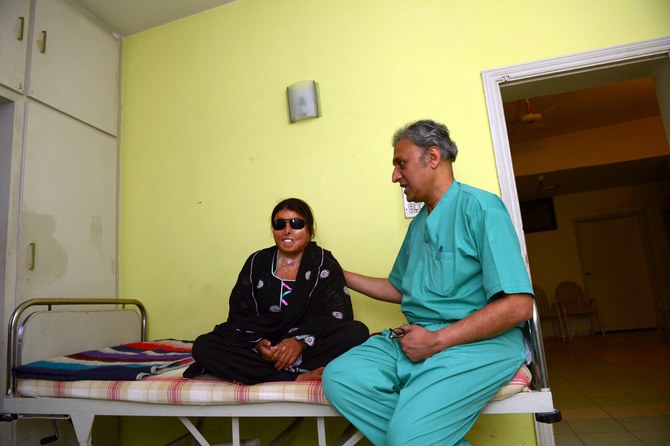

KARACHI: Despite an overall decline in acid attacks in Pakistan, such incidents have surged in Karachi in recent weeks, making officials and experts describe the emerging trend as “alarming.”
According to media reports, six acid attacks were reported in different parts of the city in the last 45 days in which four women, one transwoman and a man were targeted by their spouses, acquaintances or partners.
The most recent acid attack victim was a transwoman, Saima, who was shifted to a local hospital after the incident, though she died during her treatment earlier this month.
According to police, Saima lived with another transgender person, Qaiser, who threw acid on her after an argument broke out between them.
“This surge in acid attacks in Karachi is alarming,” said Nuzhat Shireen of the Sindh Commission on the Status of Women (SCSW) on Wednesday.
She maintained the incidents of violence against women were usually underreported in the country, though she acknowledged that there was an overall decline in acid attack cases.
“The SCSW, which ensures legal action in cases of violence against women, will also look into this matter,” she added.
The acid attack incidents since August involved a burqa-clad woman who targeted the first wife of her husband.
Two men also poured acid on their wives while a woman gave burn wounds to her former husband who refused to remarry her.
In August, a 19-year-old TikTok star, Rimsha, died after her former husband doused her with acid. In her statement to the police, she mentioned how she was chased by him before he grabbed her and emptied a bottle of acid on her.
According to Wasim Shahmalak, a senior official of the Acid Survivors Foundation (ASF) in Sindh, more than 150 acid attack victims had been treated in Karachi since 2014, adding the number still showed a decline in these instances.
An ASF report in 2017 mentioned a significant drop in such cases following the enactment of a legislation criminalizing acid and burn violence in December 2011. The organization maintained that 1,108 acid attacks had taken place in Pakistan between 2007 and 2016 which targeted 1,375 people.
In 2014, however, 153 acid attacks targeting 210 victims were recorded while this number further declined to 69 in 2015 and slightly increased to 73 in 2016.
Shireen said certain actions by the Sindh Commission on the Status of Women, including a joint WhatsApp group where senior police officials shared progress in the cases of violence against women, had resolved the issue of legal inaction.
“We have drafted an amendment bill which will ensure better implementation of the existing laws since both federal and Sindh Acid Control and Acid Crime Prevention Acts have lacunas,” she said, adding that these loopholes made out-of-court settlements possible in such cases.
“In one instance, I traveled from Karachi to Nawabshah, but the victim did not show up in the court,” she informed. “Later, the police said that the victim had resolved the matter without involving the judicial authorities. In one case, a victim married her attacker.”
Musarrat Misbah, a Pakistani beautician and philanthropist who founded Depilex Smileagain Foundation for the treatment of acid attack survivors, speculated that COVID-19 could be one reason behind the sudden surge in such attacks since there was evidence that the pandemic had increased domestic violence in different parts of the world.
“In our society, the pressure is mostly directed toward the weak,” she said. “Women frequently become victims of domestic violence which, in its worst form, can take the shape of an acid attack.”
She noted that while there were several laws to deal with the menace, these were not fully implemented.
“If we have to address this problem, we will have to punish the preparator of these crimes and the state will have to take responsibility for that,” she added. “The state must also regulate the sale and purchase of acids.”
Speaking to Arab News, Muhammad Akram, father of the deceased TikTok star Rimsha said that her daughter’s alleged murderer had been thrown behind bars, though he added that he did not know the exact status of her case.
“I lost my daughter since she got married to a wrong man,” he said. “While the accused’s family has not asked me for an out-of-court settlement, they have been threatening me indirectly to back off. I am a poor man who is totally shattered by his daughter’s death. It is hard for me to pursue this case, but I cannot give up either.”


