KONGSBERG, Norway: A bow-and-arrow attack in Norway that left five people dead this week appears to have been motivated by mental illness, authorities indicated Friday, as the perpetrator was ordered to be kept in a medical facility.
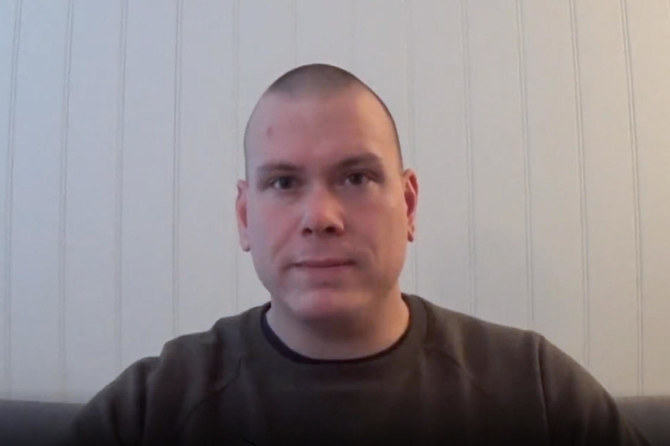
Espen Andersen Brathen, a 37-year-old Danish citizen who converted to Islam and is believed to have been radicalized, has confessed to the Wednesday killings in police questioning.
He was in custody in a medical facility on Friday pending a psychiatric evaluation.
“The strongest hypothesis after the first days of the investigation is that illness is in the background,” police inspector Per Thomas Omholt told reporters on Friday.
Police were however keeping other possibilities open, and have investigated a range of motives including “anger, revenge, impulse, extremism, illness and provocation,” Omholt said.
The psychiatric evaluation, which could take several months, is necessary to determine whether Brathen can be held legally responsible for his actions.
“This indicates that things are not exactly as they should be,” his lawyer Fredrik Neumann said, referring to his client’s mental health.
“A complete judicial assessment will clarify that,” he told the Norwegian newspaper VG.
Omholt said Friday that Brathen had admitted to the acts but did not admit guilt.
While authorities said the attack bore the hallmarks of an act of terror, they seemed to be leaning toward the theory that it was the act of a mentally unstable person.
“There is no doubt that (it) appears as if it could be an act of terror, but it’s important that the investigation continues and that we establish the motive of the suspect,” the head of Norway’s intelligence service PST, Hans Sverre Sjovold, said Thursday.
“This is a person who has been in and out of the health system for some time.”
Four women and one man were killed and three people injured in the attack in the town of Kongsberg, and police said a bow and arrows and two other undisclosed weapons were used before he was arrested.
Brathan was known to PST, which is in charge of Norway’s anti-terrorism efforts, but few details have emerged about why. According to public broadcaster NRK, the first warning was in 2015.
“There were fears linked to radicalization previously,” police official Ole Bredrup Saeverud told reporters.
Those reports dated to last year or earlier, and police said they had followed up at the time.
Norwegian media reported that in 2018 the PST had warned that he could commit “a small-scale attack.”
It also said that Brathen was subject to two prior court rulings, including a restraining order against him regarding his parents after threatening to kill his father, and a conviction for burglary and purchasing narcotics in 2012.
Local media also unearthed a video Brathen allegedly posted on social media in 2017, in which he issued a “warning” and declared his Muslim faith.
Speaking anonymously, one of Brathen’s neighbors described him as a big person with a crew cut and a serious demeanour, who was always seen “alone.”
“No smile, nothing in the face. He was just staring,” the neighbor told AFP.
Brathen is believed to have acted alone when he killed four women and a man, aged between 50 and 70, in several locations in Kongsberg where he lived.
Flowers and candles were placed in front of the various crime scenes in Kongsberg, a town of 25,000 people still reeling from the attack.
Norway’s Prime Minister Jonas Gahr Store, who took office on Thursday following elections last month, visited the town on Friday.
“We stand together when crisis strikes. For those of who have political responsibility, the safety of our citizens is the most important thing,” he said in a speech.
Svein Westad, a 75-year-old pensioner wandered aimlessly on Hyttegata street, where two of his neighbors and close friends were killed in their homes.
“I’m totally broken into pieces, I cannot say anything more than that. I will never get over this,” he told AFP.
“They should have caught him immediately,” he said, referring to criticism against the police for arresting Brathen more than 30 minutes after the first reports came in.
Norway rarely experiences such violence, but 10 years ago Anders Behring Breivik killed 77 people in the country’s worst massacre since World War II.


Mental illness may have triggered Norway bow-and-arrow attack
https://arab.news/c6gnz
Mental illness may have triggered Norway bow-and-arrow attack

- Espen Andersen Brathen is believed to have acted alone when he killed four women and a man, aged between 50 and 70, in several locations in Kongsberg where he lived
- While authorities said the attack bore the hallmarks of an act of terror, they seemed to be leaning toward the theory that it was the act of a mentally unstable person


UK pays Guantanamo detainee ‘substantial’ compensation over US torture questions
- Abu Zubaydah has been held at Guantanamo Bay without charge for 20 years
- British security services knew he was subjected to ‘enhanced interrogation’ but failed to raise concerns for 4 years
LONDON: A Saudi-born Palestinian being held without trial by the US has received a “substantial” compensation payment from the UK government, the BBC reported.
Abu Zubaydah has been imprisoned at Guantanamo Bay in Cuba for almost 20 years following his capture in Pakistan in 2002, and was subjected to “enhanced interrogation” techniques by the CIA.
He was accused of being a senior member of Al-Qaeda in the aftermath of the Sept. 11 terror attacks on the US. The allegations were later dropped but he remains in detention.
The compensation follows revelations that UK security services submitted questions to the US to be put to Abu Zubaydah by their US counterparts despite knowledge of his mistreatment.
He alleged that MI5 and MI6 had been “complicit” in torture, leading to a legal case and the subsequent compensation.
Dominic Grieve, the UK’s former attorney general, chaired a panel reviewing Abu Zubaydah’s case.
He described the compensation as “very unusual” but said the treatment of Abu Zubaydah had been “plainly” wrong, the BBC reported.
Grieve added that the security services had evidence that the “Americans were behaving in a way that should have given us cause for real concern,” and that “we (UK authorities) should have raised it with the US and, if necessary, closed down co-operation, but we failed to do that for a considerable period of time.”
Abu Zubaydah’s international legal counsel, Prof. Helen Duffy, said: “The compensation is important, it’s significant, but it’s insufficient.”
She added that more needs to be done to secure his release, stating: “These violations of his rights are not historic, they are ongoing.”
Duffy said Abu Zubaydah would continue to fight for his freedom, adding: “I am hopeful that the payment of the substantial sums will enable him to do that and to support himself when he’s in the outside world.”
He is one of 15 people still being held at Guantanamo, many without charge. Following his initial detention, he arrived at the prison camp having been the first person to be taken to a so-called CIA “black site.”
He spent time at six such locations, including in Lithuania and Poland, outside of US legal jurisdiction.
Internal MI6 messages revealed that the “enhanced interrogation” techniques he was subjected to would have “broken” the resolve of an estimated 98 percent of US special forces members had they been subjected to them.
CIA officers later decided he would be permanently cut off from the outside world, with then-President George W. Bush publicly saying Abu Zubaydah had been “plotting and planning murder.”
However, the US has since withdrawn the allegations and no longer says he was a member of Al-Qaeda.
A report by the US Senate Select Committee on Intelligence said Abu Zubaydah had been waterboarded at least 83 times, was locked in a coffin-like box for extended periods, and had been regularly assaulted. Much of his treatment would be considered torture under UK law.
Despite knowledge of his treatment, it was four years before British security services raised concerns with their American counterparts, and their submission of questions within that period had “created a market” for the torture of detainees, Duffy said.
A 2018 report by the UK Parliament’s Intelligence and Security Committee was deeply critical of the behavior of MI5 and MI6 in relation to Abu Zubaydah.
It also criticized conduct relating to Guantanamo detainee Khalid Sheikh Mohammed, widely regarded as a key architect of the Sept. 11 attacks, warning that the precedent set by Abu Zubaydah’s legal action could be used by Mohammed to bring a separate case against the UK.
MI5 and MI6 failed to comment on Abu Zubaydah’s case. Neither the UK government nor Mohammed’s legal team would comment on a possible case over his treatment.


