The masks are off in public places as Saudi Arabia eases COVID-19 restrictions

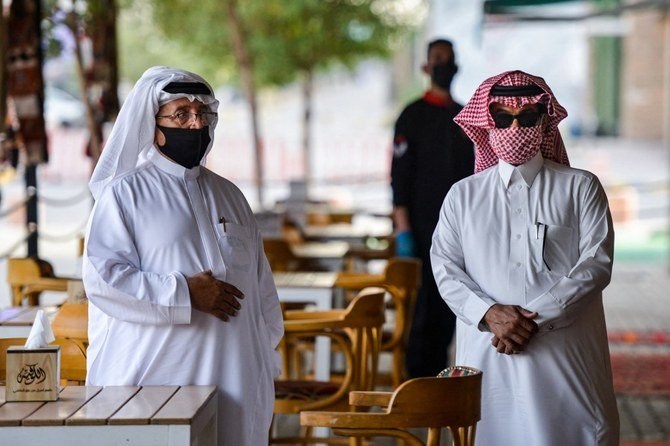
Mask-clad clients wait for their table to be sanitised upon arriving at a cafe in Saudi Arabia's capital Riyadh on June 21, 2020. (File/AFP)
Short Url
Updated 15 October 2021
Follow

The masks are off in public places as Saudi Arabia eases COVID-19 restrictions

  • The Grand Mosque and the Prophet’s Mosque will also be operating at full capacity for those who have been double jabbed

Saudi Arabia announced on Friday the easing of restrictions previously imposed due to the coronavirus pandemic. 

People will no longer be required to wear masks in open places from Oct. 17, state news agency SPA reported, citing  a source in the Ministry of Interior.

The Grand Mosque and the Prophet’s Mosque will also be operating at full capacity for those who have been double jabbed with the vaccine. But workers and visitors will still be required to wear a face mask at all times.

There will no longer be social distancing measures, gatherings will be allowed, while public places, public transport, restaurants, and cinemas, will operate at full capacity.


King Abdulaziz Foundation reveals rare images from king’s 1916 Basra visit

Updated 20 December 2025
Follow

King Abdulaziz Foundation reveals rare images from king’s 1916 Basra visit

  • Photographs form part of a wider collection documented by British photographer Gertrude Bell

RIYADH: The King Abdulaziz Foundation has revealed archival photographs documenting King Abdulaziz’s tour of the outskirts of Basra in 1916, a visit that came at an early stage of his efforts to build regional relationships.

One of the photographs, taken by British photographer Gertrude Bell, shows King Abdulaziz standing with his men in the Basra desert, the Saudi Press Agency reported. 

The image reflects his early political and diplomatic engagement in the region, as he sought to strengthen ties with neighboring areas and engage with the wider Arab and international community, SPA added.

The photograph forms part of a wider collection documented by Bell, which records key developments and transformations across the Arabian Peninsula during the early 20th century.

The Basra visit holds particular significance in King Abdulaziz’s journey as a unifying leader. 

Rather than crossing borders in pursuit of power, the visit reflected an approach focused on stability, cooperation and long-term regional harmony, laying the groundwork for a leadership style defined by pragmatism and openness, SPA said.