MOSCOW: Russia’s Sputnik Light vaccine shows 70 percent effectiveness against the Delta variant of COVID-19 three months after injection. The one-shot product is likely to become the country’s main vaccine, Russia’s sovereign wealth fund said on Wednesday.
The findings are part of a Russian push to promote Sputnik Light as an effective standalone vaccine and as a booster that can be combined with non-Russian vaccines.
RDIF, the wealth fund which markets Sputnik Light abroad, cited data submitted by the developer, the Gamaleya Institute, to medical website medRxiv ahead of a peer review. The data was based on 28,000 participants who received a dose of Sputnik Light, and an unvaccinated control group of 5.6 million.
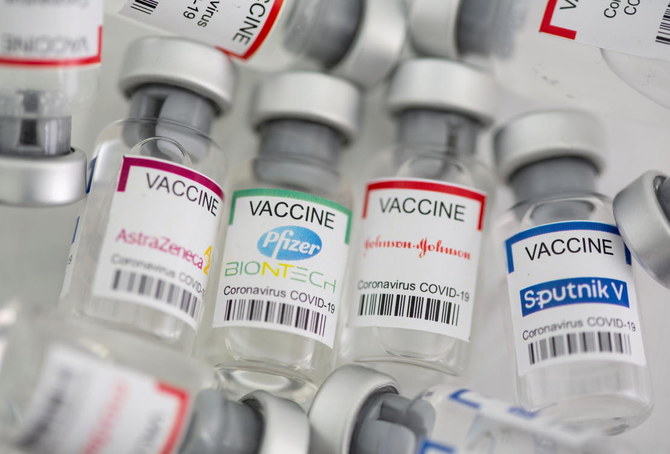
Russia is battling soaring infections and hesitancy about vaccines at home, while struggling to compete in some markets with Western vaccines developed by Pfizer, Moderna and AstraZeneca.
Countries around the world are deploying or considering administering third doses of Pfizer or Moderna as booster shots though there is no scientific consensus about how broadly they should be used.
When used as a booster for other vaccines, Sputnik Light, which comprises the first shot of Russia’s two-shot flagship Sputnik V, will be over 83 percent effective against infection by the Delta variant and over 94 percent effective against hospitalization, RDIF said in a statement.
Kirill Dmitriev, head of the RDIF, told Reuters he expected Sputnik Light to become Russia’s main COVID-19 vaccine.
“Eventually, we believe that Sputnik Light could be the main vaccine one year from now when many people will just need to get revaccinated or will have had COVID and won’t need Sputnik V,” he said.
RDIF expects to produce enough Sputnik V and Sputnik Light for 700 million people this year, with around 50 percent of production already located abroad, Dmitriev said.
He said Russia wanted no more than 20-25 percent of the global market and had no ambition to take a monopoly position.
Argentina and some other counties were doing trials to combine Sputnik Light with AstraZeneca, Sinopharm and Moderna. Two countries were combining Pfizer and Sputnik Light, he said.
Alexander Gintsburg, director of the Gamaleya Institute, said Sputnik Light was easy and fast to produce.
Manufacturers have told Reuters that they have had difficulties producing the second Sputnik V dose.
RDIF had hoped to clinch regulatory approval for Sputnik V from the European Medicines Agency (EMA) and the World Health Organization (WHO) months ago, but it has taken longer than expected, depriving it of access to more markets.
Dmitriev said RDIF expected the WHO to approve Sputnik V for use by the end of the year. The WHO said on Wednesday approval for Sputnik V was on hold pending some missing data and legal procedures, which it hoped would be “sorted out quite soon.”
Dmitriev said it was possible the EMA would grant approval by the end of this year as well. RDIF had got positive feedback from the EU on clinical trials and expected an EU inspection in the autumn, he said.
RDIF had applied for separate approval for the two components used in Sputnik V, and Sputnik Light would therefore be automatically approved at the same time, he added.
Dmitriev said Sputnik Light had already been registered in 15 countries and he expected it to be approved in 30 other countries in the next month.
The two-shot Sputnik V vaccine is registered in 70 countries.


![]()

Russia says Sputnik Light is 70 percent effective against Delta variant
Short Url
https://arab.news/nyp55
Russia says Sputnik Light is 70 percent effective against Delta variant
- The findings are part of a Russian push to promote Sputnik Light as an effective standalone vaccine and as a booster that can be combined with non-Russian vaccines
- Russia is battling soaring infections and hesitancy about vaccines at home, while struggling to compete in some markets with Western vaccines


Latest updates


© 2026 SAUDI RESEARCH & PUBLISHING COMPANY, All Rights Reserved And subject to Terms of Use Agreement.