

Turkey says it will do ‘what is necessary’ after Syria attacks

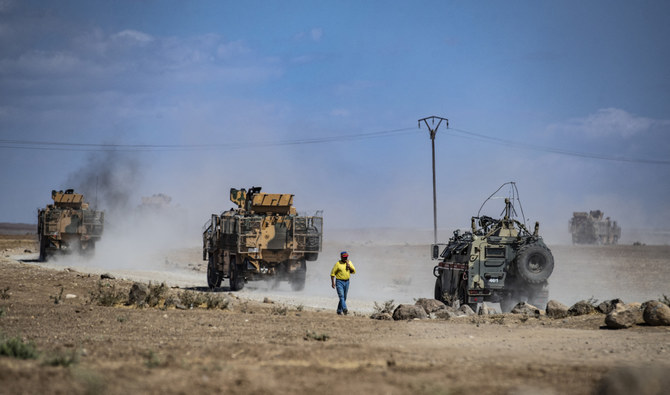
Turkey controls swaths of territory in northern Syria. (AFP)
Short Url
Updated 13 October 2021
Follow

Turkey says it will do ‘what is necessary’ after Syria attacks

  • Erdogan said a YPG attack in Turkey that killed two Turkish police was “the final straw”

ANKARA: Turkey has begun laying the groundwork for a new military incursion into northern Syria amid a rise in cross-border attacks by Syrian Kurdish YPG militia.

President Recep Tayyip Erdogan said on Monday that a YPG attack in southern Turkey that killed two Turkish police was “the final straw” and Turkey was determined to eliminate the threat.

On Wednesday, Foreign Minister Mevlut Cavusoglu said the US and Russia had failed to ensure a YPG withdrawal from the Syrian border area. “In the latest attacks ... both Russia and the US have a responsibility as they did not keep their promises,” Cavusoglu said. “Since they are not keeping their promises, we will do what is necessary for our security.”

Turkey controls swaths of territory in northern Syria, after carrying out three separate cross-border offensives against Daesh and the YPG. Ankara halted an offensive in 2019 in exchange for the withdrawal of YPG militants 30 km south of its border, but has repeatedly complained of violations.

Reired major Nihat Ali Ozcan, a a security analyst at the TEPAV think tank in Ankara, said Cavusoglu and Erdogan were sending direct messages to Russia and the US.

“As part of its commitments to Russia, Turkey committed to reopen M4, a vital link between Aleppo and Latakia. If it establishes security in that area, Russia may be willing to open a gateway to Tal Rifaat to let Turkish troops hit the YPG,” he told Arab News.

However, Ozcan said such a move could undermine US-Turkey relations at a time when both parties were trying to build trust after years-long disagreements over several key issues, including Turkey’s purchase of Russian-made S-400 missiles.

“There is a scheduled meeting between President Erdogan and his Joe Biden in Rome in late October. An operation against the YPG risks canceling this meeting and opening up a new chapter of crisis in bilateral relations,” he said.

Aydin Sezer, an expert on Turkey-Russia relations, said Turkey was uneasy over YPG intrusions into the Operation Peace Spring area, but conditions were “not appropriate for conducting such a large-scale operation.”

He said: “Turkey has nothing strategic to offer the Russian side for getting its approval for any aerial strike. However, these latest statements by Erdogan and Cavusoglu might have been helpful for Moscow to use as a stick against the YPG for them to make peace with Assad,” he told Arab News.

“A small-scale operation to the eastern side of the Operation Peace Spring is possible but any large-scale operation to Tal Rifaat would mean entering into direct war with Assad because the regime troops are mainly deployed in that area.”

Oytun Orhan, coordinator of Syria studies at the ORSAM think tank in Ankara, said an operation was likely although not in the short term.

“Considering the pattern in Turkey’s previous cross-border operations in Syria, the politicians first escalated the rhetoric, gave messages to the domestic and international audiences, then waited for a reaction from their counterparts, then launched the operation sometimes within months when the conditions become mature. So these statements cannot be accepted as merely bluff,” he told Arab News.

“Although it would be a symbolic move from Turkish side to attack Ain Al-Arab, a powerful symbol of Kurdish national identity where the YPG began emerging, Turkey wouldn’t risk attracting international criticism with such a starting point. It will probably start by hitting the YPG points at the eastern side of the Operation Peace Spring area up to Qamishli.”


Death toll in Iran protests rises to more than 500, rights group says

Updated 3 sec ago
Follow

Death toll in Iran protests rises to more than 500, rights group says

DUBAI/JERUSALEM: Unrest in Iran has killed more than 500 people, a rights group said on Sunday, as Tehran threatened to target US military bases if President Donald Trump carries ​out threats to intervene on behalf of protesters.
With the Islamic Republic’s clerical establishment facing the biggest demonstrations since 2022, Trump has repeatedly threatened to intervene if force is used on protesters.
According to its latest spreadsheet — based on activists inside and outside Iran, US-based rights group HRANA said it had verified the deaths of 490 protesters and 48 security personnel, with more than 10,600 people arrested.
Reuters was unable to independently verify the tolls.
Iranian Parliament Speaker Mohammad Baqer Qalibaf, speaking in parliament on Sunday, warned the United States against “a miscalculation.”
“Let us be clear: in the case of an attack on Iran, the occupied territories (Israel) as well as all US bases and ships will be our legitimate target,” said Qalibaf, a former commander in Iran’s elite Revolutionary Guards.
Authorities intensify crackdown
The protests began on December 28 in response to soaring prices, before turning against the clerical rulers who have governed since the 1979 Islamic Revolution.
Authorities accuse the US and Israel of fomenting unrest. Iran’s police ‌chief Ahmad-Reza Radan said ‌security forces had stepped up efforts to confront “rioters.”
The flow of information from Iran has been hampered ‌by ⁠an Internet blackout ​since Thursday.
Footage ‌posted on social media on Saturday from Tehran showed large crowds marching along a street at night, clapping and chanting. The crowd “has no end nor beginning,” a man is heard saying.
In footage from the northeastern city of Mashhad, smoke can be seen billowing into the night sky from fires in the street, masked protesters, and a road strewn with debris, another video posted on Saturday showed. Explosions could be heard.
Reuters verified the locations.
State TV aired footage of dozens of body bags on the ground at the Tehran coroner’s office on Sunday, saying the dead were victims of events caused by “armed terrorists.”
Three Israeli sources, who were present for Israeli security consultations over the weekend, said Israel was on a high-alert footing for the possibility of any US intervention.
An Israeli military official said the protests were an internal Iranian matter, but Israel’s military was ⁠monitoring developments and was ready to respond “with power if need be.” An Israeli government spokesperson declined to comment.
Israel and Iran fought a 12-day war in June last year, which the United States briefly joined by ‌attacking key nuclear installations. Iran retaliated by firing missiles at Israel and an American air base in ‍Qatar.
US ready to help, says Trump
Trump, posting on social media on Saturday, said: “Iran is looking at FREEDOM, perhaps like never before. The USA stands ready to help!!!“
In a phone call on Saturday, Israeli Prime Minister Benjamin Netanyahu and US Secretary of State Marco Rubio discussed the possibility of US intervention in Iran, according to an Israeli source present for the conversation.
Reza Pahlavi, the exiled son of Iran’s last shah and a prominent voice in the fragmented opposition, said Trump had observed Iranians’ “indescribable bravery.” “Do not abandon the streets,” Pahlavi, who is based in the US, wrote on X.
Maryam Rajavi, president-elect of the National Council of Resistance of Iran, a Paris-based Iranian opposition group, wrote on X that people in Iran had “asserted control of public spaces and reshaped Iran’s political landscape.”
Her group, also known as Mujahideen-e-Khalq (MEK), joined the 1979 revolution but later broke from the ruling clerics and fought them during the Iran-Iraq war in ‌the 1980s.
Netanyahu, speaking during a cabinet meeting, said Israel was closely monitoring developments. “We all hope that the Persian nation will soon be freed from the yoke of tyranny,” he said.