KARACHI: Pakistan’s national currency on Tuesday hit another all-time low against the US dollar to close at Rs171.04 amid growing demand for greenback for imports payments, analysts and traders said.
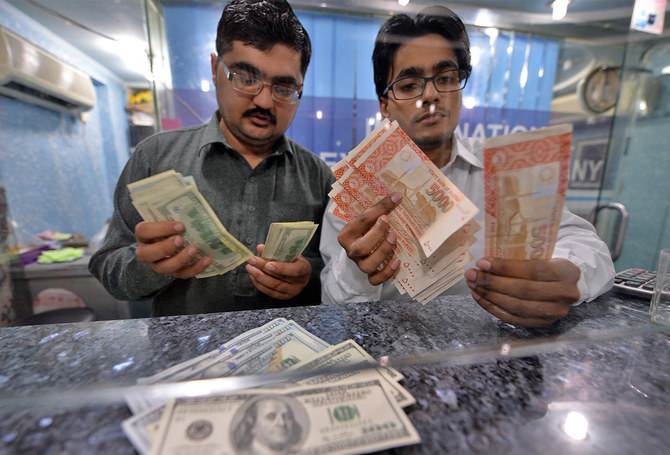
The rupee lost 30 paisas or 0.18 percent in the interbank market during the trading session. The currency also depreciated by 60 paisas in the open market for buying and traded at Rs171.60, according to the Exchange Companies Association of Pakistan.
“Daily demand in the interbank market is about $300 million while the supply including those from exports is only $200 million,” Malik Bostan, the association’s chairperson, told Arab News. “The government will have to take steps to reduce import demand or increase the dollar supply by any other means.”
Analysts say the currency is under pressure due to the increasing import bill, adding the demand for payments continue to build pressure on the currency.
“The Pak rupee is under pressure due to increasing import bill as the demand for the dollar to make external payments continue to rise,” Samiullah Tariq, director research at the Pakistan-Kuwait Investment, told Arab News.
“The increasing prices of commodities in the international markets are also among the key factors keeping the Pak rupee under pressure,” he added.
Tariq said the uncertainty related to the talks between Pakistan and the International Monetary Fund (IMF) was also one of the reasons behind the depreciation of the national currency.
“The conclusion of the talks with the IMF over the weekend or next week is likely to ease the pressure on the Pakistani rupee,” he added.
Due to higher imports, the country’s trade deficit stood at $11.66 billion during the first quarter of the fiscal year which is 101 percent higher than the trade deficit when compared to $5.8 billion during the corresponding period last year.
“The prices of petroleum products, palm oil and other essential commodities have increased in the global market which is inflating the import bill,” Tariq said.
Pakistan is also facing rising pressure due to the current financial situation of Afghanistan where the dollar supply has almost halted after the withdrawal of the international forces this August.
Pakistani authorities including the central bank have taken measures to control the flow of US dollar to Afghanistan by imposing some restrictions on travelers.
The central bank allowed people going to Afghanistan to carry only $1,000 per person per visit, with a maximum annual limit of $6,000.
The exchange companies have also been asked to conduct biometric verification for all foreign currency sales equivalent to $500 and above along with outward remittances from October 22, 2021.
To ease the burden on the rupee, the Federal Investigation Agency (FIA) has also been activated by the government.
The agency on Monday arrested eight people associated with a foreign exchange company as part of a largescale crackdown against the smuggling of currency mainly to Afghanistan.
“The FIA raids will not reduce the demand for greenback which is mainly coming from the interbank market where demand for import is building pressure on the rupee,” Bostan maintained.


![]()

Pakistani rupee continues plunge to hit new all-time low against the greenback
Short Url
https://arab.news/rpg94
Pakistani rupee continues plunge to hit new all-time low against the greenback
- The Pak rupee depreciated by 60 paisa in open market for buying and traded at Rs171.60 during the day
- Currency traders say the daily demand for greenback in interbank market is $300 million while its supply is only $200 million
Latest updates





© 2026 SAUDI RESEARCH & PUBLISHING COMPANY, All Rights Reserved And subject to Terms of Use Agreement.