

Saudi UN envoy calls for international consensus on Yemen at Human Rights Council

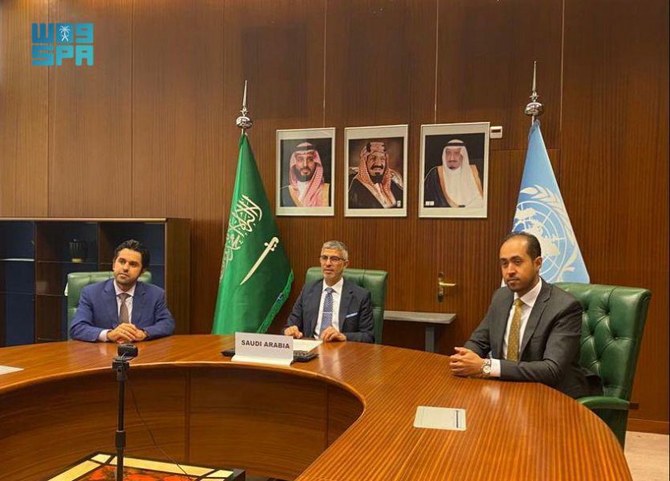
Abdul Aziz Al-Wasel, Saudi Arabia’s permanent representative to the UN, was speaking during the 48th session of the Human Rights Council in Geneva on Monday, Oct. 11, 2021. (SPA)
Short Url
Updated 12 October 2021
Follow

Saudi UN envoy calls for international consensus on Yemen at Human Rights Council

  • HRC announces the Kingdom’s candidate, Dr. Nurah Alamro, had been elected to its Advisory Committee
  • The council also extends mandate of the independent Fact Finding Mission to Libya

LONDON: An international consensus on the crisis in Yemen is the most effective way to help the people of the country, Abdul Aziz Al-Wasel, Saudi Arabia’s permanent representative to the UN in Geneva, said on Monday.
Speaking in the Swiss city during the 48th session of the Human Rights Council, he also highlighted the importance of Security Council resolutions, support for the UN’s special envoy for Yemen, Hans Grundberg, and all efforts to reach a political solution to the crisis.
The HRC rejected a resolution on the human rights situation in Yemen that would have extended the mandate for the council’s investigations of war crimes in the country. Al-Wasel said this was a response to the just and legitimate demands to end the activities of the investigators, known as the Group of Eminent Experts, demands he said were supported by a majority of council member states from various geographical regions.
The draft resolution was narrowly rejected by a vote of 21 to 18 against, with seven abstentions. The GEE had been tasked with investigating all alleged violations and abuses of international human rights committed by all parties to the conflict since September 2014.
However, Al-Wasel said the group’s reports had ignored international initiatives and resolutions issued on Yemen — including Security Council Resolution 2216, which authorizes sanctions on those found to be undermining the stability of Yemen — and that the team had abused its mandate in an unprecedented manner.
He said it had derived most of the information included in its reports from non-governmental organizations sympathetic to the Houthi militia. This had the effect, he added, of confusing international public opinion, widening the gap between segments and sects of the Yemeni population, strengthening and legitimizing the militia’s position, and overlooking the grave human rights violations carried out by the Houthis by portraying the Yemeni crisis as a dispute between conflicting parties and not a coup carried out by a militia that had seized power by force.
During the meeting, the HRC announced that the Kingdom’s candidate, Dr. Nurah Alamro, had been elected to its Advisory Committee, with a majority of the votes.
Alamro’s membership comes as an extension of the achievements made by Saudi diplomacy with the support of the leadership, and as a result of the efforts made by the Kingdom’s mission to the UN in Geneva, Saudi Press Agency reported.

The Advisory Committee is a think tank that provides advice to the HRC, works on studies and researches on issues related to the council’s mandate, and presents proposals on care and promotion of all human rights.
Meanwhile, the UK welcomed the decision to extend the mandate of the independent Fact Finding Mission to Libya.
“Libya must continue to cooperate with the mission, make accountability central to reconciliation and hold accountable mercenaries and foreign forces for the crimes they have committed,” said James Cleverly, minister for Middle East and North Africa at the Foreign, Commonwealth and Development Office.
At the end of the session, the council approved a resolution to extend the mission’s mandate for another nine months “to allow for the implementation of its mandate.”


Threat to Kingdom’s security is ‘red line’ that will be ‘addressed and neutralized,’ Saudi envoy says

Updated 14 January 2026
Follow

Threat to Kingdom’s security is ‘red line’ that will be ‘addressed and neutralized,’ Saudi envoy says

  • Abdulaziz Alwasil tells UN Security Council the situation in southern Yemen is ‘a just cause with social and historic dimensions’ that can only be resolved through dialogue
  • Recent military activity in the south was unilateral, resulting in an escalation that harms the interests of Yemeni people and undermines efforts to address issues in the south, he said

NEW YORK CITY: Any attempt to threaten Saudi Arabia’s national security is a “red line” and will be met with decisive action, the Kingdom’s ambassador to the UN told the Security Council on Wednesday.

Speaking during a meeting of the council to discuss Yemen, Abdulaziz Alwasil said the situation in the south of the country is “a just cause with social and historic dimensions” that can only be resolved through dialogue.

“We stress that any attempt to threaten our national security is a red line, and we will not hesitate to take the necessary actions and steps to address it and neutralize it,” he added.

Alwasil reaffirmed Saudi Arabia’s support for Yemeni President Rashad Al-Alimi, the Presidential Leadership Council, and the Yemeni government in their efforts to achieve security, stability, development and peace while preserving national unity.

He said military activity by Southern Transitional Council forces in Hadramout and Al-Mahra on Dec. 2, 2025, was unilateral, did not have the approval of the Presidential Leadership Council, and was not carried out in coordination with the Coalition to Restore Legitimacy in Yemen.

It had resulted in an unjustified escalation that harmed the interests of the Yemeni people, undermined efforts to address the issues in the south, and ran counter to the coalition’s objectives, Alwasil added.

The Kingdom, working with its coalition partners, the Presidential Leadership Council and the Yemeni government, had moved to contain the situation by dispatching a military force to coordinate arrangements with the Southern Transitional Council in Aden, he said.

The aim was to ensure the return of the southern council’s forces to their previous positions outside of Hadramout and Al-Mahra, and the handover of camps to legitimate government forces and local authorities in line with agreed procedures, Alwasil added.

He expressed regret over the military operations that took place in Hadramout and Al-Mahra, close to Saudi Arabia’s southern border, which he said posed a direct threat to the Kingdom’s national security, as well as the security of Yemen and regional stability. Such steps were extremely dangerous, he added, and contradicted the principles on which the Coalition to Restore Legitimacy in Yemen had been founded.

Alwasil welcomed a prisoner and detainee exchange agreement signed in Muscat on Dec. 23, which he described as an important humanitarian measure to alleviate suffering and build confidence.

He praised Oman for hosting and sponsoring the consultations and supporting negotiations, and commended the efforts of UN’s special envoy for Yemen, Hans Grundberg, the International Committee of the Red Cross and all others that has played a part.

Regarding the political efforts to resolve the crisis, Alwasil said Saudi Arabia welcomed President Al-Alimi’s call for an inclusive conference in Riyadh to bring together all stakeholders to discuss just solutions to the situation in southern Yemen.

Preparations for the conference have begun, he added, in cooperation with the Yemeni government and southern representatives, reflecting the close ties between the two countries and their shared interests in stabilizing Yemen.

He urged all southern stakeholders to participate actively and constructively in the talks, to help find comprehensive and just solutions that meet the legitimate aspirations of the people of southern Yemen.

Alwasil called on all Yemeni forces and stakeholders to cooperate and intensify their efforts to reach a lasting political settlement that would ensure security and stability.

He described the southern issue as “a just cause with social and historic dimensions,” adding that “the only way to address it is through dialogue that leads to a comprehensive political solution” based on nationally and internationally agreed terms of reference.