

Dr. AQ Khan, pioneer of Pakistan’s nuclear arsenal, buried in Islamabad

Army soldiers carry the national flag-draped coffin of Pakistan's nuclear scientist Abdul Qadeer Khan, during his funeral in Islamabad, Pakistan, on October 10, 2021. (REUTERS)
Short Url
Updated 11 October 2021
Follow

Dr. AQ Khan, pioneer of Pakistan’s nuclear arsenal, buried in Islamabad

  • Khan had been admitted at a local hospital where his health deteriorated, he has remained in poor health for years
  • His funeral prayers at Faisal Mosque were "as per his wishes"

ISLAMABAD: Pakistani nuclear scientist Dr. Abdul Qadeer Khan, revered in Pakistan as the father of its atomic bomb but known around the world for a nuclear proliferation scandal, was buried in Islamabad after his funeral prayers were held at the capital’s iconic Faisal Mosque on Sunday. 
Khan died at the age of 85 early on Sunday. 
In January 2004, he was subjected to a debriefing by the government of then military ruler Gen Pervez Musharraf over evidence of nuclear proliferation handed to Pakistan by the United States.
Khan was pardoned but placed under house arrest in 2004 after the scientist confessed on television to selling nuclear secrets to Iran, North Korea and Libya. He was freed in 2009. 
“Deeply saddened at passing away of national hero Dr. AQ Khan,” the foreign office said. “Great loss. Invaluable contributions for Pak. Heartfelt condolences to family members and friends.”

Khan had been admitted at a local hospital where his health deteriorated early on Sunday, state-run Radio Pakistan said.
“Dr. Abdul Qadeer Khan played an important role in making Pakistan a nuclear power. His services for defense of the country will be remembered for a long time,” it added.
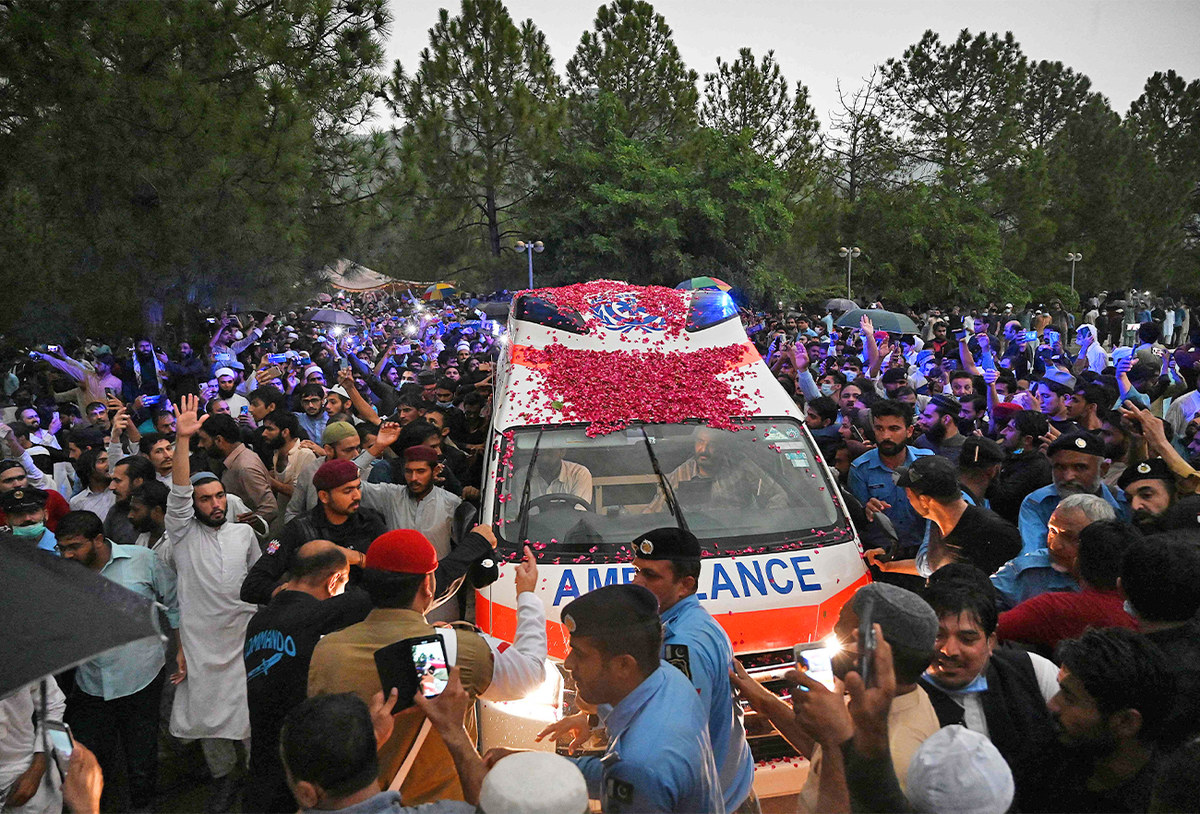


Supporters and officials gather around an ambulance carrying the coffin of the late Pakistan's nuclear scientist Abdul Qadeer Khan for his funeral outside the Faisal Mosque following his death in Islamabad on October 10, 2021. (AFP

Last month, Khan was hospitalized with COVID-19 but was discharged and sent home. He has remained in poor health on and off for years.
After Musharraf stepped down and a new government came to power in Pakistan in 2008, Khan gave a series of media interviews in which he recanted his 2004 confession, saying he only took the blame in return for assurances from Musharraf.
Pakistan tested nuclear weapons in 1998, weeks after arch-rival India conducted similar tests.
Khan was born in India before the creation of Pakistan. His family migrated to Pakistan in 1951.
From 1961, he studied material science at the Technical University in West Berlin before moving to Delft University of Technology in the Netherlands in 1965. In 1967, Khan got an engineer’s degree in Materials technology and joined the doctoral program in metallurgical engineering at the Katholieke Universiteit Leuven in Belgium.
After learning of India’s ‘Smiling Buddha’ nuclear test in 1974, Khan joined Pakistan’s clandestine efforts to develop atomic weapons when he founded the Khan Research Laboratories in 1976.
“The whole nation is saddened by the demise of Dr. Abdul Qadeer Khan,” information minister Chaudhry Fawad Hussain said. “His services to Pakistan are innumerable. May God have mercy.”


Pakistan says mosque data collection in Indian-administered Kashmir violates religious freedom

Updated 4 sec ago
Follow

Pakistan says mosque data collection in Indian-administered Kashmir violates religious freedom

  • Indian police distributed forms to collect details of mosques, including finances of institutions and personal details of imams
  • The exercise has triggered widespread concern in the territory, with a local leader calling it ‘infringement of the religious freedom’

ISLAMABAD: Pakistan on Saturday condemned reported profiling of mosques and their management committees in Indian-administered Kashmir, calling it “blatant intrusion into religious affairs.”

Police distributed forms to local officials to collect details of mosques, seminaries in Indian-administered Kashmir, including finances of the institutions, personal details of imams and members of management committees, Hindustan Times reported this week, citing residents.

The police referred to the busting of a “white collar terror module” last year, which included an imam, as the reason for the exercise that has triggered widespread concern in the territory, with National Conference leader Aga Ruhullah Mehdi calling it “infringement of the religious freedom.”

Pakistan’s foreign office said the forcible collection of personal details, photographs and sectarian affiliations of religious functionaries amounts to systematic harassment, aimed at “instilling fear among worshippers and obstructing the free exercise of their faith.”

“This blatant intrusion into religious affairs constitutes a grave violation of the fundamental right to freedom of religion and belief, and reflects yet another coercive attempt to intimidate and marginalize the Muslim population of the occupied territory,” the Pakistani foreign office said.

There was no immediate response from New Delhi to the statement.

Kashmir has been divided between Pakistan and India since their independence from Britain in 1947. Both countries have fought two of their four wars over the disputed region, which is ruled in part but claimed in its entirety by both India and Pakistan.

The Pakistani foreign office said the people of Indian-administered Kashmir possess an inalienable right to practice their religion “without fear, coercion or discrimination.”

“Pakistan will continue to stand in solidarity with them and will persist in raising its voice against all forms of religious persecution and intolerance targeting Kashmiris,” it added.