

Dr. AQ Khan, pioneer of Pakistan’s nuclear arsenal, buried in Islamabad

Army soldiers carry the national flag-draped coffin of Pakistan's nuclear scientist Abdul Qadeer Khan, during his funeral in Islamabad, Pakistan, on October 10, 2021. (REUTERS)
Short Url
Updated 11 October 2021
Follow

Dr. AQ Khan, pioneer of Pakistan’s nuclear arsenal, buried in Islamabad

  • Khan had been admitted at a local hospital where his health deteriorated, he has remained in poor health for years
  • His funeral prayers at Faisal Mosque were "as per his wishes"

ISLAMABAD: Pakistani nuclear scientist Dr. Abdul Qadeer Khan, revered in Pakistan as the father of its atomic bomb but known around the world for a nuclear proliferation scandal, was buried in Islamabad after his funeral prayers were held at the capital’s iconic Faisal Mosque on Sunday. 
Khan died at the age of 85 early on Sunday. 
In January 2004, he was subjected to a debriefing by the government of then military ruler Gen Pervez Musharraf over evidence of nuclear proliferation handed to Pakistan by the United States.
Khan was pardoned but placed under house arrest in 2004 after the scientist confessed on television to selling nuclear secrets to Iran, North Korea and Libya. He was freed in 2009. 
“Deeply saddened at passing away of national hero Dr. AQ Khan,” the foreign office said. “Great loss. Invaluable contributions for Pak. Heartfelt condolences to family members and friends.”

Khan had been admitted at a local hospital where his health deteriorated early on Sunday, state-run Radio Pakistan said.
“Dr. Abdul Qadeer Khan played an important role in making Pakistan a nuclear power. His services for defense of the country will be remembered for a long time,” it added.
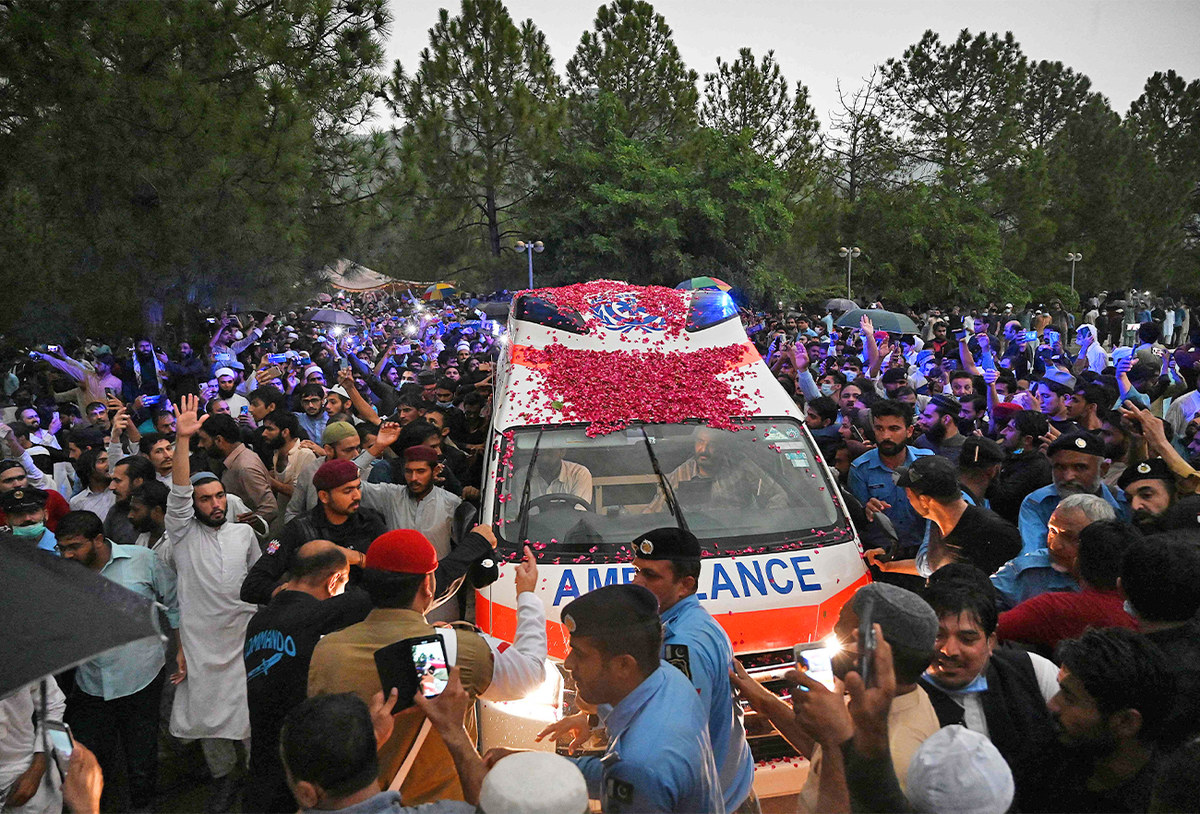


Supporters and officials gather around an ambulance carrying the coffin of the late Pakistan's nuclear scientist Abdul Qadeer Khan for his funeral outside the Faisal Mosque following his death in Islamabad on October 10, 2021. (AFP

Last month, Khan was hospitalized with COVID-19 but was discharged and sent home. He has remained in poor health on and off for years.
After Musharraf stepped down and a new government came to power in Pakistan in 2008, Khan gave a series of media interviews in which he recanted his 2004 confession, saying he only took the blame in return for assurances from Musharraf.
Pakistan tested nuclear weapons in 1998, weeks after arch-rival India conducted similar tests.
Khan was born in India before the creation of Pakistan. His family migrated to Pakistan in 1951.
From 1961, he studied material science at the Technical University in West Berlin before moving to Delft University of Technology in the Netherlands in 1965. In 1967, Khan got an engineer’s degree in Materials technology and joined the doctoral program in metallurgical engineering at the Katholieke Universiteit Leuven in Belgium.
After learning of India’s ‘Smiling Buddha’ nuclear test in 1974, Khan joined Pakistan’s clandestine efforts to develop atomic weapons when he founded the Khan Research Laboratories in 1976.
“The whole nation is saddened by the demise of Dr. Abdul Qadeer Khan,” information minister Chaudhry Fawad Hussain said. “His services to Pakistan are innumerable. May God have mercy.”


‘Fully stand with Bangladesh’: Pakistan PM backs decision to boycott India match

Updated 04 February 2026
Follow

‘Fully stand with Bangladesh’: Pakistan PM backs decision to boycott India match

  • Pakistan’s government have not allowed the national cricket team to play its World Cup match against India on Feb. 15
  • Pakistan has accused India of influencing ICC decisions, criticized global cricket body for replacing Bangladesh in World Cup

ISLAMABAD: Prime Minister Shehbaz Sharif on Wednesday backed his government’s decision to bar the national men’s cricket team from playing against India in the upcoming T20 World Cup tournament, reaffirming support for Bangladesh. 

Pakistan’s government announced on social media platform X last week that it has allowed its national team to travel to Sri Lanka for the World Cup. However, it said the Green Shirts will not take the field against India on their scheduled match on Feb. 15. 

Pakistan’s participation in the tournament was thrown into doubt after Pakistan Cricket Board (PCB) Chairman Mohsin Naqvi criticized the International Cricket Council (ICC) for replacing Bangladesh with Scotland. The decision was taken after Bangladesh said it would not let its team travel to India out of security concerns. 

During a meeting of the federal cabinet, Sharif highlighted that Pakistan has said that politics should be kept away from sports. 

“We have taken this stand after careful consideration and in this regard, we should stand fully with Bangladesh,” Sharif said in televised remarks. 

“And I believe this is a very reasonable decision.”

Pakistan has blamed India for influencing the ICC’s decisions. The global cricket governing body is currently led by Jay Shah, the head of the Board of Control for Cricket in India. Shah is the son of Indian Home Minister Amit Shah. 

Pakistan’s boycott announcement has triggered media frenzy worldwide, with several Indian cricket experts and analysts criticizing Islamabad for the decision. An India-Pakistan cricket contest is by far the most lucrative and eagerly watched match of any ICC tournament. 

The ICC has ensured that the two rivals and Asian cricket giants are always in the same group of any ICC event since 2012 to capitalize on the high-stakes game. 

The two teams have played each other at neutral venues over the past several years, as bilateral cricket remains suspended between them since 2013 due to political tensions. 

Those tensions have persisted since the two nuclear-armed nations engaged in the worst fighting between them since 1999 in May 2025, after India blamed Pakistan for an attack in Indian-administered Kashmir that killed tourists. 

Pakistan denied India’s allegations that it was involved in the attack, calling for a credible probe into the incident.