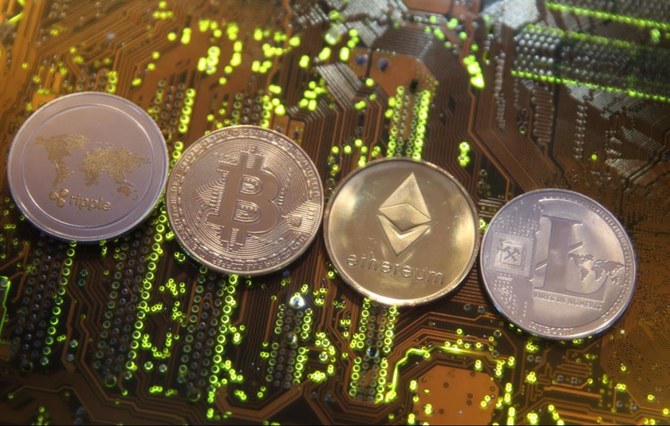
Can the White House stop cryptocurrencies being used for cybercrime?

There were 304 million ransomware attacks globally last year, according to Statistica. (Reuters)
Short Url
Updated 09 October 2021
Follow

Can the White House stop cryptocurrencies being used for cybercrime?

  • Cryptocurrency transactions can be traced on public blockchains, but the identity of the owner is not always clear

LONDON: The White House is considering how it can regulate cryptocurrencies so they are not used to facilitate ransomware attacks and other cybercrime.

The National Security Council and the National Economic Council, forums through which the president consults and makes policy decisions, are working with other agencies to “ensure that cryptocurrency and other digital assets are not used to prop up bad actors,” a White House spokeswoman said on Saturday.

The oversight could include an executive order, Bloomberg News reported on Thursday, although that was not confirmed by the spokeswoman.

Cyber criminals often demand that ransoms are paid in cryptocurrencies, so they are harder to trace. There were an estimated 304 million ransomware attacks globally in 2020, with 68.5 percent of companies the subject of an attack, according to data from Statistica.

The FBI was informed of almost 2,500 ransomware attacks last year, which cost the victims about $29.1 million, up more than 200 percent from the previous year.

It is not the first rumblings of firmer action from the US. In September, the Treasury Department’s Office of Foreign Assets Control sanctioned a crypto exchange in a first as part of its response to a spate of ransomware attacks.

However, there are limits to what the White House, or anyone else, can do to stop cryptocurrencies being used for cybercrime.

Despite rumors to the contrary, cryptocurrencies are more traceable than cash. Every transaction involving a crypto asset is stored on a public blockchain. However, the identity of those carrying out the transactions is not always clear.

Scammers tend to move bitcoins or their crypto of choice through hundreds or thousands of transactions and may control dozens of wallets, making it a huge job for law enforcement to track. They even use software called a “mixer” to break it up into many smaller transactions and complicate tracing it even further.

So, if there is a really large ransom that the FBI, or another national law enforcement agency, wants to track down, they may be able to do it after investing a lot of time and expertise, but smaller amounts will usually fall between the cracks.

What the White House may be able to do is improve know-your-customer rules for exchanges and wallets that are allowed to operate in their jurisdiction. Banks have to do this kind of thing before taking on new customers; if cryptocurrency intermediaries were forced to do the same, it would make it harder for cyber criminals to hide their ill-gotten gains. But not impossible.


Saudi stock market opens its doors to foreign investors

Updated 06 January 2026
Follow

Saudi stock market opens its doors to foreign investors

RIYADH: Foreigners will be able to invest directly in Saudi Arabia’s stock market from Feb. 1, the Kingdom’s Capital Market Authority has announced.

The CMA’s board has approved a regulatory change which will mean the capital market, across all its segments, will be accessible to investors from around the world for direct participation.

According to a statement, the approved amendments aim to expand and diversify the base of those permitted to invest in the Main Market, thereby supporting investment inflows and enhancing market liquidity.

International investors' ownership in the capital market exceeded SR590 billion ($157.32 billion) by the end of the third quarter of 2025, while international investments in the main market reached approximately SR519 billion during the same period — an annual rise of 4 percent.

“The approved amendments eliminated the concept of the Qualified Foreign Investor in the Main Market, thereby allowing all categories of foreign investors to access the market without the need to meet qualification requirements,” said the CMA, adding: “It also eliminated the regulatory framework governing swap agreements, which were used as an option to enable non-resident foreign investors to obtain economic benefits only from listed securities, and the allowance of direct investment in shares listed on the Main Market.”

In July, the CMA approved measures to simplify the procedures for opening and operating investment accounts for certain categories of investors. These included natural foreign investors residing in one of the Gulf Cooperation Council countries, as well as those who had previously resided in the Kingdom or in any GCC country. 

This step represented an interim phase leading up to the decision announced today, with the aim of increasing confidence among participants in the Main Market and supporting the local economy.

Saudi Arabia, which ‌is more than halfway ‍through an economic plan ‍to reduce its dependence on oil, ‍has been trying to attract foreign investors, including by establishing exchange-traded funds with Asian partners in Japan and Hong Kong.