

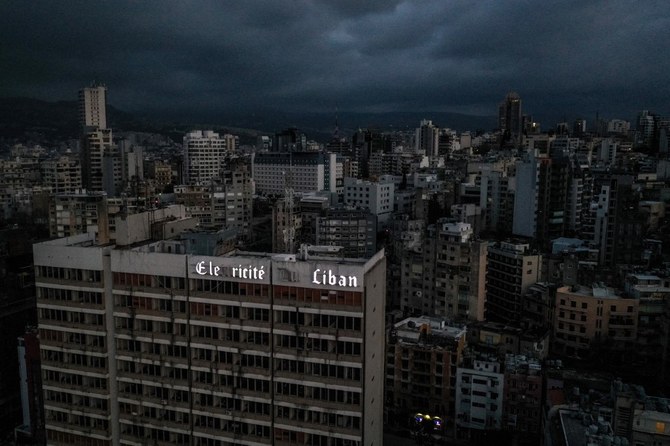

BEIRUT: Lebanon is witnessing significant demand for the installation of solar power units, amid a severe energy crisis that saw the country plunged into a total blackout on Saturday.
Two main power stations went offline because they ran out of fuel, said the state electricity company Electricite du Liban, with people rushing to find alternative sources of energy in anticipation of such a blackout.
People have also been looking for space on the roof of their building to install solar panels, said one electrical engineer.
They wanted the least amount of energy in order to keep food in the fridge, and their lights, internet and television on.
“In the last three months, the demand for installing solar energy or installing UPS batteries has increased to the point that this equipment disappeared from the Lebanese market and reservations for obtaining them took a month,” electrical engineer Bilal Rahm told Arab News. “Most of those who want to install solar energy are either rich or have children abroad who provide them with fresh money, and some poor people borrow money to get this solar energy. Everyone needs lighting, especially those who have children in schools and universities. One of my customers is a greengrocer who decided to turn to solar energy.
“Sometimes the residents of the building disagree about using the roof for personal benefit, so they ask us to dismantle these panels, but these disputes began to subside because everyone felt that they needed this method and residents agreed to build an iron top on the roof of the building to install solar panels on it. Merchants are taking advantage of this demand and have raised the prices of imported equipment under the pretext of the high cost of air freight.”
Merchants were importing the equipment from different countries, including China, Germany, England and the UAE, he said.
Dealers of electrical appliances, including Marwan Tabbara, described the demand for UPS devices as “frightening” with the onset of winter. People were looking for an alternative to subscribing to a private generator, where the bill was twice the minimum wage.
The Interior Ministry warned people a few days ago to verify “the durability” of solar energy equipment on the rooftops of buildings before the onset of winter and storms that may cause them to fall and “cause ominous damage” to people and property.
The country’s electricity network was completely disconnected after the Al-Zahrani and Deir Ammar power plants stopped as a result of a drop in energy production to below 200 megawatts.
A source at the Energy Ministry said that all was being done “to find a way out” of the problem, while EDL said it was trying to “conduct maneuvers to manually rebuild the public network in the absence of the National Control Center, which was completely damaged due to the Beirut Port explosion.”
The Deir Ammar power plant, located in the north of the country, was closed on Friday due to the lack of diesel.
Al-Zahrani, located in the south of the country, switched off on Saturday afternoon.
The production capacity of Zouk and Jiyeh power plants — which currently stands at 350 megawatts — decreased to less than 250 megawatts, which led to the disconnection of the network.
Diana Qaisi, executive director of the Lebanese Oil and Gas Initiative and an expert in energy affairs, said: “The disconnection of the network was expected because the Zouk and Jiyeh plants were not subject to real maintenance and there are no maintenance credits. We still have private generators in Lebanon. Are they enough to cover the needs of the Lebanese? Certainly not. They cannot do the job of power plants, and then there is the need for diesel.
“What we were warning of has happened. We said, carry out the required reforms, but all the state is doing is patching, and that is why we have been plunged into darkness. Our warnings were not taken seriously, and no one believed that darkness was coming.”
The next problem, she added, would be securing diesel for generators. Importers needed US dollars and securing this currency from the black market meant raising prices due to the high demand for dollars that were not available in the first place, she explained.
Lebanon has been experiencing a months-long energy crisis, even as it suffers from economic and financial difficulties.
Rationing of state electricity reached 23 hours a day, with private generators also rationing power.


