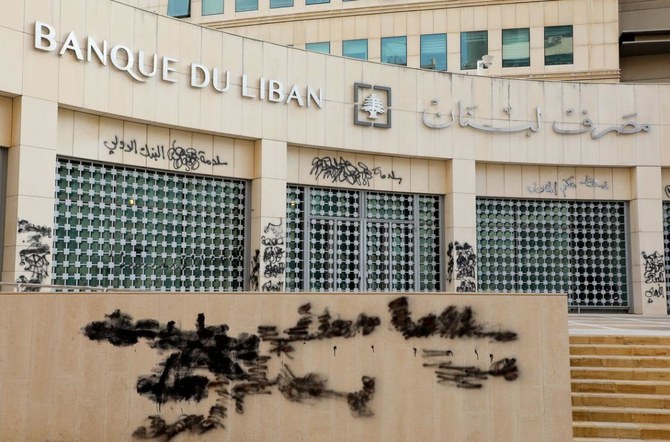
BEIRUT: Lebanon’s central bank denied on Friday a Swiss newspaper report that alleged the International Monetary Fund had removed information from a 2016 report on the country at the request of central bank governor Riad Salameh.
Switzerland’s Le Temps said in a report on Thursday that in 2016, as Lebanon was headed toward financial ruin, 14 pages containing vital information were removed from an IMF assessment through the intervention of Salameh.
Reuters could not independently verify the report.
Salameh did not respond to a request from Reuters for comment.
“This article and everything that was mentioned in it has nothing to do with the truth,” the Lebanese central bank said in a statement.
“What was reported in Le Temps newspaper makes clear the article is not serious as it says the governor of the central bank of Lebanon personally omitted 14 pages from a report of an international and respectable organization like the IMF.”
According to the IMF’s transparency policy, deletions to staff reports are generally considered at the request of the authorities of the country the report is about.
“Deletions should be limited to information that is not already in the public domain that constitutes either: Highly market-sensitive material, mainly the Fund’s views on the outlook for exchange rates, interest rates, the financial sector, and assessments of sovereign liquidity and solvency,” the IMF rules, published in 2014, say.
An IMF spokesperson told Reuters the 2016 report had highlighted as an early warning key vulnerabilities facing the Lebanese financial system.
“It emphasized the need to reduce economic and financial risks, including the reliance on new deposit inflows to cover large fiscal and external deficits. It also pointed to significant resources that would be needed to ensure banks remained capitalized in the event of a severe shock,” the spokesperson said.
Lebanon is suffering what the World Bank has described as one of the deepest depressions in modern history. Its economic meltdown has thrown three-quarters of the population into poverty and the Lebanese pound currency has lost 90 percent of its value in the past two years.
The financial system collapsed in 2019 following decades of corruption and waste in the state and the unsustainable way it was financed.
Lebanon’s woes were aggravated by political deadlock which lasted for over a year, with bickering politicians unable to form a government.
Prime Minister Najib Mikati’s cabinet, formed this September, has said it will resume negotiations with the IMF for a funding program and technical talks are expected to begin soon.


![]()

Lebanon’s central bank denies Swiss report about 2016 IMF paper
Short Url
https://arab.news/vewz7
Lebanon’s central bank denies Swiss report about 2016 IMF paper
- It is alleged the IMF removed information from a 2016 report on the country at the request of central bank governor Riad Salameh


Latest updates


© 2026 SAUDI RESEARCH & PUBLISHING COMPANY, All Rights Reserved And subject to Terms of Use Agreement.