Rs2 billion earmarked to improve Karachi Zoo as activists decry poor conditions for animals

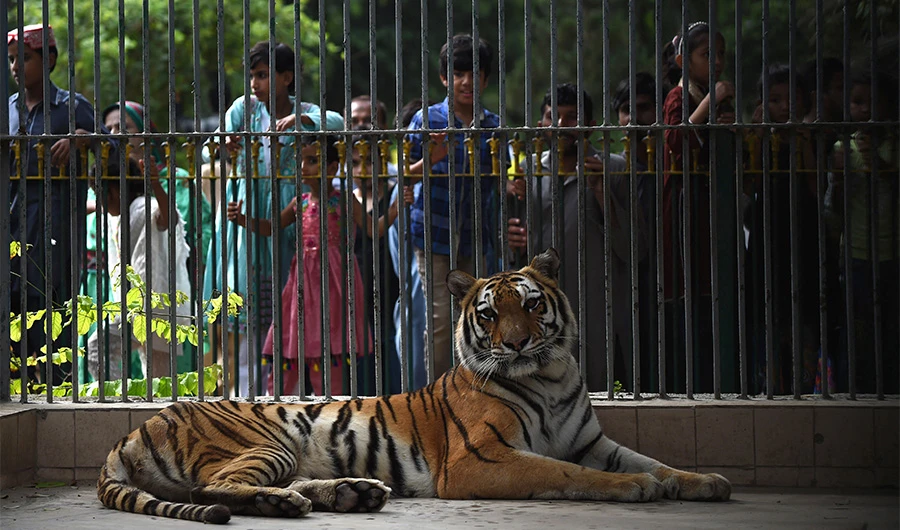
People look at a Bengal tiger in its cage at Karachi Zoo in Karachi, Pakistan, on July 28, 2019. (AFP)
Short Url
Updated 09 October 2021
Follow

Rs2 billion earmarked to improve Karachi Zoo as activists decry poor conditions for animals

  • Karachi Zoo, established in 1878, is the country’s largest animal sanctuary
  • Facility has made headlines in recent years for poor treatment, deaths of several animals 

KARACHI: The Karachi Zoological and Botanical Gardens would soon be expanded to offer better living conditions to animals, its management said on Friday, as animal rights activists complained the inhabitants of the facility were not getting their natural habitat.
The Karachi Zoo is the country’s largest animal sanctuary which was established in 1878 and was called the Mahatma Gandhi Gardens. The facility was renamed after Pakistan’s independence, and it currently shelters 834 different varieties of animals and birds.
The place has made headlines in recent years for various negative developments, including the death of several animals and their poor living conditions.
In October last year, about 40 petitioners filed a case in the Sindh High Court after a video of a 20-year-old Syrian brown bear at the zoo went viral, making many social media users claim that she looked “exhausted.”
The animal was later moved to a bigger cage where she could sit in the shadow of a big tree.
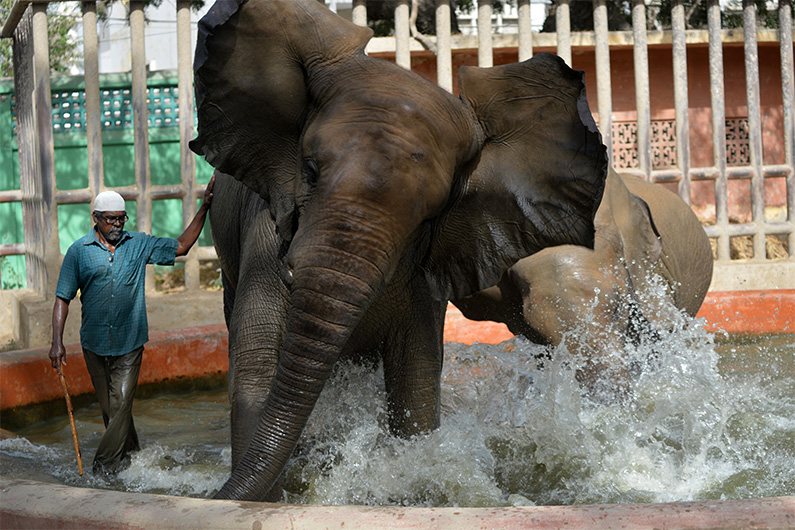


A zookeeper gives a bath to elephants inside their enclosure at Karachi Zoo during a heatwave, in Karachi, Pakistan, on March 31, 2021. (AFP)

“Three new habitats are ready while a total of 107 cages will be constructed,” Khalid Hashmi, the director of the facility, said on Friday. “This will offer animals living conditions that are closer to their habitat.”
Hashmi added the uplift was part of the Sindh government’s mega project in the seaside metropolis of Karachi.
A petition filed in March this year accused the Karachi Metropolitan Corporation (KMC) — the organization responsible for running the zoo — of neglecting four elephants who were allegedly chained in small cages and denied medical care.
The Sindh High Court in September permitted Dr. Frank Goëritz, the head veterinarian at the Leibniz Institute for Zoo and Wildlife Research, to travel to Pakistan and check the health of the elephants.
Mahera Omar, cofounder of the Pakistan Animal Welfare Society (PAWS) and one of the petitioners, said Goëritz would arrive in the country in the foreseeable future.
Murtaza Wahab, KMC administrator and spokesperson for the Sindh government, however, rejected the claim that proper care of animals was not taken by the relevant authorities.
“It is totally wrong to say that animals are not kept in a good condition at the Karachi Zoo since our new measures have brought about considerable improvement,” he told Arab News, adding: “In the past, too, such a perception was created. However, this proved to be baseless and the citizens of Karachi were witness to it.”
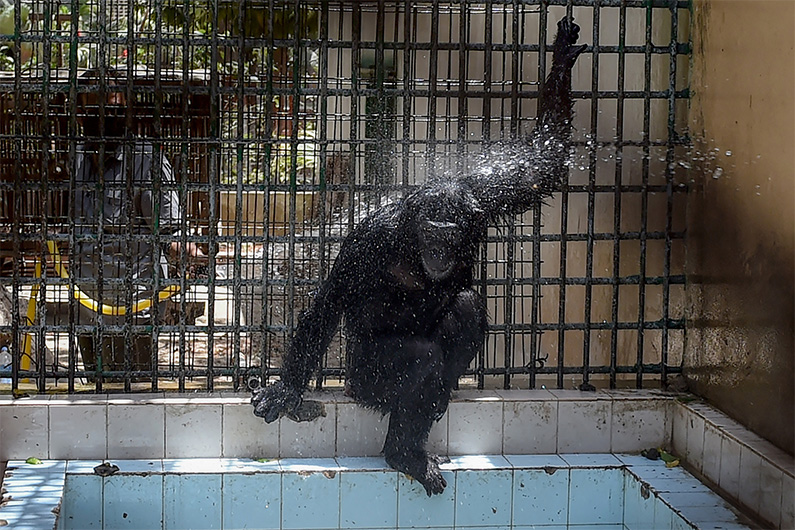


A caretaker sprays water on a chimpanzee to cool off at Karachi Zoo during a heatwave in Karachi, Pakistan, on May 6, 2020. (AFP)

The Sindh government, Wahab continued, had taken several important measures to improve the living conditions of animals at the Karachi Zoo, adding it had procured more varieties of them and brought them to the facility.
He added the provincial government had earmarked Rs2 billion to renovate and improve the sanctuary.
Hashmi said a large number of cages were empty and several animals, including a tiger, lion and bear, were living alone, making the authorities issue a tender for the purchase of more of these animals.
“The animals will not only get better homes but those who are lonely will also get their partners,” he added.
However, the cofounder of PAWS said zoo animals mostly lived in miserable conditions, adding that such facilities had a dark history of displaying the human’s dominion over wild animals from exotic lands.
“In this modern day and age, with its dwindling biodiversity, shrinking habitats and a climate crisis, our focus should be on nature-led ecological restoration,” she said. “Let’s keep our wildlife wild and free to exhibit their natural behavior in the habitat where they belong, and not confine them to a life of misery in zoos.”


A caretaker sprays water on a chimpanzee to cool off at Karachi Zoo during a heatwave in Karachi, Pakistan, on May 6, 2020. (AFP)

Last week, Chief Justice of Islamabad High Court Justice Athar Minallah heared a petition which maintained that animals had natural rights and should not be subjected to unnecessary pain and suffering.
However, the architect working on the renovation of the Karachi Zoo, Shahid Sayeed Khan, told Arab News he had designed open enclosures to replace the cages.
“The new design of the facility has no cages,” he said. “Instead, the animals will be kept in open enclosures of different sizes as per International standards.”
“The concept,” he continued, “is to keep animals in open spaces, except for primates.”
Pakistan secures $1.2 billion as IMF clears reviews, flags gains on stability and reforms

Updated 9 sec ago
Follow

Pakistan secures $1.2 billion as IMF clears reviews, flags gains on stability and reforms

  • IMF praises Pakistan’s policy implementation despite challenging global environment and climate-driven shocks
  • The Executive Board urges faster energy, SOE and governance reforms for macroeconomic and fiscal sustainability

KARACHI: The International Monetary Fund (IMF) approved Pakistan’s second review under its Extended Fund Facility (EFF) and the first review of its Resilience and Sustainability Facility (RSF), said a statement on Tuesday, unlocking about $1.2 billion in new financing while praising the country’s progress in stabilizing the economy despite recent floods.

The decision taken by the IMF Executive Board allows Islamabad to draw $1 billion under the EFF and $200 million under the RSF, bringing total disbursements under both arrangements to about $3.3 billion. The Fund said Pakistan’s policy implementation had improved financing conditions, strengthened reserves and preserved stability even as the country faced a challenging global environment and climate-driven shocks.

Under the 37-month EFF, approved last year in September, the IMF noted strong fiscal performance, including a primary surplus of 1.3 percent of GDP, a rebound in gross reserves to $14.5 billion by end-FY25 from $9.4 billion a year earlier and progress on rebuilding confidence. It noted a surge in inflation due to flood-related food price spikes but said it was expected to ease.

“Pakistan’s reform implementation under the EFF arrangement has helped preserve macroeconomic stability in the face of several recent shocks,” IMF Deputy Managing Director Nigel Clarke said. “Real GDP growth has accelerated, inflation expectations have remained anchored, and fiscal and external imbalances have continued to moderate.”

Clarke said Islamabad’s commitment to meeting its FY26 primary balance target while also addressing urgent post-flood relief signaled strong fiscal intent. He urged continued tax policy simplification and base broadening to build space for climate resilience, social protection and public investment.

The IMF official maintained a tight monetary stance should be continued to keep inflation within the State Bank Pakistan’s target range, while allowing exchange-rate flexibility and deepening the interbank market.

Additionally, he said financial regulation enforcement and capital market development were essential for a resilient financial sector.

The IMF also flagged energy sector reforms as “critical to safeguarding viability,” noting that timely tariff adjustments had helped curb circular debt but that Pakistan must now focus on reducing electricity production and distribution costs and addressing operational inefficiencies in both the power and gas sectors.

The statement also welcomed the publication of Pakistan’s Governance and Corruption Diagnostic report, a detailed IMF-supported assessment that maps out where government systems are vulnerable to inefficiency or misuse and recommends reforms to improve transparency, accountability and service delivery.

Further priorities include the privatization of state-owned enterprises and strengthening economic data quality.
Clarke said reducing Pakistan’s climate vulnerability was vital for long-term stability, referring to the RSF, a financing tool that provides long-term, low-cost loans to help countries address climate risks.

“The RSF arrangement is supporting efforts to strengthen natural disaster response and financing coordination, improve the use of scarce water resources, raise climate considerations in project selection and budgeting, and improve the information on climate-related risks in financing decisions,” he said.

Pakistan faced a prolonged economic crisis in recent years before it began implementing stringent IMF-recommended reforms, which have driven a gradual improvement in macroeconomic indicators over the past two years.

The country also remains one of the world’s most climate-vulnerable nations despite contributing less than one percent of global greenhouse-gas emissions.

It has endured a series of extreme weather events in recent years, most notably the 2022 super-floods that submerged one-third of the country, displaced millions and caused an estimated $30 billion in losses.

This year’s floods killed over 1,000 people and caused at least $2.9 billion in damage to agriculture and infrastructure, underscoring the scale of climate pressures facing the economy.

Economic experts told Arab News a day earlier that the Fund’s disbursements under the two loan programs would support the cash-strapped nation, which has relied heavily on financing from bilateral partners such as Saudi Arabia, China and the United Arab Emirates, as well as multilateral lenders.

“It obviously will help strengthen the external sector, the balance of payments,” said Samiullah Tariq, group head of research at Pakistan Kuwait Investment Company.

Another analyst, Shankar Talreja, head of research at Karachi-based Topline Securities, said the move was likely to send a positive signal to domestic and international investors about the government’s commitment to its reform agenda.

“This will help strengthen reserves and will eventually help a rating upgrade going forward,” he said.