Afghan girls football team will be allowed to resettle in UK after fleeing Taliban

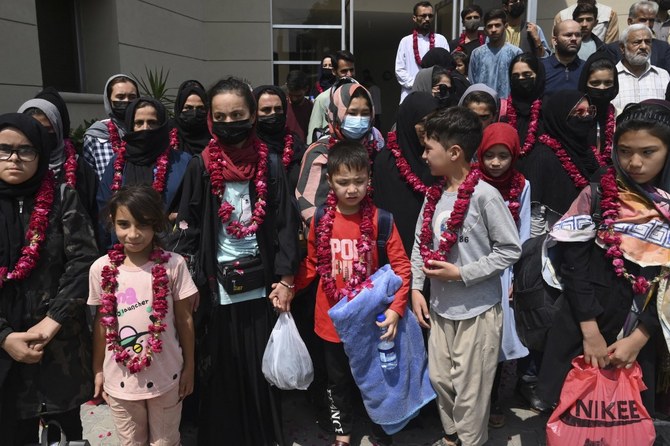
Members of Afghanistan's national girls football team arrive at the Pakistan Football Federation (PFF) in Lahore. (File/AFP)
Short Url
Updated 06 October 2021
Follow

Afghan girls football team will be allowed to resettle in UK after fleeing Taliban

  • The girls faced being sent back to the Taliban once their asylum period ran out in Pakistan
  • “Every single visa is a life enhanced, the right to education protected and the freedom to play football preserved”: Siddiqi

LONDON: Afghanistan’s girls football team will be allowed to resettle in the UK after fleeing the Taliban to Pakistan where they currently hold temporary visas.

The UK’s Home Secretary Priti Patel has authorized the issuing of visas to the girls’ squad, their coaches and families, British newspaper The Sun reported. 

The girls faced being sent back to the Taliban once their asylum period ran out in Pakistan. 

A source close to Patel told The Sun that “the protection of women and girls” is at the “heart of Priti’s new Afghan resettlement scheme.”

The source added that the football team “will be able to make the UK their home, free from fear and persecution.”

Last month, the chairman of Leeds United Andrea Radrizzani offered to place all the players in the club’s youth development teams.

He said that the football club was prepared to “give the girls a prosperous and peaceful future.”

Kashif Siddiqi, co-founder of charity Football for Peace, thanked UK Prime Minister Boris Johnson and Patel for the visas.

“We’re still waiting to hear, but if confirmed it means 111 Afghan girls, family and coaches have had their lives changed forever by Britain,” Siddiqi said. 

“Every single visa is a life enhanced, the right to education protected and the freedom to play football preserved.”

“Without Britain they faced a return to the nightmare that is Afghanistan; this decision gives them futures potentially playing for Leeds United and other clubs,” he said.


Palestinian ambassador condemns British Museum’s removal of the word ‘Palestine’ from displays

Updated 5 sec ago
Follow

Palestinian ambassador condemns British Museum’s removal of the word ‘Palestine’ from displays

  • The museum updated some exhibits in its ancient Middle East galleries to replace ‘Palestine’ with ‘Canaanite’
  • It followed complaints from a pro-Israel group that use of the word ‘Palestine’ could obscure the ‘history of the Jewish people’

LONDON: The Palestinian ambassador to the UK, Husam Zomlot, condemned a decision by the British Museum in London to remove the word “Palestine” from certain displays, following pressure from a pro-Israel group.

“Cultural institutions must not become arenas for political campaigns,” the Palestinian Wafa news agency reported Zomlot as saying on Monday. “Palestine exists. It has always existed and it always will.”

The British Museum updated some displays in its ancient Middle East galleries to replace the word “Palestine” with “Canaanite,” The Guardian newspaper reported.

It did so after the group UK Lawyers for Israel expressed concern that the inclusion of the word “Palestine” in displays related to the ancient Levant and Egypt could obscure the “history of Israel and the Jewish people.”

In a letter to the director of the museum, Nicholas Cullinan, they wrote: “Applying a single name — Palestine — retrospectively to the entire region, across thousands of years, erases historical changes and creates a false impression of continuity.”

The museum said it views the word “Palestine” to be no longer considered historically “neutral,” and that it might be interpreted as a reference to political territory.

However, the Palestinian embassy said: “Attempts to cast the very name ‘Palestine’ as controversial risk contributing to a broader climate that normalizes the denial of Palestinian existence at a time when the Palestinian people in Gaza face an ongoing genocide, and their fellow Palestinians in the West Bank face ongoing ethnic cleansing, annexation and state-sponsored violence.”

More than 9,000 people have so far signed a Change.org petition calling on the museum to reverse its decision, arguing that it lacks historical support and erases Palestinian presence from public memory.