Egypt’s pavilion at Expo 2020 harks back to pharaonic era

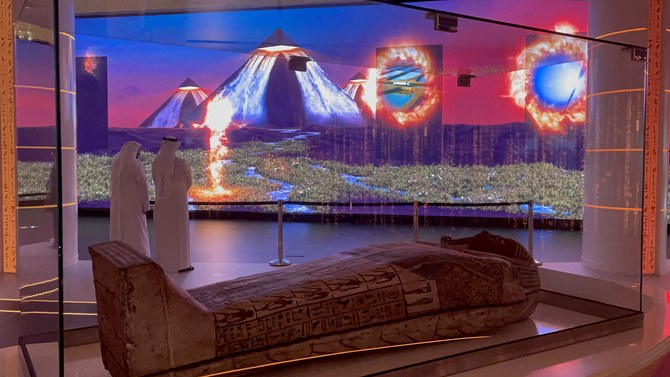
Visitors were shown a pharaonic coffin of Priest Psamtik, which was discovered in a group burial by the mission of the Supreme Council of Antiquities working in Saqqara. (AN/Farah Heiba)
Short Url
Updated 07 October 2021
Follow

Egypt’s pavilion at Expo 2020 harks back to pharaonic era

  • The structure is built on four levels with a partial glass facade and outer walls imprinted with hieroglyphic letters
  • Visitors are shown a modern replica of the iconic golden mask of Egyptian King Tutankhamun

DUBAI: Wednesday marks Egypt’s anniversary of the 1973 October War with Israel. To highlight the occasion, Arab News visited Egypt’s Pavilion at Expo 2020 Dubai to find out more about the country’s history and culture.

On the right side of the building, a pharaoh statue sits on a small water space, giving visitors a glimpse of what lies within.

When entering the building, visitors are asked to watch a short clip of a virtual guide welcoming them to the pavilion. The building includes more hieroglyphic letters and symbols on its interior walls.

On their right, visitors are greeted by a large LED screen playing another clip about Egypt’s history and current economic developments, such as the Suez Canal.

After the video ends, visitors are shown a pharaonic coffin of Priest Psamtik. It was discovered in a group burial by the mission of the Supreme Council of Antiquities working in Saqqara, which is an ancient village in Giza province. The discovery was among the coffins that belonged to priests of the goddess Bastet and their families.

Visitors are then shown a modern replica of the iconic golden mask of Egyptian King Tutankhamun, one of the world’s most popular ancient artifacts. This mask is made of over 10 kg of solid gold and precious stones.

The original mask was found inside the burial chamber of the king’s tomb in the Valley of the Kings, according to a description displayed next to the mask.

Visitors are then introduced to modern replicas of three royal coffins of Tutankhamun. Each coffin is human-shaped. The outer coffin is wood covered in sheet gold. The middle one is wood covered with colored glass and precious stones, while the third is made from solid gold.

People are later asked to enter a small room surrounded by an LED screen that shows a clip of Egypt’s touristic sites.

Visitors then go up a level to explore more about Egypt’s arts, sciences and technologies. The second floor is divided into small rooms. One of the rooms includes a “Time Machine” where people sit on motion chairs and take a ride to explore Egypt’s different attractions.

Workshops and business meetings take place on the remaining two floors of the pavilion.


Syrian refugee returns set to slow as donor support fades

Updated 08 December 2025
Follow

Syrian refugee returns set to slow as donor support fades

  • Some aid officials say Syria is one of the first crises to be hit by aid funding cuts because the end of the war means it no longer counts as an emergency, eligible for priority funding

GENEVA: More than 3 million Syrians have returned home since the collapse of Bashar Assad’s rule a year ago but a decline in global funding could deter others, the UN refugee agency said on Monday.
Some 1.2 million refugees in addition to 1.9 million internally displaced people have gone back home following the civil war that ended with Assad’s overthrow, but millions more are yet to return, according to UNHCR.
The agency said much more support was needed to ensure the trend continues.
“Syrians are ready to rebuild – the question is whether the world is ready to help them do it,” said UNHCR head Filippo Grandi. Over 5 million refugees remain outside Syria’s borders, mostly in neighboring countries like Jordan and Lebanon.

RISK OF REVERSALS
Grandi told donors in Geneva last week that there was a risk that those Syrians who are returning might even reverse their course and come back to host states.
“Returns continue in fairly large numbers but unless we step up broader efforts, the risk of (reversals) is very real,” he said.
Overall, Syria’s $3.19 billion humanitarian response is 29 percent funded this year, according to UN data, at a time when donors like the United States and others are making major cuts to foreign aid across the board.
The World Health Organization sees a gap emerging as aid money drops off before national systems can take over.
As of last month, only 58 percent of hospitals were fully functional and some are suffering power outages, affecting cold-chain storage for vaccines.
“Returnees are coming back to areas where medicines, staff and infrastructure are limited – adding pressure to already thin services,” Christina Bethke, Acting WHO Representative in Syria, told reporters.
The slow pace of removing unexploded ordnance is also a major obstacle to recovery, said the aid group Humanity & Inclusion, which reported over 1,500 deaths and injuries in the last year. Such efforts are just 13 percent funded, it said.
Some aid officials say Syria is one of the first crises to be hit by aid funding cuts because the end of the war means it no longer counts as an emergency, eligible for priority funding.
Others may have held back as they wait to see if authorities under President Ahmed Al-Sharaa make good on promises of reform and accountability, including for massacres of the Alawite minority in March, they say.