

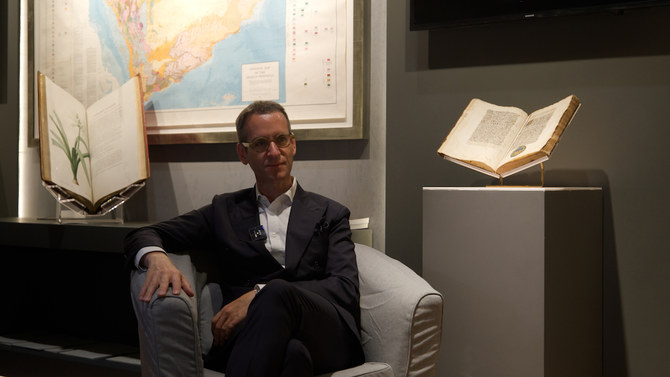

RIYADH: Christies’ EMEA expressed an openness to new opportunities involving art in Saudi Arabia during its participation at the Riyadh International Book Fair 2021.
Arab News had the opportunity to talk to its president of Europe, Middle East, Russia and India, Dr. Dirk Boll, whose auction house showcased rare and historical maps and manuscripts at the Christie’s booth.
“Christie’s has a great tradition in showcasing and selling art. We want to understand what the collecting crowd is interested in. That’s why we’re always behind the latest fashion, and why we’re called a secondary market,” Dr. Boll said.
Found in 1766 in the UK, Christie’s holds auctions in London, Paris, New York and Hong Kong — the art sellers’ most favorable markets.
Christie’s don’t sell directly from the atelier of the artists’ workshop, rather it offers items that have seen a certain reception in the market and institutions, Dr. Boll explained.
Dr. Boll, who has worked with Christie’s for 23 years, grew up in Kassel, Germany, where there was a prevalent tradition of collecting old art pieces, such as rare manuscripts and antiquities.
Every five years, Kassel becomes the center of the art universe, as hundreds of thousands of visitors make their way to “documenta,” the world‘s largest international exhibition of contemporary art.
“I had the best of two worlds, and that’s what inspired me as a pupil [in art],” Dr. Boll said.
“As we all know, printed books are a successor to the manuscript. Christie’s have products of art older than 600 years, dating back to the 15th century,” he said.
“The art market in Saudi is a small market because it is a market that is defined by a regional demand and production on the one hand, but also it is a society that looks across borders and traditionally buy and sells abroad as well.
“So you have a matrix of a local situation and a local client base that is absolutely used to international behaviour and collecting,” he said.
When selecting art to showcase and auction, Christie’s looks at the most interesting pieces available through a careful selection process, involving filtering and due diligence, to confirm its art is authentic.
Art in the past 70 years has been changing at a rapid pace, starting from the post-war era, moving into globalization and the progress made in “communication technology”; however, this is not necessarily a “bad” thing, Dr. Boll explained, as art is all about the way the world connects.
Before COVID-19, buying and selling art rarely seldom took place in the digital world.
“Art is all about the direct inspection and perception of the artwork. We want to see it in all its dimensions, we want to feel it, want to smell it — if it’s made of a smelly material — and that was impossible in 2020,” Dr. Boll said.
Buyers and collectors of art took to replacing these experiences online using technology, such as enhanced image quality, deeper content and videoing.
“It’s always better to look at it in the flesh,” Dr. Boll said. “It is a bit of an arrogant view of people who live in metropolitan cities, because if you’re interested in something that is auctioned off six hours away from where you live, it’s not so easy.
“The new digital future of the art market today reflects the current status of society, globally,” he said.
One way in which art has changed digitally is the introduction of Non-Fungible Tokens (NFTs).
Dr. Boll said he was excited to see artists view it as a new tool and as technology that ensures participation and certain rights when it comes to resales, publicity and reach.
This ties back to how art is meant to reflect today’s society and the ways in which the world connects, he said.
“The fashion for NFT-based works or digital works that are accompanied by an NFT certificate, reflects how societies have developed over the past 10 to 15 years, therefore I welcome that.”
Christie’s has been auctioning NFTs for a month now, Dr. Boll said, and as of last week had sold more than $100 million of NFT art in 2021 alone.
He is planning on returning to Riyadh next month to take part in the Misk Global Forum.


