UPS launches world first solar vehicle charging point at Expo 2020 Dubai

1 / 2
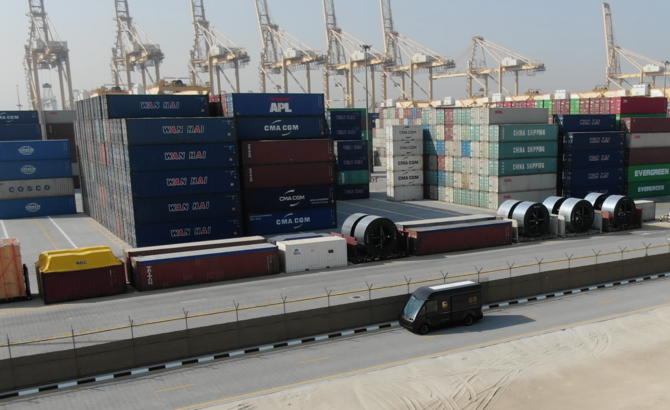
The EVs will eventually replace the entire UPS fleet. (Supplied)
2 / 2
The EVs will eventually replace the entire UPS fleet. (Supplied)
Short Url
Updated 03 October 2021
Follow

UPS launches world first solar vehicle charging point at Expo 2020 Dubai

  • The EVs will eventually replace the entire UPS fleet

DUBAI: The world’s first solar-powered vehicle charging point has been launched at Expo 2020 Dubai where it will be used by the courier service UPS to power its fleet of electric delivery vans.

UPS, made the announcement alongside its partners Arrival and DP world, at a press conference at the Expo site on Sunday.

Sunlight will be captured through solar panels on the roof of DP World’s Flow pavilion, with the solar energy flowing through a processing system to an off-grid battery Energy Storage System (BESS) unit which powers the charging station.

The UPS fleet of electric vehicles being used at the Expo are part of the company’s larger transition to a zero-emissions fleet within the next three years.

The two vehicles, produced by UK-based manufacturer Arrival, are part of an initial order of 10,000 purpose-built electric vehicles that will propel the company towards its carbon-neutral goal by 2050.

The vehicles, which come in three sizes, will be dispatched across the UAE at a later date, “in Jebel Ali and other parcel sorting facilities,” Abdulla Bin Damithan, the CEO and managing director of the Dubai-based logistics company DP World, said.

“Our clients and their clients are demanding it,” said Scott Price, the president of UPS International.

“You simply don’t stay in business that long without innovating, which is why our partnership with arrival is very important,” Price noted.

Arrival, a six-year-old UK-based company that has recently emerged from the shadows, first announced the partnership with UPS to develop electric vehicles in 2016, giving the latter compelling commercial and environmental benefits to transition to a zero-emissions fleet.

“Our electric vans are zero-emission, powered by the sun, and don’t need to be connected to the electrical grid to deliver packages. It’s truly transformative,” Avinash Rugoobur, Arrival’s Chief Strategy Officer, said.

The company announced in Jan. 2020 a $110 million investment from Hyundai and Kia while UPS has also acquired a minority stake.

The two Arrival prototypes will be on display on-site at the Expo site, delivering packages across the 4.38 sq km venue. 

“Expo is where innovation and technology come together to make life better,” Rygoobur noted, highlighting the importance of the off-the-grid aspect of the vehicles.

These vehicles can be used anywhere in the world, with the lack of electric connectivity in remote areas no longer a hindrance.

“The sun takes them off the grid and frees up these vehicles to be used anywhere,” Price said.

Arrival has put forth a new method of assembly using low capital, low footprint microfactories located to serve local communities and profitable from thousands of units, Ryoobur said.

It also makes their vehicles price competitive with fossil fuel-powered commercial vans, buses and other vehicles.

“This paves the way for locally manufactured vehicles in the region,” he added, with Arrival currently operating four plants in the UK, US and Spain.

With no metals and composed of fully recyclable solar panels, these vehicles “transform the way we think of mobility,” Ryoobur, who joined the company almost three years ago, highlighted.

To further its sustainability pledge and in line with Expo 2020 Dubai’s theme, UPS will purchase carbon offsets for every package shipped at the UPS Expo 2020 customer counters to mitigate its environmental impacts.

“It is our collective responsibility to become more sustainable and environmentally friendly,” Bin Damithan said. 


Saudi Cabinet cancels expat worker fees for licensed industrial facilities

Updated 5 sec ago
Follow

Saudi Cabinet cancels expat worker fees for licensed industrial facilities

RIYADH: Saudi Arabia’s Cabinet, chaired by Crown Prince Mohammed bin Salman, has approved the abolition of fees imposed on expatriate labor in industrial facilities licensed under an industrial permit, following a recommendation from the Council of Economic and Development Affairs.

The Saudi Press Agency reported that the decision reflects the Kingdom’s ongoing support for the industrial sector and aligns with the crown prince’s commitment to empowering national factories, enhancing their sustainability and global competitiveness, and advancing Saudi Vision 2030’s goal of a resilient, diversified industrial economy.

The decision to abolish the financial levy on expatriate workers in industrial facilities will enhance the global competitiveness of Saudi industry and expand the reach of non-oil exports in international markets, said Minister of Industry and Mineral Resources Bandar Alkhorayef.

In remarks to SPA, Alkhorayef stated that the decision reflects the continued support and empowerment provided to the industrial sector by the crown prince. He emphasized that industry remains a key pillar of national economic diversification under Saudi Vision 2030.

He explained that the move will strengthen sustainable industrial development in the Kingdom, enhance national industrial capabilities, and attract high-quality investments, supported by the incentives and enablers offered by the industrial ecosystem.

Alkhorayef added that abolishing the levy will reduce factories’ operating costs, enabling them to expand, grow, and increase production, while accelerating the adoption of modern operating models such as automation, artificial intelligence, and advanced manufacturing technologies — thereby improving efficiency and boosting the sector’s global competitiveness.

The minister reaffirmed the ministry’s commitment to supporting continued industrial growth, attracting international investment, and providing 800 investment opportunities across various industrial activities valued at SR1 trillion ($270 billion), in addition to tripling industrial gross domestic product to SR895 billion by 2035.

He noted that the government’s coverage of the expatriate levy over the past six years — during the first and second exemption periods from Oct. 1, 2019, to Dec. 31, 2025 — played a pivotal role in driving qualitative growth in the industrial sector and expanding the Kingdom’s industrial base.

Between 2019 and the end of 2024, the sector achieved significant milestones, including an increase in the number of industrial facilities from 8,822 factories to more than 12,000, and a 35 percent rise in total industrial investments from SR908 billion to SR1.22 trillion.

Non-oil exports grew by 16 percent, rising from SR187 billion to SR217 billion, while employment increased by 74 percent, from 488,000 workers to 847,000. Localization improved from 29 percent to 31 percent, and industrial GDP expanded by 56 percent, from SR322 billion to more than SR501 billion.