Supreme Court extends detention of Tehreek-e-Labbaik Pakistan leader

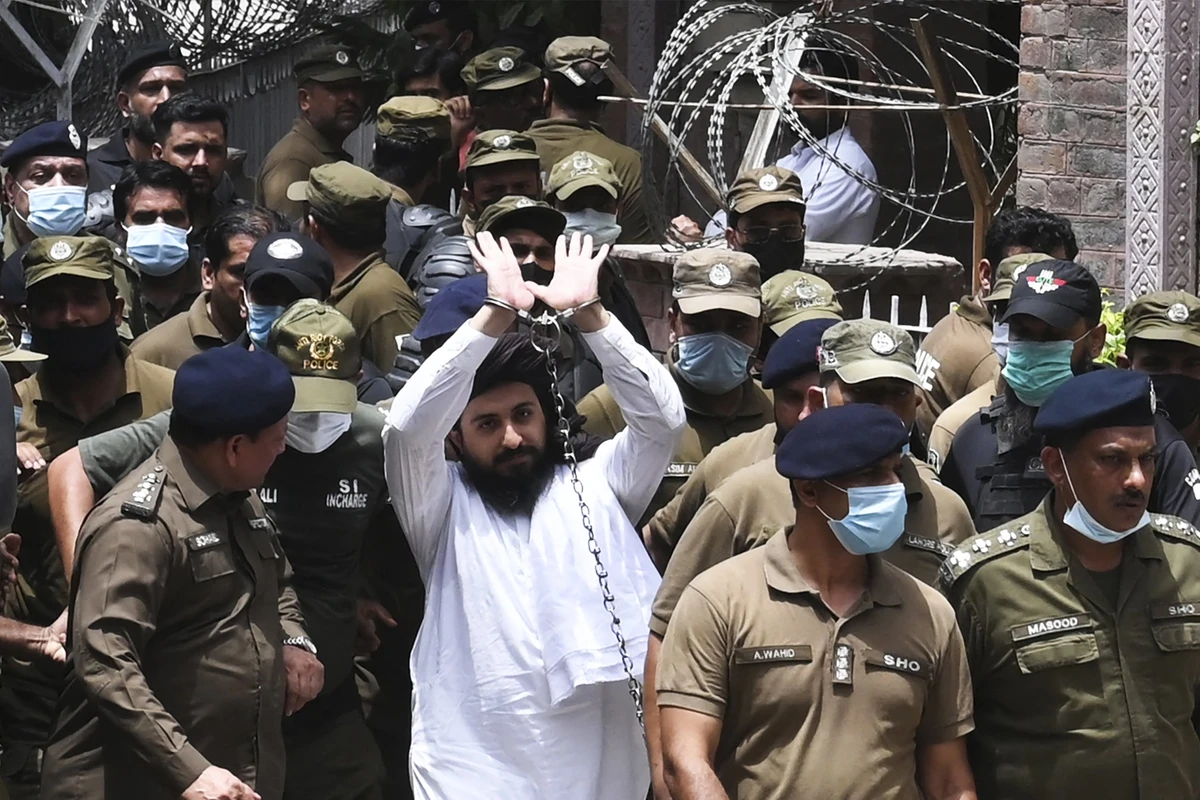
Hafiz Saad Hussain Rizvi (C), son of late Khadim Hussain Rizvi, the founder of hard line religious political party Tehreek-e-Labbaik, waves as he arrives for a case hearing outside a court in Lahore on July 2, 2021. (AFP)
Short Url
Updated 03 October 2021
Follow

Supreme Court extends detention of Tehreek-e-Labbaik Pakistan leader

  • Supreme Court order comes a day after a high court approved a petition against Saad Rizvi’s prolonged detention
  • Rizvi was arrested in April after he threatened the government with rallies if it failed to expel French envoy

ISLAMABAD: Pakistan’s Supreme Court has extended the detention of Saad Rizvi, chief of the banned Tehreek-e-Labbaik Pakistan (TLP) religious party, for a month.

The order comes a day after a high court approved a petition against his prolonged detention.

In its decision taken during a virtual meeting on Saturday, the Supreme Court’s Federal Review Board said: “The detention period of detenue [Saad Hussain Rizvi] is extended for one month. The matter be placed in the next meeting.” A date for the next meeting will be issued later.

Rizvi was arrested in Lahore in April for threatening the government with rallies if it did not expel the French envoy to Islamabad over cartoons of the Prophet Muhammad (pbuh) published in France last year.

Violent demonstrations by TLP supporters erupted in major cities after his arrest. Six policemen were killed and over 800 injured, according to official figures, in protests that lasted a week.

The Lahore High Court (LHC) on Friday approved a petition filed by Rizvi’s uncle against his continued detention under Pakistan’s antiterrorism laws.

“We are hopeful for Saad Rizvi’s release on Monday as the court’s written order will reach the relevant departments on first working day of the week,” Advocate Burhan Moazzam Malik, who represents Rizvi, told Arab News on Saturday before the order.

He said the court had declared the TLP leader’s detention illegal in its detailed judgment but a written order for the verdict’s implementation is awaited.

“The government failed to provide any plausible reason in the court to detain him under the Anti-Terrorism Act, 1997,” Malik said. “The right to protest is enshrined in the constitution.”

Rizvi has been detained at Kot Lakhpat Jail in Lahore, which is managed by the provincial government of Punjab. Punjab Prisons Minister Fayyaz-ul-Hassan Chohan declined comment on the case.

The party has built a wide base of support in recent years, rallying around cases of blasphemy, which are punishable by death in Pakistan.

It was banned following April’s protests.

Rizvi became the leader of TLP in November last year after the sudden death of his father, Khadim Hussein Rizvi.


Islamabad hits back after Indian minister blames Pakistan army for ‘ideological hostility’

Updated 10 sec ago
Follow

Islamabad hits back after Indian minister blames Pakistan army for ‘ideological hostility’

  • Jaishankar tells a public forum most of India’s problems with Islamabad stem from Pakistan’s military establishment
  • Pakistan condemns the remarks, accusing India of waging a propaganda drive to deflect from its destabilizing actions

ISLAMABAD: Pakistan accused India on Sunday of running a propaganda campaign to malign its state institutions, a day after Indian External Affairs Minister Subrahmanyam Jaishankar attributed what he described as Pakistan’s “ideological hostility” toward New Delhi to the country’s powerful army.

Addressing a public forum in New Delhi, Jaishankar said most of India’s problems with Pakistan stemmed from its military establishment, which he argued had cultivated and sustained an entrenched animosity toward India.

His remarks came months after a brief but intense military confrontation between the nuclear-armed neighbors, during which both sides exchanged artillery and missile fire and deployed drones and fighter jets.

Responding to the comments, Pakistan’s Foreign Office spokesperson Tahir Andrabi called them “highly inflammatory, baseless and irresponsible.”

“Pakistan is a responsible state and its all institutions, including armed forces, are a pillar of national security, dedicated to safeguarding the sovereignty and territorial integrity of the country,” Andrabi said in a statement. “The May 2025 conflict vividly demonstrated Pakistan armed forces’ professionalism as well as their resolve to defend the motherland and the people of Pakistan against any Indian aggression in a befitting, effective yet responsible manner.”

“The attempts by Indian leadership to defame Pakistan’s state institutions and its leadership are a part of a propaganda campaign designed to distract attention from India’s destabilising actions in the region and beyond as well as state-sponsored terrorism in Pakistan,” he said, adding that such “incendiary rhetoric” showed the extent of India’s disregard for regional peace and stability.

Andrabi said that rather than making “misleading remarks about the armed forces of Pakistan,” India should confront the “fascist and revisionist Hindutva ideology that has unleashed a reign of mob justice, lynchings, arbitrary detentions and demolition of properties and places of worship.”

He warned that the Indian state and its leadership had become hostage to “this terror in the name of religion.”

India and Pakistan have fought three wars since independence in 1947. They have also engaged in countless border skirmishes and major military standoffs, including the 1999 Kargil conflict.

The four-day conflict in May 2025 ended with a US-brokered ceasefire, after Washington said both sides had expressed willingness to pursue dialogue.

Pakistan said it was ready to discuss all outstanding issues, but India declined talks.


-End