PESHAWAR: A day after Prime Minister Imran Khan told an international news channel his administration was in talks with some factions of the proscribed Tehreek-e-Taliban Pakistan (TTP), the militant network denied any split within its ranks and ruled out cessation of hostilities against the country.
In an interview with TRT World on Friday, Khan said some groups within the militant conglomerate were willing to negotiate for peace and reconciliation, adding that the government was willing to forgive them once they laid down their arms.
The prime minister’s statement, which was widely quoted in local and international media, was followed by reports that a TTP district shura in Waziristan had announced a 20-day cease-fire and its members would not attack the Pakistani security forces.
However, the top leadership of the militant network said it was not looking for a peace agreement with the Pakistani authorities.
“Tehreek-e-Taliban Pakistan has never announced a cease-fire,” its spokesperson, Muhammad Khurasani, said in a statement. “TTP fighters should continue their attacks wherever they are.”
Khurasani described TTP as an “organized movement,” saying there were “no fissures or factions within the group.”
“The movement has a collective policy which no one can deviate from,” he added.
Last month, President Arif Alvi and Foreign Minister Shah Mahmood Qureshi announced the government was willing to offer amnesty to TTP members if they renounced violence and adhered to the country’s constitution.
However, the militant network stated in response it was proud of its “struggle” and was not seeking forgiveness from anyone.
The Pakistani prime minister, who said he did not believe in military solutions, continued to hope during his recent interview that a deal was likely come out of his government’s negotiations with the militant network in Afghanistan.
Pakistan’s information minister Chaudhry Fawad Hussain also maintained in a video message that repentant TTP members should get a chance to return to “normal life.”
A security analyst, Saleem Khan, told Arab News the government was also negotiating a peace deal with the Hafiz Gul Bahadur group in North Waziristan, though he added the faction was never a part of the Pakistani Taliban.
He maintained that these talks were complicated since most of the armed groups in the territory were sympathetic to TTP and had pledged allegiance to the leader of the banned group, Mufti Noor Wali Mehsud.
“There are complications in the negotiations because they [the government] are holding talks with Hafiz Gul Bahadur while the main entity is Tehreek-e-Taliban Pakistan,” he said. “Unless they address the TTP challenge, talks with Hafiz Gul Bahadur will not help. In any case, his faction did not cause too much trouble to the government in the past.”
A conglomerate of several armed factions, TTP was banned soon after its emergence in Pakistan’s tribal areas in 2007 since it started killing Pakistani civilians and security forces.
Inspired by Al Qaeda ideology, it targeted the army headquarters in Rawalpindi and massacred more than 100 children at a school in Peshawar.
The network also took responsibility for shooting Malala Yousafzai, who later became the world’s youngest Nobel laureate, in her hometown, Swat, for advocating girls’ education.


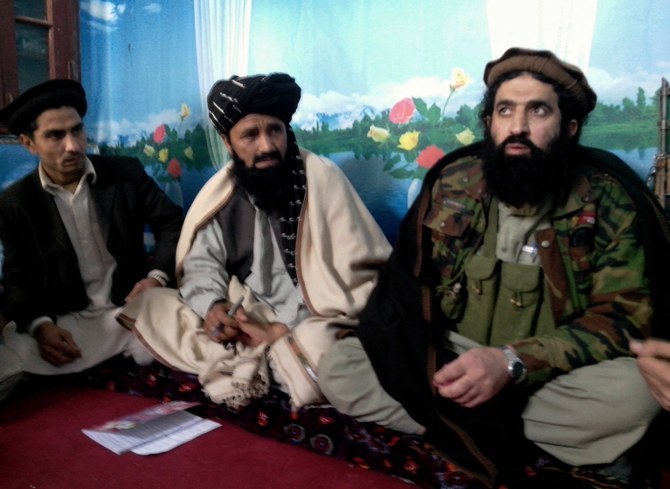
Tehreek-e-Taliban Pakistan dismisses reports of ceasefire, denies internal divisions
https://arab.news/2ekkh
Tehreek-e-Taliban Pakistan dismisses reports of ceasefire, denies internal divisions

- The proscribed militant entity issued a statement after PM Khan said his administration was negotiating with its factions for peace, reconciliation
- TTP called itself an ‘organized movement,’ saying it had a collective policy which no one could deviate from

Pakistan IT minister in Kuwait to attend digital cooperation body meeting on AI risks
- Shaza Fatima Khawaja to attend event themed ‘Inclusive Prosperity in the Age of AI’
- Pakistan approved National AI Policy last year, launched first locally hosted AI cloud
KARACHI: Pakistan’s Information Technology (IT) Minister Shaza Fatima Khawaja on Wednesday arrived in Kuwait on a two-day visit to hold discussions on artificial intelligence (AI) and its risks at the fifth Digital Cooperation Organization General Assembly (DCOGA), her office said.
The annual gathering brings together representatives of various states and international organizations to discuss the digital economy and the challenges associated with its growth. This year’s theme is “Inclusive Prosperity in the Age of AI.”
Pakistan has been actively developing its AI landscape, marked by the approval of the National AI Policy in July last year and the subsequent launch of its first locally hosted AI cloud in a bid to integrate AI for economic growth.
“The federal minister will participate in the General Assembly of the Digital Cooperation Organization (DCO) and hold meetings with representatives of member states,” the IT ministry said in a statement on Wednesday.
“Discussions will be held on artificial intelligence and its risks, with meetings scheduled with global policymakers.”
Khawaja will hold high-level meetings with global leaders at the event and participate in the DCO thematic ministerial roundtable comprising ministers from various countries, it added.
The development comes as Pakistan seeks to position itself as a credible participant in the global AI economy to harness AI for productivity, skills development and innovation while managing regulatory risks.
Pakistan has mainly been engaging with Gulf countries on AI. In October last year, Pakistan’s Prime Minister Shehbaz Sharif announced that Saudi Arabia has offered free training in IT and AI for Pakistani youth. Last November, Pakistan and the United Arab Emirates agreed to deepen cooperation in AI, digital governance and data innovation.
Pakistan is also hosting a week-long national AI initiative, “AI Indus Week 2026,” from Feb. 9-15 to promote the responsible use of technology and accelerate the adoption of AI across the public and private sectors.


