

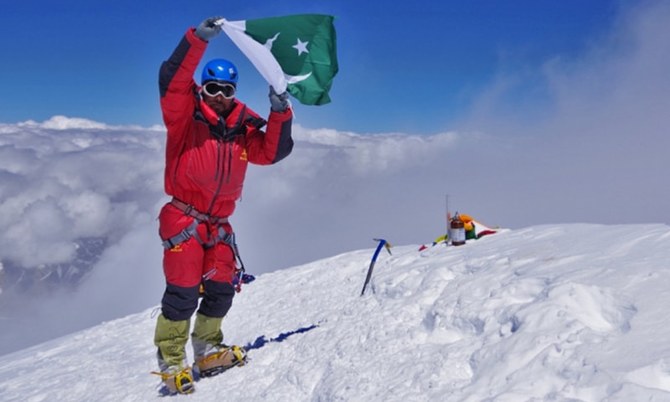
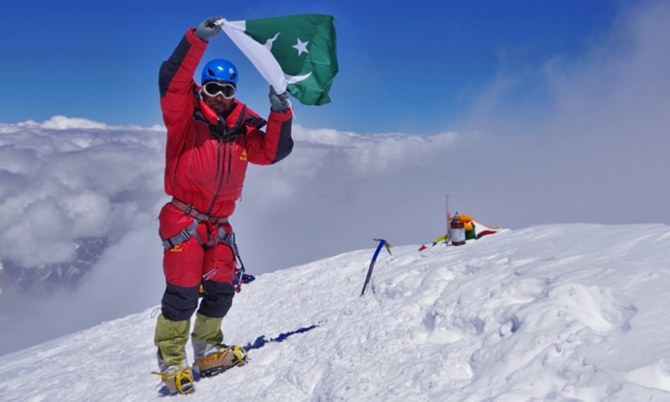
KHAPLU, GILGIT-BALTISTAN: Pakistani climber Sirbaz Khan has successfully summited the 8,167-meter-high Dhaulagiri mountain to become the first Pakistani ever to climb nine out of 14 ‘Eight-thousanders’ in the world, Pakistan’s Alpine Club and Nepalese Seven Summit Treks confirmed on Friday.
The world’s 14 tallest mountains, called the ‘Eight-thousanders,’ all are over 8,000 meters. Dhaulagiri is the seventh highest.
Born and raised in Ali Abad village in Pakistan’s mountainous Hunza district, Khan had already summited eight highest peaks in the world, including Mount Everest.
He was the only Pakistani other than legendary climber Muhammad Ali Sadpara — killed during a K2 winter expedition this year — to have summited eight of the world’s highest peaks. K2, at 8,611 meters, is the world’s second highest and deadliest peak, often referred to as the ‘Savage Mountain.’
“CONGRATULATIONS!! Sirbaz Khan, the first Pakistani to climb 9x8000-M,” Karrar Haidri, the Alpine Club secretary, said in a Facebook post. “As a part of the Seven Summit Treks Sirbaz Khan successfully climbed Mount Dhaulagiri 8167-M.”
Khan began his climbing career in 2016, becoming the first Pakistani to summit Mount Lhotse, the world’s fourth highest mountain measuring 8,516m in Nepal, without the use of supplementary oxygen, according to Haidri.
His other 8,000m summits include K2, Nanga Parbat, Broad Peak, Manaslu, Annapurna, Mount Everest and Gasherbrum II. On four of his 8,000m peaks expeditions, Khan had accompanied Muhammad Ali Sadpara. Their last expedition together was from Nepal to Manaslu.
“Today at 5:30am approx., with the combined efforts, a team of experienced Nepalese Sherpas have fixed the ropes to the summit of Mt. Dhaulagiri I (8167m), being the first to scale the peak in this season,” Chhang Dawa Sherpa, the head of the tour, announced.
“At least 12 International climbing members [including Sirbaz Khan of Pakistan] and 8 Shepas of Seven Summit Treks are on the same trail for the summit bids. It seems the climbing weather window is favorable until the first week of October.”
In an interview with Arab News last month, Khan had said his ‘Mission Summit 14’ was not just about getting his name into the record books but would be a matter of “pride” for his country.
“When I climb on these mountains where no Pakistani has ever climbed before me, it is not just me climbing alone, it’s Pakistan climbing with me ... Each time I raise the green flag on a mountain, that piece of cloth claps in the name of respect and honor deserved by great Pakistani mountaineers – all those who came before me and those who will come after,” he had said.
Congratulations started pouring in on Friday following Khan’s summit of Dhaulagiri.
“Lots of congratulations to Sirbaz Khan for climbing Daulaghiri. After summiting Dhaulagiri, he is the first Pakistani to summit nine 8000 mountains,” Sajid Ali Sadpara, the son of late Muhammad Ali Sadpara, said in a Twitter post.
Lots of congratulations to @Sirbazkhan to climb Daulaghiri .
After summitting Daulaghiri he is first Pakistani to summit nine 8000 mountains.#Daulaghiri#mountains#highaltitude#Sirbazkhan pic.twitter.com/YvZMfxX57W— Sajid Ali Sadpara (@sajid_sadpara) October 1, 2021
“This morning Sirbaz Khan reached the summit of Mount Dhaulagiri in Nepal becoming the only Pakistani to summit nine 8000ers! Let’s congratulate him on behalf of the whole nation and pray for his safe descent,” the Karakorum Club tweeted.
#SummitAlert
This morning Sirbaz Khan reached the summit of mount #Dhaulagiri in #Nepal becoming the only Pakistani to summit nine 8000ers! Let's congratulate him on behalf of the whole nation and pray for his safe descent! #SirbazKhan pic.twitter.com/lNtU74toN3— The Karakoram Club (@KarakoramClub) October 1, 2021


